




.svg)


Modern data teams operate in constant motion. Engineers ship pipelines at scale, analysts explore shared datasets across engines, and data scientists train models directly on raw and curated data.
As environments grow more distributed, trust becomes harder to maintain. That pressure is why lakehouse architectures have taken hold across enterprises. Several organizations leverage lakehouses to support AI model development, but many still struggle to make data discoverable, governed, and reliable.
A data catalog for lakehouse architecture becomes the control plane that connects metadata, lineage, and access across open platforms, helping teams evaluate the best data catalog for lakehouse architecture without slowing innovation.
What Is a Data Catalog for Lakehouse Architectures?
A data catalog for lakehouse architecture provides a unified way to discover, understand, and govern data across open, decoupled environments. In lakehouses, multiple engines access the same datasets, schemas change frequently, and ownership spans teams.
Traditional catalogs fall short in these conditions. A lakehouse-ready catalog tracks metadata, lineage, and access consistently, helping teams maintain trust and control as data scales across platforms.
Core Components of a Lakehouse
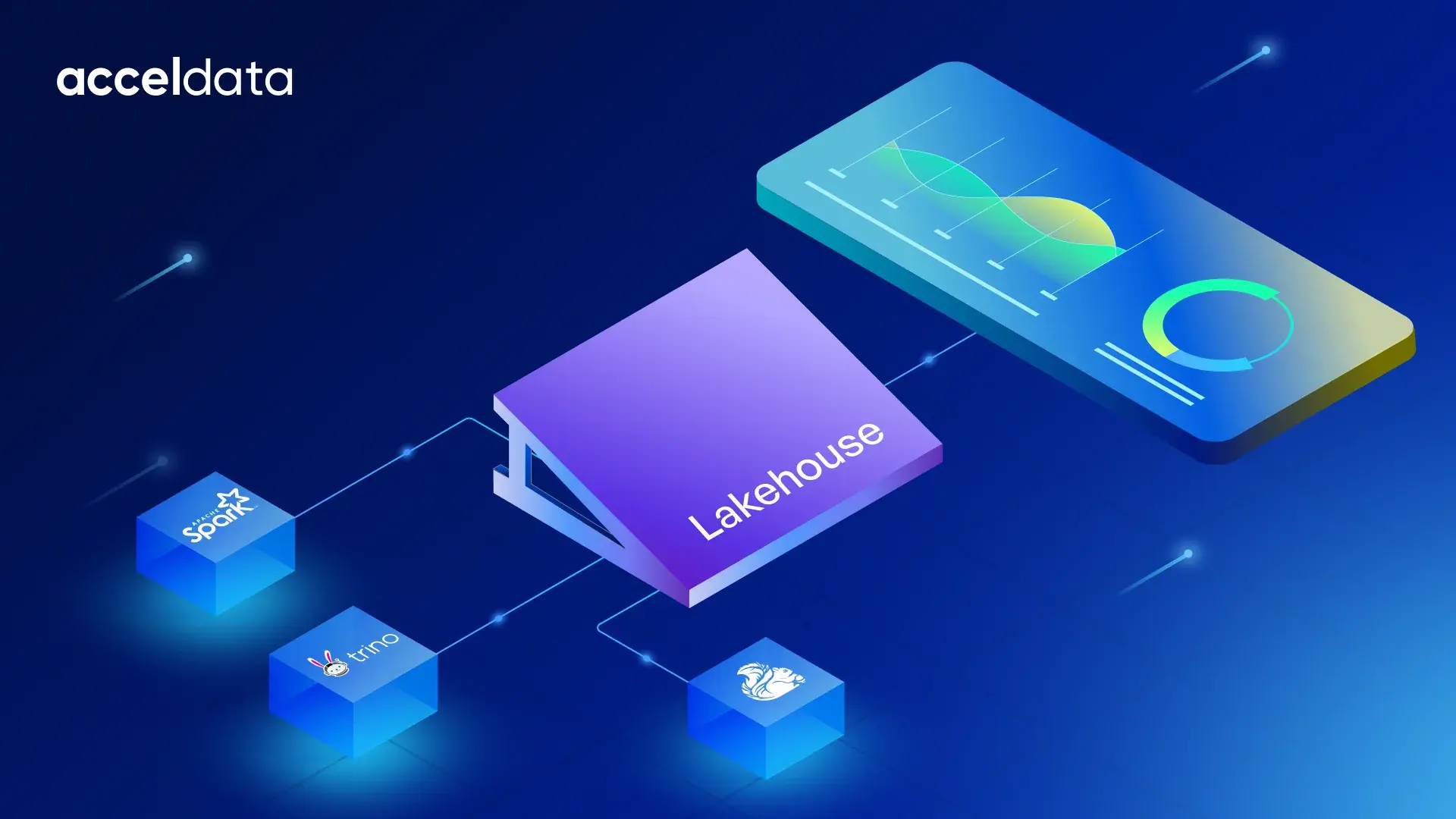
A lakehouse architecture brings together three essential layers:
- Storage layer: Cloud object storage holds raw and curated data in open formats such as Parquet, ORC, and Avro, a foundation explained in this overview of the data lakehouse.
- Table and metadata layer: Open table formats organize files into reliable tables, enabling transactions, schema evolution, and historical views.
- Compute layer: Multiple engines query the same data for batch processing, interactive analytics, and AI workloads.
A data catalog sits across these layers, unifying technical and business metadata and ensuring data remains discoverable as platforms evolve. This is where a data catalog transforms data management from fragmented to reliable.
How Lakehouses Combine Lakes and Warehouses
Lakehouses bridge the gap between flexibility and governance. Data lakes offered scale but limited control, while warehouses enforced structure at the cost of openness.
Lakehouses combine both by adding transactional metadata and governance directly on lake storage, a shift explored in comparisons of data lakes vs lakehouses. A catalog becomes critical to apply standards, policies, and context without slowing teams down.
Common Enterprise Use Cases for Lakehouse Architectures
Enterprises rely on lakehouses to support analytics and AI across domains:
- Financial services analyze transactions and behavioral data for fraud detection.
- Retail teams unify clickstream and purchase data to improve personalization.
- Healthcare organizations manage clinical and research data under strict compliance.
- Manufacturing teams combine sensor data with operational systems.
In each case, the best data catalog for lakehouse architecture ensures teams can trust what they find, while the top data catalog for lakehouse architecture scales governance as use cases expand.
What Are Your Thoughts on Data Lakehouses and Open Architecture?
Open lakehouse architectures mark a clear shift away from closed platforms toward choice and interoperability. For enterprises, the real question is no longer whether to adopt open systems, but how to manage the complexity they introduce without losing control or trust.
What open architecture gets right:
- It reduces vendor lock-in by separating storage, compute, and governance, a foundation rooted in data lake architecture principles.
- Teams can adopt best-fit tools for analytics, engineering, and AI without replatforming data.
- Open table formats and shared metadata make cross-engine access practical at scale.
Where challenges emerge:
- More tools mean more metadata, ownership boundaries, and policy surfaces to manage.
- Inconsistent standards across engines can fragment lineage and access controls.
- Without a strong data catalog for lakehouse architecture, openness quickly turns into operational sprawl.
The difference between flexibility and chaos comes down to coordination. The best data catalog for lakehouse architecture provides a shared understanding of data across open systems, while the top data catalog for lakehouse architecture enforces standards that align lakes, warehouses, and AI workloads. As enterprises build on the data lake, catalogs become the stabilizing layer that makes open architectures sustainable at scale.
Key Capabilities a Data Catalog Must Support for Lakehouse Architectures
A data catalog for lakehouse architecture must do more than store metadata. It needs to operate across open formats, engines, and teams while staying reliable at scale. As lakehouse adoption grows, catalogs become the layer that enables discovery, governance, and trust without slowing analytics or AI workloads.
End-to-End Data Lineage Across Lakehouse Layers
Lakehouses rely on many tools working together, which makes data lineage critical. Data flows across storage, table formats, and engines, often changing shape along the way. A catalog must capture lineage end-to-end so teams can understand the impact before changes propagate.
Strong lineage capabilities should:
- Track transformations across engines and pipelines, not just tables.
- Support impact analysis when schemas or upstream data change.
- Enable faster root-cause analysis during incidents and audits.
Given that 64% of CIOs now prioritize data readiness and governance for lakehouses, lineage has shifted from a nice-to-have to a requirement. Catalogs that integrate with modern data lineage tools make this visibility actionable instead of reactive.
Business and Technical Metadata Management
Metadata is the foundation of discovery and trust in lakehouses. Technical metadata describes how data is stored and optimized, while business context explains what the data means and who owns it. Both are required to scale access responsibly.
Effective metadata management should:
- Unify schemas, statistics, and file-level details with ownership and descriptions.
- Support search and discovery across technical and business terms.
- Keep metadata current as data changes, not manually maintained.
Schema Evolution and Change Tracking
Lakehouse table formats allow rapid change, but unmanaged change creates risk. Catalogs must track schema evolution over time and surface schema drift before it breaks downstream systems. Key requirements include:
- Version history that shows when fields were added or modified.
- Visibility into schema changes across pipelines and consumers.
- Alignment with data modeling practices to maintain long-term scalability.
Data Quality and Trust Signals
Discovery without trust leads to rework. Modern catalogs surface data quality signals directly where users search and explore data. High-impact trust signals include:
- Freshness, completeness, and validation status.
- Profiling statistics and anomaly indicators.
- Clear alignment with defined data quality measures.
This context allows teams to assess fitness for use before analysis begins, reducing downstream errors.
Access Controls and Policy Awareness
Open lakehouses increase access, but governance must scale with it. Catalogs need policy awareness built in, aligned with enterprise data protection policy requirements.
Core capabilities include:
- Fine-grained access controls across tables, columns, and rows.
- Policy visibility that explains why access is granted or restricted.
- Audit-ready tracking for compliance and accountability.
The top data catalog for lakehouse architecture balances self-service with control and enforces standards consistently across open systems.
Best Data Catalog for Lakehouse Architecture, What to Look For
Choosing the best data catalog for lakehouse architecture comes down to how well it supports open systems at scale. The right data catalog for lakehouse architecture must connect formats, engines, and governance in one layer, so teams can operate with speed, trust, and control.
Evaluation criteria for a top data catalog for lakehouse architecture:
| Capability area | What to evaluate | Why it matters in a lakehouse |
|---|---|---|
| Table format support | Native understanding of Iceberg, Delta Lake, and Hudi, including time travel and hidden partitions | Ensures metadata stays consistent across open table formats without manual reconciliation |
| Compute engine coverage | Deep integration with Spark, Trino, Dremio, and similar engines | Captures query behavior, usage patterns, and execution context for accurate lineage and optimization |
| Lineage and metadata | Automated lineage capture tied to evolving schemas and transformations | Keeps metadata trustworthy as data flows across pipelines and formats, a foundation for the future of metadata |
| Governance and security | Fine-grained controls, audit logs, and policy enforcement | Applies data governance best practices without slowing self-service analytics |
| Discovery and collaboration | Search across technical and business contexts with tagging and ownership | Helps teams find trusted data quickly and reduce duplication |
| APIs and automation | Programmatic access through a data API | Enables integration with engineering workflows, orchestration tools, and monitoring systems |
| Operational scale | Ability to handle millions of tables and files with high availability | Supports growth as lakehouse usage expands across teams and workloads |
A catalog that performs well across these dimensions allows enterprises to maintain flexibility without losing consistency. Instead of selecting tools by feature lists, focus on whether the platform can adapt as formats, engines, and data volumes evolve. That adaptability is what separates a catalog that works today from one that remains viable as lakehouse architectures grow more complex.
Top Data Catalog Challenges in Lakehouse Environments
A data catalog for lakehouse architecture must operate across open systems, constant change, and enterprise controls. The top data catalog for lakehouse architecture often fails when metadata, lineage, and governance cannot keep pace with how lakehouses really run.
Fragmented Metadata Across Tools
Every layer of a lakehouse produces its own signals, from file systems to engines to catalogs. When those signals do not align, teams see conflicting schemas, stale definitions, and broken discovery. This is why metadata examples vary across tools and why many enterprises turn to advanced metadata tools to reconcile technical and business views.
A global information provider running a GCP lakehouse with 500 billion rows faced this exact issue. By automating more than 200 validation rules, Acceldata cut data quality processing from 22 days to 7 hours, keeping their catalog accurate for 600 million business records.
Incomplete or Broken Lineage
Lineage breaks when data moves across engines, formats, or notebooks without consistent tracking. Gaps prevent impact analysis, slow root cause resolution, and raise audit risk.
PubMatic, which processes 2 petabytes of lakehouse data daily, relied on real-time lineage to track trillions of advertiser bids. With full visibility, they reduced storage footprint by 30 percent and eliminated 10 million dollars in annual OEM support costs, keeping their catalog dependable at scale.
Rapid Schema Changes
Lakehouse flexibility means schemas evolve often. Without tight controls, this leads to undocumented changes, broken dashboards, and mistrusted data. These failures contribute to the hidden cost of poor data quality and governance that quietly erodes confidence and budgets.
Balancing Governance With Self-Service Access
Teams need self-service analytics, but security teams require control. Without data governance with agentic AI, approvals become bottlenecks and data becomes risky.
PhonePe scaled its lakehouse by 2000 percent while cutting warehousing costs by 65 percent by automating observability and catalog governance. That balance kept their platform a trusted source of financial insight across millions of transactions.
How a Data Catalog Enables Governance in Lakehouse Architectures
A data catalog for lakehouse architecture turns governance into an active system of control, not a passive record. The best data catalog for lakehouse architecture applies policies, ownership, and trust signals directly across open lakehouse environments.
Standardizing Definitions Across Domains
In lakehouses, different data domains often interpret the same data in different ways. A catalog aligns these views by linking business terms to physical datasets, so every team works from a shared meaning. This consistency reduces reporting conflicts and improves AI data analytics by ensuring models train on correctly defined data.
Improving Data Ownership and Accountability
Strong data ownership is the backbone of governance. A catalog assigns stewards, tracks who is responsible for each dataset, and logs how issues are resolved. This visibility creates accountability, while shared standards protect enterprise-wide data hygiene as lakehouse usage grows.
Supporting Compliance and Auditability
Governance fails without proof. Catalogs maintain access logs, schema histories, and lineage records that show how data moves and who touched it. This makes it easier to ensure compliance with AI data governance platforms and meet regulatory requirements without slowing analytics teams.
Enabling Responsible AI and Analytics
As lakehouses feed machine learning, catalogs document which datasets trained each model and how features were created. This traceability supports reproducibility, bias detection, and safer deployment of AI data analytics across the enterprise.
The top data catalog for lakehouse architecture connects governance to daily work, giving leaders confidence that analytics and AI run on trusted, controlled data.
Bring Order to Lakehouse Data Discovery With Acceldata
A data catalog for lakehouse architecture only delivers value when teams can trust what they find and act on it in real time. That is what separates the best data catalog for lakehouse architecture from a static index.
Acceldata’s Agentic Data Management platform adds autonomous discovery, lineage, and quality signals so the top data catalog for lakehouse architecture stays accurate as data changes.
Request a demo to see how Acceldata keeps lakehouse data trusted, governed, and ready for analytics and AI.
FAQs about Data Catalogs and Lakehouse Architecture
What is a data catalog for lakehouse architectures?
A data catalog for lakehouse architectures provides unified metadata management across storage layers, table formats, and compute engines, enabling data discovery, governance, and optimization in hybrid analytical environments.
Why do lakehouse architectures require a different approach to data catalogs?
Lakehouse catalogs must handle schema evolution, support multiple table formats, work with decoupled storage and compute, and maintain consistency across diverse tools—challenges traditional warehouse catalogs weren't designed to address.
What are your thoughts on Data Lakehouses and Open Architecture?
Open architectures offer unprecedented flexibility and innovation through interoperable components, though they require careful management of complexity and consistent governance across heterogeneous systems.
What capabilities should a data catalog have for a lakehouse?
Essential capabilities include multi-format support, end-to-end lineage tracking, unified business and technical metadata, schema evolution handling, quality monitoring, and fine-grained access controls.
How does a data catalog support governance in a lakehouse?
Catalogs enforce governance through access controls, maintain audit trails, standardize definitions, assign ownership, and enable compliance reporting across distributed data assets.
Can a single catalog support both analytics and AI use cases?
Yes, modern catalogs track both analytical queries and ML workflows, maintaining lineage from raw data through feature engineering to model training and deployment.
What challenges arise when cataloging open data architectures?
Key challenges include metadata fragmentation across tools, incomplete lineage tracking, rapid schema changes, and balancing self-service access with governance requirements.
How should enterprises evaluate the best data catalog for lakehouse architecture?
Evaluate based on table format compatibility, compute engine integration, governance features, discovery capabilities, API completeness, scalability, and vendor ecosystem support.