



.svg)


New
Acceldata recognized as an Exemplary Leader in 2026 ISG Buyers Guide™ for Data Quality and Data Observability. Read the Report→
Platform Overview

Data & AI Observability
Agentic Data Engineering
Data Warehousing
Agentic Runtime
Agentic Data Management
Hadoop Modernization
Platform Overview
Everything you need to build, govern, and scale data and AI workloads—one unified platform.
xLake Architecture

CAPABILITIES
Manage your data estate under one platform
Explore Integrations


Data & AI Observability
Monitor, detect, and resolve data and AI issues with end-to-end observability across pipelines.
Explore
Agentic Data Engineering
Build, orchestrate, and run data pipelines with intelligent agents that automate the entire engineering workflow.
Explore ADE
Data Warehousing
Query your lakehouse in-place with Velox-accelerated performance. 10x faster than traditional warehouses.
Explore Data Warehousing
CAPABILITIES


Agentic Runtime
Distributed training, high-throughput inference, and GPU notebooks—everything you need for production AI.
Explore
CAPABILITIES


Agentic Data Management
Build, deploy, and manage intelligent agents to automate and optimize data operations.
Explore ADM

Industries
Browse solutions to help you solve the complex business challenges unique to your industry.
4+ hrs → 15 min
to validate critical lending data
to validate critical lending data
Learn More
40+
enterprise data products with unified health visibility
enterprise data products with unified health visibility
Learn More
20% → 90%
sales forecast confidence score
sales forecast confidence score
Learn More
4+ hrs → 15 min
to validate critical lending data
to validate critical lending data
Learn More
39 mos → 12 mos
to clinical candidate selection
to clinical candidate selection
Learn More
4+ hrs → 15 min
to validate critical lending data
to validate critical lending data
Learn More
Resources
Browse materials to help you access the tools, guides, and insights essential to your workflows.


Company
Learn about our mission, leadership, and vision driving modern data operations forward.


Products

Industry
Resources
Company

Back
Platform Overview
Data & AI Observability
Agentic Data Management
Agentic Data Engineering
Data Warehousing
Data Science
Data Platform Modernization
Back
Industries
Browse solutions to help you solve the complex business challenges unique to your industry.
Explore Case Studies
4+ hrs → 15 min
to validate critical lending data
to validate critical lending data
Learn More
Back
Resources
Browse materials to help you access the tools, guides, and insights essential to your workflows.
Back
Company
Learn about our mission, leadership, and vision driving modern data operations forward.
Back
Platform Overview
Everything you need to build, govern, and scale data and AI workloads—one unified platform.
xLake Architecture
CAPABILITIES
Manage your data estate under one platform
Explore Integrations
Back
Data & AI Observability
Monitor, detect, and resolve data and AI issues with end-to-end observability across pipelines.
Explore
Back
Agentic Data Management
Build, deploy, and manage intelligent agents to automate and optimize data operations.
Explore ADM
Back
Agentic Data Engineering
Build, orchestrate, and run data pipelines with intelligent agents that automate the entire engineering workflow.
Explore ADE
Back
Data Warehousing
Query your lakehouse in-place with Velox-accelerated performance. 10x faster than traditional warehouses.
Explore Data Warehousing
CAPABILITIES
Back
Agentic Runtime
Distributed training, high-throughput inference, and GPU notebooks—everything you need for production AI.
Explore
CAPABILITIES

TRUSTED BY ENTERPRISE DATA TEAMS WORLDWIDE










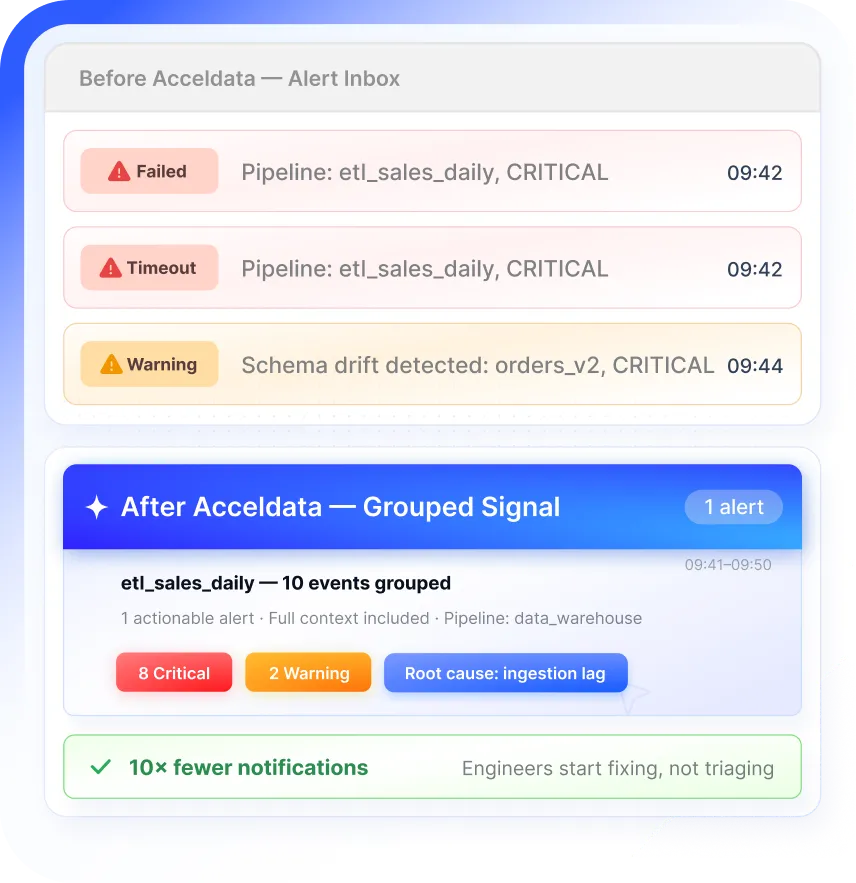
- One media streaming provider replaced 10 separate alert pings per failing pipeline with a single grouped alert.
- Engineers opened one notification and understood the full scope immediately.
- They started fixing immediately — instead of triaging ten near-identical tickets.
Fewer alerts. More signal. Faster decisions.

Stop Treating Every Alert the Same
Most monitoring tools fire an alert for every anomaly, every policy breach, every threshold crossed. The result: alert fatigue so severe that engineers start ignoring the inbox entirely.
Acceldata groups related alerts by asset, pipeline, or schema — collapsing redundant noise into single, actionable signals.
Understand Any Alert in Seconds — Without Tab-Switching
Once an alert fires, the real time sink begins: opening five tools, hunting for lineage documentation, reconstructing context manually.


Real outcome: A retail chain identified the exact table and transform causing a data freshness delay — inside the alert view, without opening a single additional tool. Time from alert to root cause: minutes, not hours.
Route the Right Alerts to the Right People
Acceldata's configurable subscription reports let you build routing logic that matches how your team actually operates
Alert Type
Delivery
Recipient
HIGH
Pipeline failure
Immediate
PagerDuty + Slack
On-call engineer
Team lead CC'd
MEDIUM
Pipeline failure
Within 1 Hour
Email + Slack
Owning team
Domain DL
LOW
Pipeline failure
Daily Digest
Email summary
All subscribers
Batched 6am
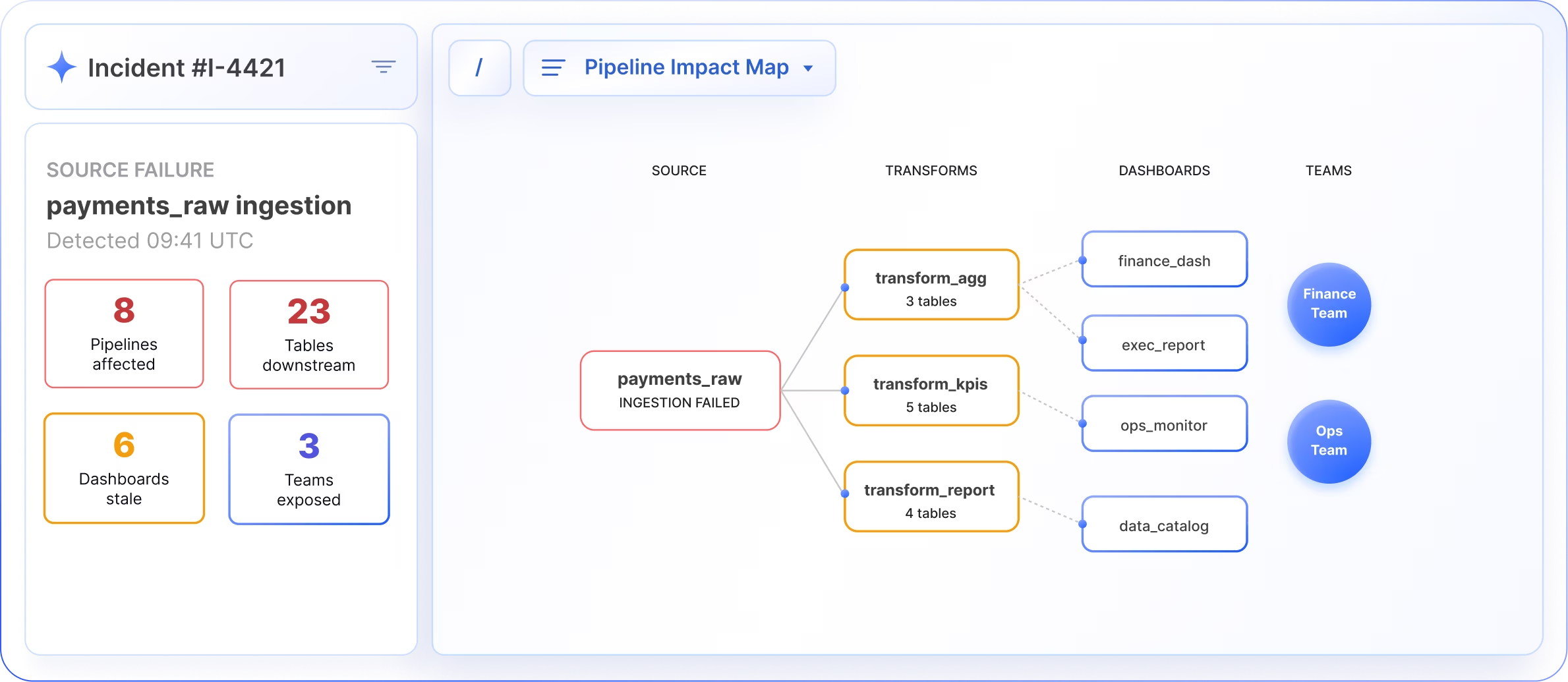
See the Blast Radius Before You Start Remediating
One broken pipeline rarely breaks just one thing. Acceldata's impact analysis maps the direct blast radius of every incident the moment it triggers.
Reduce MTTR — Not by Working Faster, But by Guessing Less
Engineers spend the majority of incident time reconstructing context — what failed, why it failed, what else it touched, and what to do next. Acceldata compresses that phase to near-zero.

Correlated Alerts
Correlated alerts show related failures across assets so you see patterns, not isolated events

Root-Cause Context
Root-cause context surfaces the originating failure in the pipeline chain

Recommended actions
Recommended actions give engineers a starting point, not a blank page
The outcome is measurable: reduction in alerts summarized per tenant and decrease in MTTR are the primary success metrics tracked across Acceldata's subscription reports rollout.
Built for Teams Running Complex Data Pipelines at Scale
If your team is:

Managing pipelines across multiple clouds, warehouses, or orchestration tools

Struggling to prioritize incidents without knowing their downstream impact
Spending more time reconstructing context than actually fixing problems
Getting escalations from business users before internal monitoring catches the issue
Ready to get started
Explore all the ways to experience Acceldata for yourself.
