



.svg)


New
Acceldata recognized as an Exemplary Leader in 2026 ISG Buyers Guide™ for Data Quality and Data Observability. Read the Report→
Platform Overview

Data & AI Observability
Agentic Data Engineering
Data Warehousing
Agentic Runtime
Agentic Data Management
Hadoop Modernization
Platform Overview
Everything you need to build, govern, and scale data and AI workloads—one unified platform.
xLake Architecture

CAPABILITIES
Manage your data estate under one platform
Explore Integrations


Data & AI Observability
Monitor, detect, and resolve data and AI issues with end-to-end observability across pipelines.
Explore
Agentic Data Engineering
Build, orchestrate, and run data pipelines with intelligent agents that automate the entire engineering workflow.
Explore ADE
Data Warehousing
Query your lakehouse in-place with Velox-accelerated performance. 10x faster than traditional warehouses.
Explore Data Warehousing
CAPABILITIES


Agentic Runtime
Distributed training, high-throughput inference, and GPU notebooks—everything you need for production AI.
Explore
CAPABILITIES


Agentic Data Management
Build, deploy, and manage intelligent agents to automate and optimize data operations.
Explore ADM

Industries
Browse solutions to help you solve the complex business challenges unique to your industry.
4+ hrs → 15 min
to validate critical lending data
to validate critical lending data
Learn More
40+
enterprise data products with unified health visibility
enterprise data products with unified health visibility
Learn More
20% → 90%
sales forecast confidence score
sales forecast confidence score
Learn More
4+ hrs → 15 min
to validate critical lending data
to validate critical lending data
Learn More
39 mos → 12 mos
to clinical candidate selection
to clinical candidate selection
Learn More
4+ hrs → 15 min
to validate critical lending data
to validate critical lending data
Learn More
Resources
Browse materials to help you access the tools, guides, and insights essential to your workflows.


Company
Learn about our mission, leadership, and vision driving modern data operations forward.


Products

Industry
Resources
Company

Back
Platform Overview
Data & AI Observability
Agentic Data Management
Agentic Data Engineering
Data Warehousing
Data Science
Data Platform Modernization
Back
Industries
Browse solutions to help you solve the complex business challenges unique to your industry.
Explore Case Studies
4+ hrs → 15 min
to validate critical lending data
to validate critical lending data
Learn More
Back
Resources
Browse materials to help you access the tools, guides, and insights essential to your workflows.
Back
Company
Learn about our mission, leadership, and vision driving modern data operations forward.
Back
Platform Overview
Everything you need to build, govern, and scale data and AI workloads—one unified platform.
xLake Architecture
CAPABILITIES
Manage your data estate under one platform
Explore Integrations
Back
Data & AI Observability
Monitor, detect, and resolve data and AI issues with end-to-end observability across pipelines.
Explore
Back
Agentic Data Management
Build, deploy, and manage intelligent agents to automate and optimize data operations.
Explore ADM
Back
Agentic Data Engineering
Build, orchestrate, and run data pipelines with intelligent agents that automate the entire engineering workflow.
Explore ADE
Back
Data Warehousing
Query your lakehouse in-place with Velox-accelerated performance. 10x faster than traditional warehouses.
Explore Data Warehousing
CAPABILITIES
Back
Agentic Runtime
Distributed training, high-throughput inference, and GPU notebooks—everything you need for production AI.
Explore
CAPABILITIES

TRUSTED BY ENTERPRISE DATA TEAMS WORLDWIDE










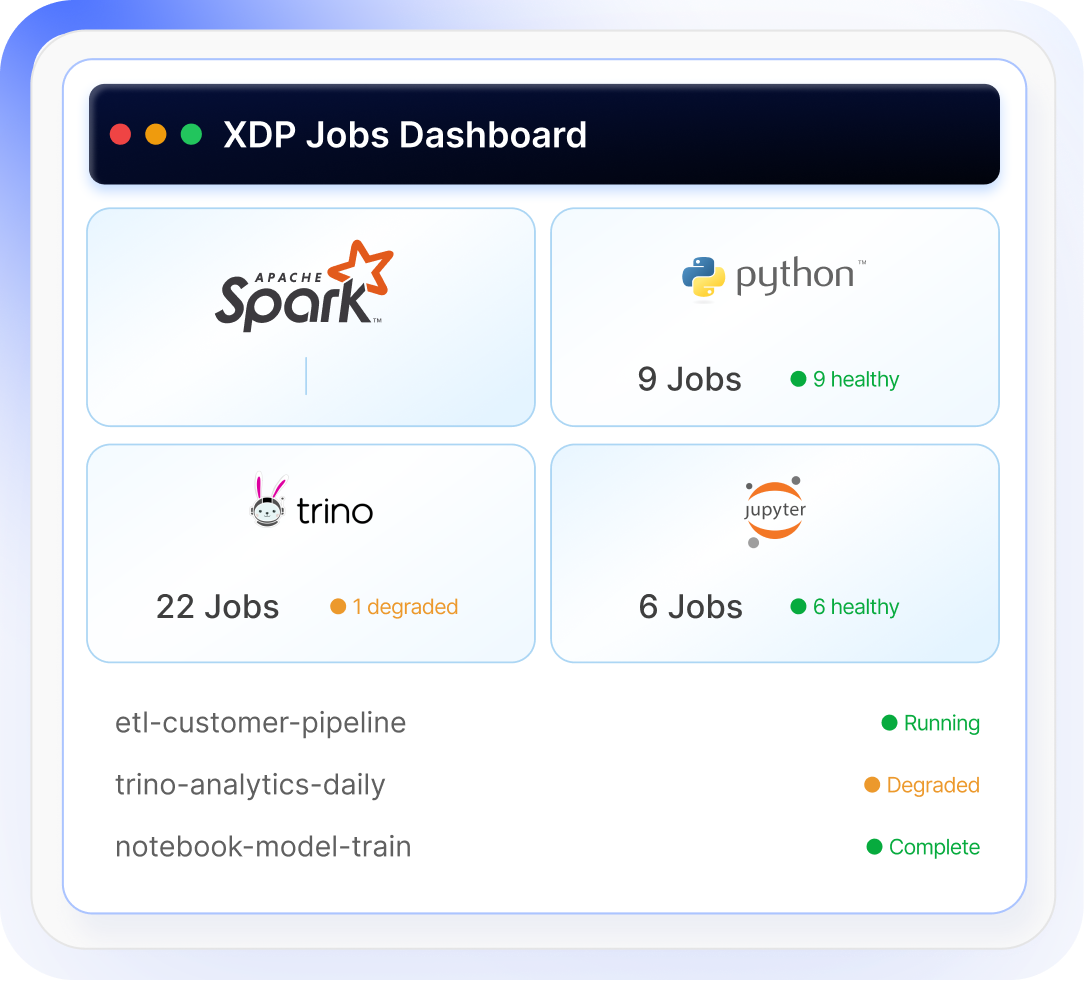
Every Job Type. One Dashboard.
xlake runs Spark Java, Spark Python, Notebook, and Trino jobs from a single Jobs dashboard — not per-engine consoles bolted together.
What You See
Why It Matters

Schedule and cluster assignment per job
No manual cross-referencing between schedulers and configs

Success rate across all engines
Catch degrading pipelines before they become incidents

Last five run statuses per job
Diagnose failure patterns without hunting through separate logs

Live status across Spark, Trino, and Jupyter
One source of truth for platform and data engineers
No tool-hopping. No fragmented overhead.


How It Works
xLake installs into your existing Kubernetes namespace. No proprietary runtime. No infrastructure replacement. No external control plane.
1


Deploy onto your cluster

Standard Kubernetes constructs only — namespaces, resource quotas, node pools. Nothing proprietary.
2
Submit a Single SQL Query
Write standard SQL. xLake's Trino engine builds an optimized distributed execution plan across every registered catalog.
3
Policy Enforced Before Execution
Access controls and catalog visibility are evaluated at the query layer — natively — before a single byte is read.
4
Execution on Your Infrastructure
Queries run on your Kubernetes clusters — EKS, AKS, GKE, or on-prem K8s 1.20+. You control resource limits and cost ceilings.
5
Results Return. Nothing Replicated.
Results go directly to the requesting system. No intermediate copies. No sync jobs. No replication pipelines.
6
Every Execution Is Observable
Query history and execution logs capture which catalogs and nodes handled each stage. Deeper observability added via Pulse observability integration.
Your Kubernetes. Your Compute. No Vendor Markup.
.png)
xLake runs on any Kubernetes 1.19+ distribution - EKS, AKS, GKE, or on-premises.
No proprietary runtime. No custom cloud dependency.
Clusters deploy inside your VPC and your Kubernetes namespace. Data never crosses your infrastructure boundary.

Built for Platform Engineers and Data Teams

Platform Engineers
Work with standard Kubernetes constructs they already understand — namespaces, resource quotas, node pools — no proprietary abstraction layer to learn.

namespaces
node pools
resource quotas

Data Engineers:
Schedule and monitor jobs through a purpose-built UI without needing to understand the underlying K8s mechanics. Focus on pipelines, not infrastructure
Jobs UI
Scheduling
Monitoring
.svg)
Both Teams. One View.
Share the same dashboard, the same cluster view, the same source of truth. No more coordination overhead across separate tooling.
Shared Dashboard
Unified View

One Control Plane. Every Workload Type.
Every cost driver that legacy platforms obscure or ignore — surfaced and resolved.


Runs Spark jobs
Runs Trino queries
Runs Jupyter notebooks
Deploys on your Kubernetes cluster
Customer-owned compute
Unified job dashboard across all engines
No proprietary runtime dependencies
Trino-Only
Platforms
Platforms
Spark-Centric Managed Platforms
xLake


See Spark, Trino, and Jupyter running from a single xLake control plane on your target Kubernetes distribution.
Frequently Asked Questions
Q1. Do I need to know Spark, Java, or Python to use xLake?
No. xLake is designed so that engineers and data practitioners can describe pipeline intent in plain language — what data to move, how to transform it, and where it should land. xLake handles all code generation. Knowledge of Spark syntax or orchestration frameworks is not required to author a production-ready pipeline.
Q2. What data stores and environments does xLake support?
Agents detect and resolve issues proactively, maintaining SLAs even when pipelines fail.
Q3. How does xLake ensure the generated pipeline is actually production-ready?
Yes—trust agents validate data early in the workflow, reducing errors downstream.
Q4: What happens to lineage and governance after a pipeline is generated?
ADM works with Airflow, Snowflake, Databricks, and more—enhancing your stack without disruption.
Q5: Can xLake generate both Java and Python Spark jobs?
Governance agents enforce policy and traceability across workflows—supporting GDPR, HIPAA, ESG, and more.
Q6: How is xLake different from visual or no-code pipeline builders?
Customers typically see 30–50% faster workflows and 80% fewer quality incidents.
Ready to get started
Explore all the ways to experience Acceldata for yourself.
