




.svg)



Enterprises today generate data at an unprecedented pace. In fact, humans and machines together produced an estimated 402 million terabytes of data each day in the year 2024.
This data explosion brings challenges such as fragmented systems, inconsistent policies, and evolving regulations that make traditional governance ineffective. The result? Higher compliance risks, operational inefficiencies, human resource deficiencies, and missed opportunities to use data strategically.
Enter AI-powered data governance platforms. They address these challenges by acting as the control panel for automated, scalable governance with minimal manual intervention.
These platforms also unlock actionable insights from your data, improving decision-making and operational efficiency across the enterprise. Let’s explore how.
What Is an AI Data Governance Platform?
An AI data governance platform is a centralized system that uses machine learning and artificial intelligence to identify, organize, monitor, and enforce policies across all your enterprise data. Unlike legacy governance tools, it operates proactively, identifying risks and ensuring compliance in real time.
The core modules of an AI data governance platform include:
- Catalog and metadata management: Indexes and organizes all data assets for easy discovery
- Data lineage: Tracks data flow across systems to ensure transparency and traceability
- Data quality: Monitors anomalies, errors, and inconsistencies
- Access control: Enforces security policies and manages user permissions efficiently
- Policy engine: Automates governance rules and compliance enforcement
- Audit and reporting: Provides detailed logs and compliance reports for regulatory purposes
Together, these modules allow you to maintain data integrity, reduce risk, and make smarter business decisions.
Why Does AI Matter in Governance?
Traditional data governance methods often rely on static controls and manual oversight, which can be slow and error-prone. In contrast, AI-powered data governance platforms enable autonomous, real-time enforcement of policies across your enterprise data.
Here are some of the key benefits of AI in data governance:
- Speed: Organizations with mature governance frameworks experience improvement in data retrieval speeds, enhancing operational efficiency
- Accuracy: According to a 2023 Gartner report, organizations with mature data governance frameworks saw a 20–40% drop in data errors[1], significantly improving data accuracy and supporting better decision-making
- Reduced security and compliance breaches: Organizations with mature data governance practices experience significantly fewer security incidents and are far more likely to achieve and maintain regulatory compliance across multiple jurisdictions
- Cost-cutting: AI-driven governance reduces manual effort and compliance overheads, lowering operational expenses and minimizing costly errors
By integrating AI into governance, you not only simplify operations but also strengthen your organization’s compliance posture and data reliability.
Essential Capabilities to Look For in an AI Data Governance Platform
A strong AI data governance platform is a system designed to manage data intelligently across its entire lifecycle. To achieve real value, look for capabilities that fit into three broad categories: control, trust, and integration.
1. Control: Managing access and enforcing policies
Governance begins with who can see what. Modern platforms should combine role- and attribute-based access controls (RBAC/ABAC) with just-in-time provisioning, approval workflows, and automatic revocations.
Add in policy engines that enforce consent, retention, and data masking, and you create guardrails that scale across the enterprise.
2. Trust: Ensuring quality and traceability
You can’t govern what you don’t understand. Platforms need automated discovery that classifies sensitive data like PII or PHI without heavy manual work. End-to-end lineage then shows exactly how data moves across warehouses, lakes, pipelines, and BI tools, critical for assessing downstream impact.
Coupled with built-in quality checks for freshness, completeness, and data anomalies, these features give you confidence in both the accuracy and reliability of your data.
3. Integration: Embedding governance into workflows
Governance shouldn’t live in isolation. Look for platforms with active metadata that triggers events, creates tickets, or fires off alerts when policies are breached.
Open connectors and APIs are equally important; they let you tie governance directly into systems such as Snowflake, Databricks, BigQuery, Kafka, dbt, Airflow, and enterprise tools such as Jira, ServiceNow, or Okta.
Finally, effective data quality dashboards and audit packs make compliance reporting straightforward and give executives the visibility they need.
In short: A strong AI data governance platform combines control, trust, and integration to enforce policies, ensure data quality and lineage, and embed governance effortlessly into enterprise workflows.
Business Impact and Measurable KPIs
A top national consumer bank faced mounting regulatory pressure, costly SLA breaches, and millions in revenue leakage. By deploying Acceldata, an AI-driven data governance platform, the bank transformed its operations. The impact was significant—SLA breaches dropped by 96%, more than $10 million in potential fines were avoided, and lost revenue was recovered at scale.
These outcomes demonstrate how governance can deliver both compliance and business value. To measure impact consistently, you should track indicators such as:
- Decline in policy violations and mean time to remediation (MTTR)
- Reduction in access request cycle time and increase in least-privilege coverage
- Increase in percentage of certified/owned data assets and data quality scores meeting thresholds
- Decrease in audit preparation time and improvement in overall control effectiveness
With these measurable gains, enterprises can shift governance from a defensive requirement to a strategic advantage.
Choosing the Right AI Data Governance Platform
Selecting the ideal AI data governance platform necessitates a thorough evaluation across multiple key dimensions. When evaluating platforms, check for these essential criteria:
- Coverage: Supports all data sources and connectors, handles growing volumes with low latency
- ML accuracy: Classifies and tags data reliably, including sensitive information
- Actionability: Detects issues, makes decisions, and takes automated or semi-automated actions
- Explainability and human-in-the-loop: Ensures decisions are transparent and auditable
- Security: Provides encryption, key management, SSO/MFA, and compliance with data residency requirements
- TCO and time-to-value: Enables cost-effective deployment with measurable ROI and vendor support
- Roadmap and enterprise support: Offers a clear future vision, ongoing updates, and dedicated assistance
This short checklist helps you quickly compare platforms and identify the one that meets your enterprise’s data governance and compliance needs.
How AI Data Governance Works: A High-Level Architecture
A modern AI data governance platform typically follows a clear workflow:
- Ingest: Collect metadata and telemetry from all data sources
- Enrich: Apply ML(Machine Learning) or NLP(Natural Language Processing) for classification, tagging, and lineage tracking
- Decide: Evaluate policies using the governance engine
- Act: Enforce controls through masking, quarantines, tickets, or notifications
- Measure: Track KPIs, audit readiness, and control effectiveness
This architecture ensures governance is continuous, automated, and measurable across the enterprise.
Phased Implementation: Building Governance Step by Step
A structured implementation plan ensures your AI data governance platform delivers value quickly and systematically. Here’s a simplified 30-60-90 plan for you:
Days 1–30: Foundation
- Connect all critical data sources and establish baseline data lineage
- Automatically classify sensitive data, including PII, PHI, and PCI
Days 31–60: Pilot and enforce
- Roll out policy enforcement in pilot domains, covering masking, access controls, and retention rules
- Set up alerts, notifications, and automated tickets for governance incidents
Days 61–90: Scale and optimize
- Expand governance coverage to additional domains
- Enable periodic access reviews and executive scorecards
- Automate audit evidence and reporting to streamline compliance
A phased AI approach can be your master builder. It adapts, reinforces, and grows the framework stronger over time.
How AI Governance Tackles Compliance and Risk
Enterprises face regulatory pressures from GDPR, HIPAA, PCI, SOX, and GLBA. AI-driven data governance platforms turn these challenges into actionable opportunities. Here’s how:
- Consent and data subject workflows (GDPR/CCPA): AI tracks and manages requests automatically, helping you respond faster and avoid penalties
- Masking and tokenization for sensitive data (HIPAA/PCI): By controlling access and protecting critical data, you shrink audit scope and reduce exposure
- Lineage evidence for audits (SOX/GLBA): Automated tracking of data flow provides precise audit trails, making compliance reporting faster and more reliable
With these capabilities, governance moves beyond a checklist. It actively reduces risk, supports audits, and gives your teams confidence to act on data.
The Acceldata Advantage: AI Governance for Enterprise Data Quality
Acceldata combines an active metadata platform with an automated data compliance platform to deliver enterprise data governance with AI that goes beyond simple monitoring. Its collaborative, agentic framework ensures your data stays accurate, compliant, and actionable at scale.
Data Quality Agent in action
Powered by the xLake Reasoning Engine, the Data Quality Agent continuously monitors your data pipelines, batch jobs, and tables for quality violations. It identifies issues such as duplicates, missing values, and stale records, then traces them back to their source using lineage analysis. Proactive remediation ensures only impacted data is reprocessed, unresolved records are flagged, and all findings are documented.
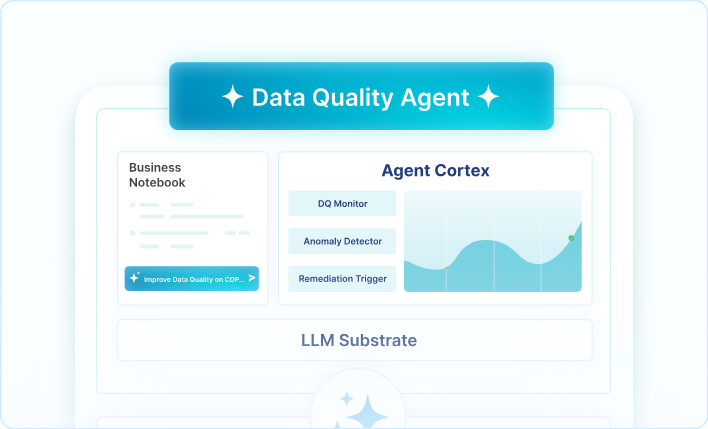
To ensure accuracy and business relevance, the Data Quality Agent incorporates human-in-the-loop (HITL) validation, allowing teams to guide, verify, and refine automated actions:
- Validate anomalies and approve or override automated actions based on business context
- Classify or annotate exceptions manually to maintain accuracy and compliance
- Review lineage impact before blocking queries or enforcing restrictions
- Track violations and resolution logs to ensure audit readiness
- Train policy logic with contextual feedback to improve enforcement over time
Data Profiling and Data Lineage agents
The Data Profiling Agent and Data Lineage Agent strengthen governance by providing visibility and control:
- Validate automatically generated lineage mappings and approve schema propagation
- Flag gaps or incorrect dependencies to enhance traceability
- Review historical snapshots for audits, root cause analysis, or impact assessment
By combining AI governance for data quality with active metadata observability, Acceldata enables automated enforcement, policy triggers, and API-first integrations that let your enterprise govern data intelligently, reliably, and at scale.
Ready to Modernize Data Governance? See how a data governance platform with AI accelerates compliance and control—without extra headcount. Request a demo today.
FAQs about AI Data Governance
1. How does an AI platform differ from a traditional governance tool?
An AI data governance platform uses machine learning and automation to continuously monitor, classify, and enforce policies. Unlike traditional tools, it adapts in real time and scales across complex data environments.
2. Can policies run autonomously with approvals?
Yes. An AI data governance platform supports autonomous policy enforcement while allowing human-in-the-loop approvals for exceptions or critical decisions.
3. How is model bias managed in auto-classification?
The platform incorporates explainable AI and feedback loops to detect and correct biases. Human-in-the-loop validation ensures classifications remain accurate and aligned with business rules.
4. What proofs are generated for audits?
AI data governance platforms automatically track lineage, policy enforcement, and remediation actions. This creates auditable evidence packs and dashboards to simplify compliance reporting.