.svg)



At enterprise scale, data observability platforms must handle massive data volume, organizational complexity, and governance requirements without becoming another bottleneck.
Introduction
Unplanned downtime costs Global 2000 companies $400 billion annually, roughly 9% of their total profits, according to a joint study by Splunk and Oxford Economics. For large enterprises running thousands of data pipelines across hybrid infrastructure, the root cause often is not a catastrophic system failure. It is a slow erosion of data reliability that no one caught in time.
What works for monitoring a dozen pipelines rarely works for monitoring thousands. Large enterprises operate across multiple cloud providers, decentralized business units, and diverse data platforms. Pipelines change constantly, schemas evolve daily, and downstream consumers range from BI dashboards to autonomous AI systems. At this scale, observability is no longer about triggering alerts. It is about establishing operational reliability across a fragmented ecosystem.
Many organizations adopt an enterprise data observability platform successfully, only to hit severe scaling limits months later. Alert noise increases, performance degrades, and engineering teams struggle to operationalize insights. The tool purchased to eliminate data downtime slowly becomes an operational burden itself.
This article explains what scaling actually means for data observability platforms, which capabilities separate enterprise-ready solutions from mid-market tools, and how large organizations evaluate platforms before standardizing globally.
What "Scale" Means in Enterprise Data Observability
When evaluating scalable data observability, many buyers focus purely on data volume. But volume is only one dimension of a massive operational puzzle. For an enterprise, scale is as much organizational as it is technical.
To achieve data observability at scale, platforms must handle five distinct layers of complexity:
- Thousands of pipelines and tables. An enterprise environment does not consist of a single cloud data warehouse. It involves tracking dependencies across ingestion layers, processing zones, and thousands of localized data marts.
- Petabyte-scale data volumes. The platform must monitor billions of daily transactions, log files, and streaming events without introducing latency into primary business pipelines.
- Hundreds of teams and owners. A single centralized data engineering team cannot manage the entire enterprise. The platform must support federated ownership, allowing hundreds of domain experts to manage their specific assets.
- Multi-cloud and hybrid environments. Enterprises operate messy, inherited architectures. The observability platform must bridge legacy on-premises databases with modern cloud infrastructure seamlessly.
- Strict security and compliance needs. Global enterprises face intense regulatory scrutiny. The platform must enforce strict access controls, data masking, and compliance tracking across every region.
Consider the CrowdStrike outage of July 2024. A single faulty software update cascaded across airlines, banks, and medical services globally. Delta Airlines alone reported $380 million in revenue losses from the five-day incident (Source:Fortune). That event exposed what enterprise data teams already know: when you operate at massive scale, a single undetected failure can cascade faster than any human team can respond.
Why Many Observability Tools Fail at Enterprise Scale
Mid-market tools are designed to solve localized problems for small teams. When deployed into massive global architectures, their foundational design principles collapse. Large enterprise data monitoring exposes several critical failure points:
- Centralized alerting overwhelms teams. Mid-market tools route all alerts to a single Slack channel or a central IT service desk. At enterprise scale, this generates thousands of notifications per day. Engineers quickly develop alert fatigue and begin ignoring critical warnings.
- Limited metadata and lineage depth. These tools track data perfectly within Snowflake but lose visibility entirely when data moves to an on-premises Oracle system or into a Kafka stream.
- Performance degradation at high volume. Tools that rely heavily on executing SQL queries against the data warehouse consume massive compute. As the organization adds more tables, monitoring queries choke the primary warehouse.
- Manual onboarding and weak governance. If an administrator must manually configure role-based access for every new user, platform adoption stalls indefinitely.
Gartner estimates that poor data quality alone costs organizations an average of $12.9 million per year. When the observability tool meant to prevent these losses introduces its own performance and governance problems, the financial damage compounds.
Mid-market observability vs enterprise-scale observability
| Capability | Mid-market tools | Enterprise-scale platforms |
|---|---|---|
| Alert routing | Centralized to one team | Federated to domain owners |
| Lineage depth | Limited to cloud data warehouse | Cross-platform and hybrid |
| Performance impact | High compute overhead | Low overhead via metadata and agents |
| Governance controls | Basic user logins | Deep role-based access and compliance |
| Onboarding model | Manual table-by-table registration | Automated discovery and cataloging |
Core Capabilities Required for Enterprise-Scale Observability
To monitor petabytes of data reliably, organizations must deploy specialized enterprise data reliability platforms. A platform built for this level of operational intensity requires five foundational capabilities.
1. Massive signal ingestion and processing
An enterprise platform must handle billions of events efficiently. It cannot rely on scheduled batch queries running once an hour. The system must ingest continuous operational telemetry, orchestration logs, and metadata signals from across the entire ecosystem in near-real time.
This requires an ingestion engine designed specifically for:
- High throughput with low latency
- Parallel processing of structured and unstructured signals
- Minimal performance impact on production pipelines
The monitoring layer should never fall behind the actual data flow.
2. Deep, always-on lineage
Tracking errors requires understanding complex dependencies. The platform must provide cross-platform, column-level lineage that updates dynamically. If a software engineer changes a column format in a proprietary on-premises application, the observability platform must trace that change through the cloud ingestion layer and all the way to a downstream machine learning model.
Utilizing an agent to automate lineage tracking ensures this dependency map remains accurate without requiring engineers to map connections manually.
3. Intelligent alerting and prioritization
At scale, reducing noise is more important than generating alerts. The platform must use historical context to focus on business impact.
For example:
- If a data volume drop occurs during a scheduled weekend maintenance window, the system should suppress the alert.
- If a minor schema drift affects a non-critical sandbox table, the system should log it without escalating.
- If the same anomaly pattern preceded a revenue-impacting incident three months ago, the system should escalate immediately.
By leveraging advanced anomaly detection, the platform learns normal operating rhythms of the business. It filters out benign anomalies and only escalates issues that actively threaten critical data products or regulatory compliance.
4. Automation and execution
Visibility without control forces engineers into manual disaster recovery. Enterprise platforms must move from passive alerts to active actions. When a critical data pipeline ingests highly corrupted files, sending an email is not enough. The platform must integrate with the orchestration layer to halt the pipeline immediately.
Through an active policy execution engine, the platform can:
- Quarantine bad data autonomously before it contaminates downstream dashboards
- Trigger rollback workflows through existing orchestration tools
- Log every automated action for compliance audit trails
Platforms that can resolve issues autonomously reduce the mean time to resolution from hours to minutes.
5. Organizational controls
Technology alone cannot secure an enterprise. The platform must provide robust organizational controls:
- Role-based access control (RBAC): Marketing analysts should only see alerts relevant to marketing datasets, while security teams require global visibility into compliance violations.
- Multi-tenancy support: Different business units should operate independently without interfering with each other's configurations.
- Domain ownership: Decentralized teams must define their own data quality rules while central IT leaders maintain a unified view of global system health.
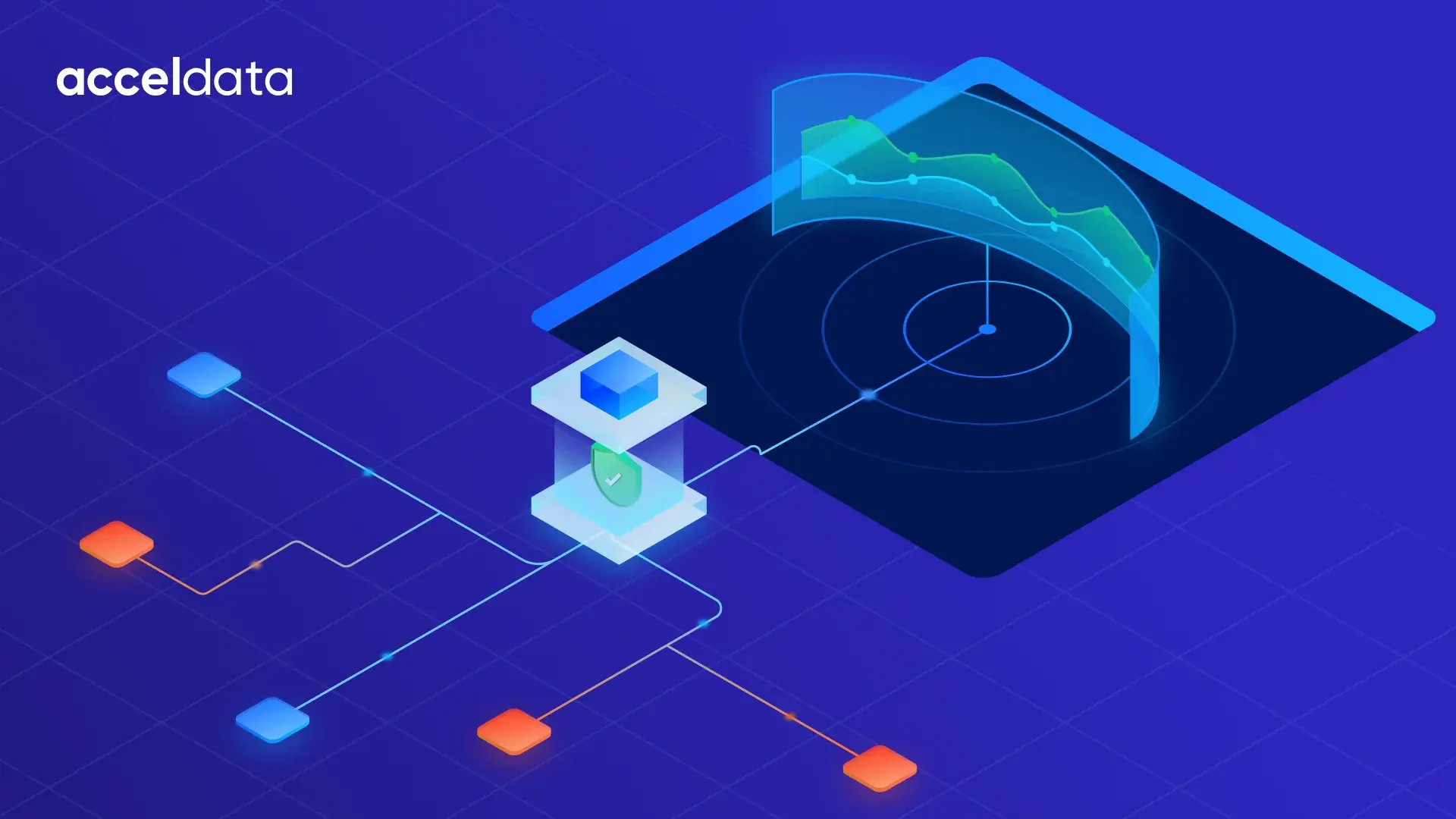
[Infographic placeholder: Enterprise Data Estate → Observability Fabric → Prioritized Actions]
Platform Architecture Considerations at Scale
The technical architecture of enterprise data observability tools dictates their long-term viability and financial sustainability. Procurement teams must look under the hood before signing multi-year agreements.
Metadata-first vs query-heavy designs
This is the most critical architectural divide. Query-heavy tools execute SQL commands against your data warehouse to check for anomalies. At enterprise scale, this approach drives secondary cloud compute costs through the roof. A metadata-first architecture reads existing system logs and telemetry, drastically reducing the compute burden. You can explore how this functions in the Acceldata guide to data observability tools.
Distributed vs centralized architectures
- Centralized platforms pull all evaluation into a single cloud environment.
- Distributed platforms deploy lightweight software agents directly to data sources, evaluating data where it resides.
- The distributed approach provides superior security and lowers data egress costs.
Real-time vs batch processing tradeoffs
Batch processing is cheaper, but it introduces unacceptable latency for use cases like fraud detection or algorithmic trading pipelines. Enterprise platforms should support both modes. Acceldata's approach to enterprise-scale data observability through PushDown and ScaleOut execution modes demonstrates how organizations balance cost and speed.
Cost predictability
A scalable platform allows you to forecast your monitoring budget accurately, rather than tying costs to highly volatile data volume metrics. If your observability spend scales linearly with every new table, your CFO will eventually question the investment.
How Large Enterprises Evaluate Observability Platforms
Procuring a platform requires a rigorous, skeptical evaluation process. Global enterprises do not buy software based on dashboard aesthetics. They use strict evaluation criteria to ensure the platform survives in production.
Five key evaluation pillars:
- Coverage across the data stack. The platform must monitor hybrid infrastructure, not just the modern cloud data warehouse. If it loses visibility when data moves to Kafka, S3, or an on-premises Oracle cluster, it fails the test.
- Performance under load. During the proof of concept, engineering teams should point the platform at their highest-volume, noisiest data pipeline to verify it does not crash or cause latency.
- Ease of onboarding at scale. The platform must automatically discover and catalog new data assets via API, rather than requiring engineers to register thousands of tables manually. Automated data discovery and classification is non-negotiable at enterprise scale.
- Integration with incident workflows. The tool must plug directly into existing enterprise operations software like ServiceNow or Jira, ensuring alerts reach the right domain owners seamlessly.
- Vendor roadmap and support. Enterprises should evaluate whether the vendor is actively building autonomous and agentic capabilities to support the future demands of AI. Review the Acceldata data observability checklist for a comprehensive evaluation framework.
Common Scaling Mistakes Enterprises Make
Even with a world-class platform, implementation strategies often derail the initiative. Four mistakes come up repeatedly:
Rolling out to everyone at once. If you activate data quality checks across 50,000 tables simultaneously, the resulting wave of alerts will paralyze your engineering department. A Fortune 500 bank that attempted a "big bang" observability deployment would likely face thousands of unactionable alerts in the first week, eroding trust in the platform before it delivers any value. Treat deployment as a phased rollout, not a flip of a switch.
Treating observability as a centralized IT function. If a central team is responsible for fixing every broken pipeline in the company, they become a permanent bottleneck. You must push accountability outward by enforcing strict domain ownership.
Ignoring domain ownership. This leads directly to alert fatigue because alerts are sent to engineers who lack the business context to resolve them. A data quality alert on a marketing attribution table routed to the infrastructure team wastes everyone's time.
Underestimating change management. You are fundamentally changing how your company builds and trusts data. You must invest time in training teams to move away from manual SQL checks and trust the automated observability fabric.
How Enterprises Roll Out Observability Successfully
A successful rollout strategy balances rapid time-to-value with sustainable operational processes. The most effective deployments follow a structured maturity curve.
Phase 1: Start with critical domains. Instead of monitoring everything, use automated data classification and discovery to identify your top 50 most important business tables.
Secure these assets first to prove immediate return on investment to executive sponsors.
Phase 2: Introduce domain-based ownership. Assign specific accountability for those 50 tables to localized business units, ensuring alerts route directly to the people who understand the data.
Phase 3: Automate prioritization. Configure the platform to suppress minor warnings and only escalate critical anomalies that threaten service-level agreements.
Phase 4: Expand coverage incrementally. Add new business domains month by month, using lessons learned from the initial rollout to refine alerting thresholds and automation rules.
Rollout phase, scope, and key outcomes
| Rollout phase | Scope | Key outcomes |
|---|---|---|
| 1. Foundation | Top 50 mission-critical tables | Immediate visibility into core business data health |
| 2. Decentralization | Route alerts to specific domains | Elimination of centralized IT bottlenecks |
| 3. Automation | Enable automated anomaly filtering | Massive reduction in false-positive alert fatigue |
| 4. Enterprise scale | Global deployment across all units | Continuous, scalable data reliability and trust |
Building Durable Data Reliability at Enterprise Scale
The data observability platforms that scale best for large enterprises are those built specifically for complexity. From massive signal ingestion and distributed execution to deep governance and autonomous automation, enterprise scale requires an architecture that offloads compute pressure rather than compounding it.
Enterprises that choose platforms designed for this level of scale avoid the incredibly disruptive process of re-platforming their observability suite eighteen months later. They build durable, long-term data reliability that accelerates AI initiatives and secures executive trust.
Acceldata operationalizes this scalability through its Agentic Data Management platform. By combining deep operational telemetry, decentralized agentic execution, and metadata-driven intelligence, Acceldata ensures your complex data ecosystem remains reliable and cost-effective regardless of data volume. Where traditional platforms stop at alerting, Acceldata's specialized AI agents act autonomously across data quality, lineage, profiling, and pipeline operations to resolve issues before they impact the business.
Book a demo today to discover how Acceldata provides the uncompromising scalability your enterprise demands.
Summary
Enterprise scale demands more than passive alerting. The most scalable data observability platforms use metadata-driven architectures, automated cross-platform lineage, and decentralized domain ownership to handle massive data volumes without driving up cloud compute costs or causing alert fatigue.
FAQs
What makes a data observability platform enterprise-grade?
An enterprise-grade platform monitors hybrid and multi-cloud environments natively. It uses a metadata-first architecture to minimize compute overhead, provides deep role-based access controls for decentralized teams, and features autonomous remediation capabilities to prevent data incidents before they cascade.
Can mid-market tools scale to enterprise needs?
Rarely. Mid-market tools are typically built on query-heavy architectures designed for single-cloud data warehouses. When deployed at enterprise scale, they generate massive cloud compute costs, cause severe alert fatigue due to centralized alerting models, and lose visibility when data moves into legacy or streaming systems.
How does lineage impact scalability?
Lineage is critical for scaling root-cause analysis. Without automated, cross-platform lineage, engineers must manually trace pipeline failures across thousands of tables to find the source of an error. Deep lineage automation allows teams to resolve incidents in minutes rather than hours, making operations sustainable at scale.
Do enterprises need multiple observability tools?
If an enterprise chooses a fragmented, mid-market tool, they often need supplementary tools to cover streaming data or legacy on-premises databases. By selecting a unified, enterprise-grade platform with hybrid architecture support, organizations can consolidate monitoring into a single, global control plane.
How long does enterprise rollout take?
A successful enterprise rollout is continuous and phased. Initial visibility on critical data products can be achieved in weeks, but federating ownership and tuning automated remediation workflows across a global enterprise typically takes six to twelve months to fully mature.

.webp)