




.svg)



Key Takeaways
- Private cloud AI is defined by who controls the infrastructure and data boundary, not just where the servers sit.
- Separating the control plane from the data plane keeps sensitive data and AI workloads within enterprise control.
- HIPAA and SOC 2 compliance both depend on that same boundary, backed by technical controls enterprises can enforce and audit.
- On-premises, hybrid, and private VPC deployments can all qualify when the enterprise retains control of the data plane.
- Governance policies must apply identically across every engine and environment, not just the primary one.
Running private cloud AI on infrastructure you control does not make the entire AI stack private. Sensitive data can still move through retrieval systems, model artifacts, logs, orchestration layers, and inference workflows that sit outside the intended boundary.
For regulated enterprises, those gaps turn an infrastructure decision into a security and compliance problem. Getting the architecture right means deciding what stays private, where workloads run, how controls are enforced, and what to verify before choosing a deployment pattern or vendor.
What is a Private Cloud AI Architecture for Enterprises?
A private cloud AI architecture is an enterprise AI setup in which training, inference, and the pipelines that feed both run on infrastructure the enterprise controls, rather than on infrastructure a vendor operates and can access. That infrastructure can be on-premises hardware, a private data center dedicated to your workloads, or a private VPC inside your own public cloud account.
Private describes the control boundary, while on-premises is only one possible location. A SaaS AI service, by contrast, sends prompts and data to models running on the provider's infrastructure, where the provider decides who can access them.
What Core Architecture Components Make an AI Deployment a True Private Cloud?
The defining component of a true private cloud AI deployment is the separation of the control plane from the data plane: the vendor's software orchestrates compute and jobs through a one-way tunnel, while data, query logs, and model artifacts never leave the enterprise's boundary.
This zero-egress design is central to a VPC-native data platform architecture, because the privacy boundary is enforced by architecture rather than by contractual promises.
The governing principle: If a vendor's control plane can reach the data plane, the deployment is not private cloud AI, regardless of how it is marketed.
That boundary has to cover every layer of the AI stack, because an external embedding service or observability endpoint can pull data out even when inference stays private:
What Compliance Requirements Must a Private Cloud AI Platform Meet in Healthcare and Financial Services?
Healthcare AI deployments must satisfy HIPAA's safeguards for protected health information, while financial services deployments typically need SOC 2 attestation, and both depend on the same private architecture to make those controls provable rather than claimed.
HIPAA for healthcare AI
HIPAA-compliant AI infrastructure must protect electronic protected health information (ePHI) as it enters, moves through, and is accessed by AI workloads. A data governance stack built for HIPAA compliance should support:
- PHI and PII detection at ingestion, before sensitive data reaches downstream AI workloads
- Column-level lineage that traces sensitive fields across datasets, transformations, and workloads
- Access auditing that records which users, services, or workloads touched protected data
- Dynamic masking that restricts sensitive values by identity, role, and policy
- Real-time anomaly detection that flags unusual access or data behavior as it occurs
SOC 2 for financial services AI
A SOC 2-compliant AI platform is assessed against controls for security, availability, processing integrity, confidentiality, and privacy, so documented policies are not enough.
When comparing US-based SOC 2 and HIPAA-compliant governance platforms, check how each records access decisions, policy enforcement, data movement, and exceptions, since that audit trail is the evidence auditors ask for.
What Deployment Patterns are Available for Private Cloud AI, Cloud, Hybrid, or On-Premises?
Private cloud AI can run fully on-premises, in a hybrid split between on-premises and cloud (not to be confused with multi-cloud), or inside a private VPC in your public cloud account, and since all three can be made compliant, the right choice depends on existing infrastructure, latency needs, and how fast you need to scale.
Because many enterprises mix patterns workload by workload, flexible deployment across cloud, hybrid, and on-prem matters as much as the pattern itself. The three patterns differ mainly in who runs the infrastructure and how much change adoption requires:
How Does Governance Work Across Every Engine in a Private Cloud AI Environment?
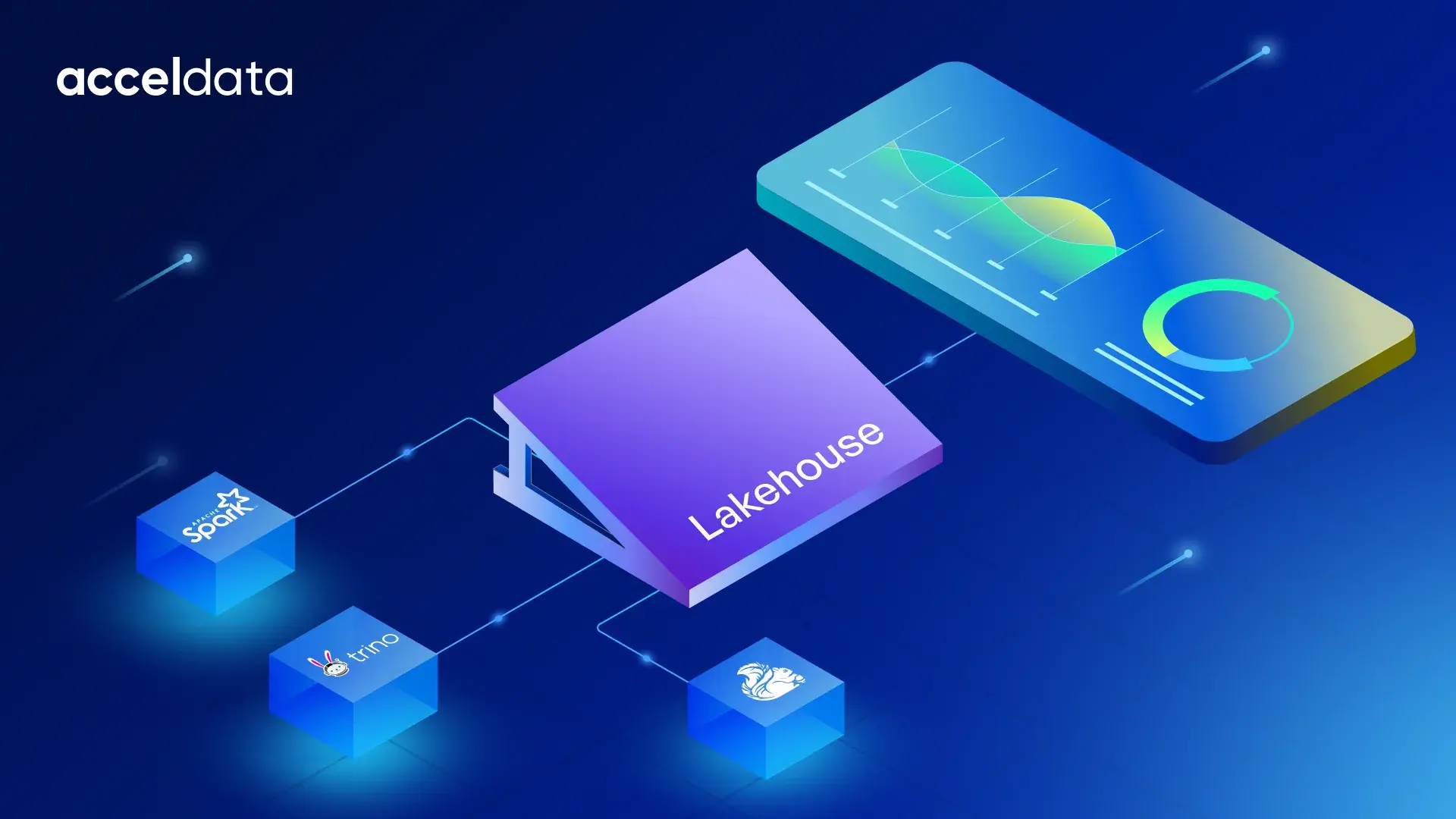
Governance in a private cloud AI environment works by enforcing the same policy whether a workload runs on Spark, Trino, a notebook, or an orchestration tool, because a gap in one engine becomes a route around every other control.
That takes runtime governance, which enforces policies during execution rather than only defining them upfront, across three operations:
- Read: Control who or what can access governed data.
- Write: Control where data can be changed, stored, or moved.
- Execute: Apply policies as each engine runs workloads against the data.
Without that consistency, an analyst blocked from a sensitive column in Trino could still read it through a notebook job running on Spark. Closing that gap takes a single policy layer that every engine answers to, which is the job Acceldata's xGovern is built for.
See how it delivers governance across every engine and every environment, enforcing read, write, and execute policies in real time across Spark, Trino, notebooks, and Airflow
Why is Enterprise Investment in AI Infrastructure Accelerating So Quickly?
Enterprise investment in AI infrastructure is accelerating because AI is moving into production:
According to Gartner, worldwide AI-optimized IaaS spending will grow 96.4% to more than $42.0 billion in 2026, with inference reaching $23.3 billion, or 55% of that spend, and overtaking training at $19 billion.
For regulated enterprises scaling now, architecture and compliance controls have to be designed for sustained inference from the start rather than bolted on later.
How Should Regulated Enterprises Evaluate a Private Cloud AI Vendor?
Evaluate a private cloud AI vendor on whether its control plane can ever touch your data plane, whether it supports the compliance frameworks you need, and whether compute can run elastically on your own infrastructure rather than only the vendor's.
Five questions expose where hidden dependencies can enter the environment:
- Control-plane access: Can the vendor's control plane reach your data plane, and where are prompts, query logs, model artifacts, and telemetry stored or sent?
- Compliance controls: Can you use existing enterprise IAM and enforce HIPAA, SOC 2, or both, including access, audit, masking, lineage, and residency policies?
- Compute portability: Does the platform offer elastic compute on any substrate, so workloads can move across your infrastructure without major rewrites?
- Open formats: Are data and workload artifacts stored in open formats, or will leaving require conversion?
- Exit cost: Which proprietary APIs, policies, connectors, and dependencies would you need to replace if you left?
Building a Private Cloud AI Architecture With Acceldata
Private cloud AI is a stack of connected decisions about architecture, compliance, and deployment, and all three have to hold together.
Three habits help before you commit:
- Confirm the vendor's control plane can never reach the data plane.
- Verify that governance policies apply the same way across every engine.
- Test deployment flexibility against real workloads, not a feature list.
Acceldata's xLake platform runs data and AI workloads across public cloud, private cloud, and on-premises environments from one control plane, while data stays inside your trust perimeter.
Book a demo to see how xLake keeps AI workloads private across the infrastructure you already run.
Private Cloud AI: Frequently Asked Questions
Is private cloud AI the same thing as running everything on-premises?
No. Private cloud AI can run on dedicated infrastructure managed by a third party or within an organization’s facilities, while on-premises AI is operated on infrastructure physically controlled by the organization. Private cloud therefore does not automatically mean on-premises or guarantee data sovereignty.
Does choosing private cloud AI mean giving up elastic scaling?
No. Private cloud AI can still support elastic scaling through dedicated infrastructure, virtualization, orchestration, and capacity expansion, although scaling may be more constrained than in a large public cloud. The trade-off depends on available capacity, architecture, and how quickly additional resources can be provisioned.
How long does migrating an existing AI workload into a private cloud architecture usually take?
Migration can take anywhere from a few weeks to several months, depending on workload complexity, data volume, dependencies, and security requirements. Simple containerized workloads may move faster, while production AI systems with large datasets, specialized hardware, and complex integrations typically require more time.
Is private cloud AI more expensive than using a public cloud AI service?
Private cloud AI can have higher upfront costs because of dedicated infrastructure, hardware, operations, and capacity management. However, the total cost can be competitive for predictable, high-volume workloads, depending on utilization, staffing, and infrastructure lifecycle costs.
What is the difference between governance and compliance in a private cloud AI environment?
Governance defines how AI systems, data, access, and infrastructure are managed through internal policies and controls. Compliance focuses on meeting external legal, regulatory, contractual, and industry requirements, with governance providing the framework for maintaining and demonstrating compliance.