



.svg)



Key Takeaways
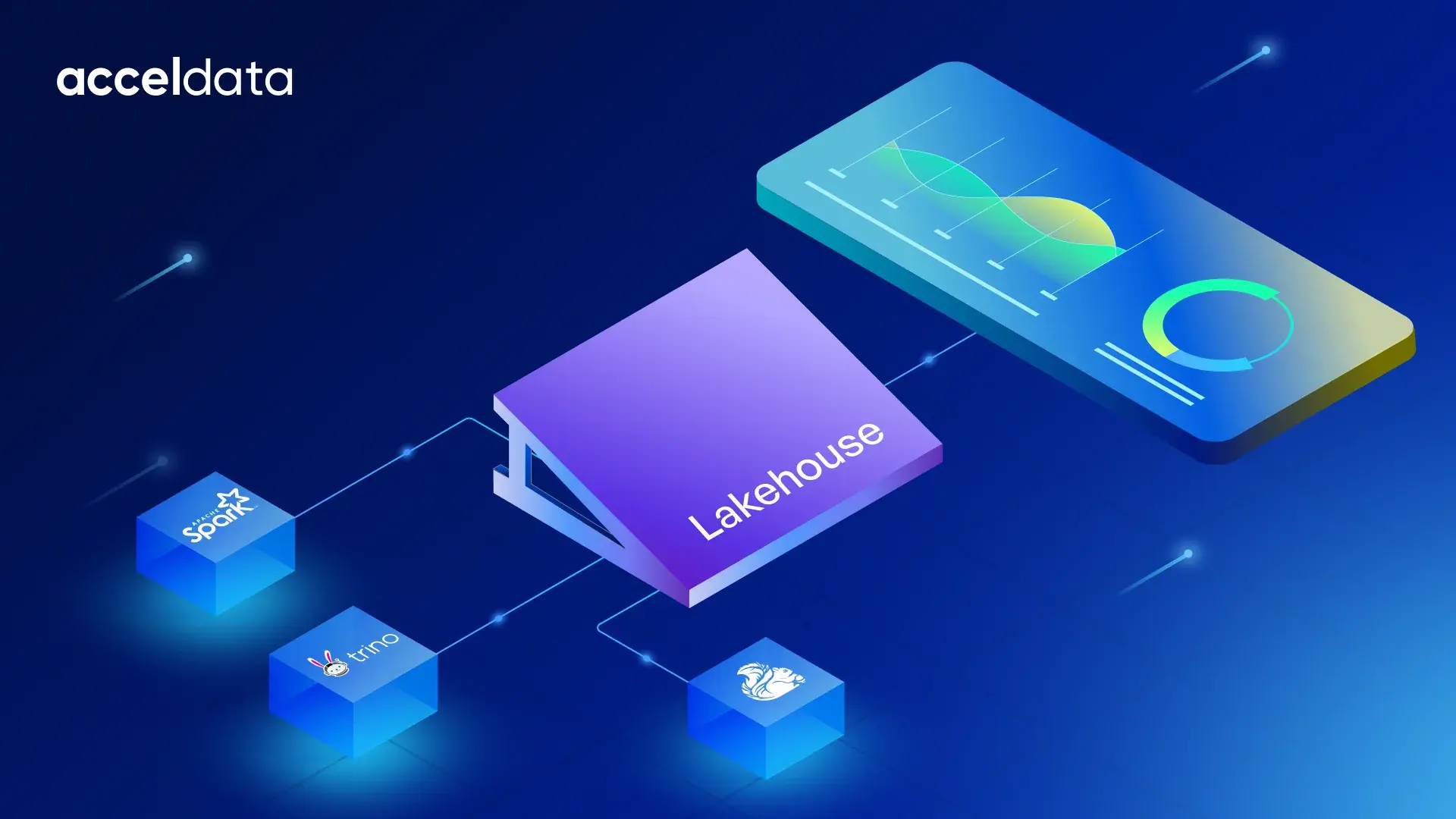
- Multi-engine query federation lets Spark, Trino, and Flink read and write the same lakehouse tables with no copies.
- Open table formats make it technically possible by separating table metadata from data files.
- Iceberg's optimistic concurrency is what keeps concurrent writers from corrupting each other.
- A shared control plane is what stops three engines from scheduling, tuning, and governing in three directions.
- Lineage and governance have to span every engine, since a policy enforced inside one engine protects nothing queried through another.
Multi-engine query federation is why most lakehouses end up running three engines whether anyone planned for it or not. A data science team standardizes on Spark, a BI team wants Trino's interactive latency, a streaming team needs Flink, and within two years all three are pointed at overlapping tables.
That arrangement works or falls apart depending on one layer: whether each engine can read and write the same data natively. The difference between a federated lakehouse and three lakehouses sharing a bucket shows up in the copies, the policies, and the lineage.
What is Multi-Engine Query Federation and Why Does it Matter for a Lakehouse?
Multi-engine query federation means several compute engines query and process the same lakehouse tables directly, with no engine holding a private copy and no engine acting as a gateway for the others.
The term is used in two ways. Some platforms use federation to mean reaching out to external systems through a single catalog, where one engine stays the entry point, and the others are sources.
The other arrangement is where each engine reads and writes the shared tables natively, and none of them proxies for the rest. Each engine earns its place by workload shape:
Forcing all three workloads through one engine means paying a penalty on two of them. Streaming through a batch engine adds latency, and interactive queries on an engine tuned for throughput frustrate the analysts waiting on them.
Federation removes the compromise by making the storage layer neutral ground, which is why a multi-engine data platform is now the default shape for a large estate instead of an exception.
Why Do Enterprises End Up Running Spark, Trino, and Flink Against the Same Data?
Enterprises end up running Spark, Trino, and Flink against the same data because three different teams adopt the three engines independently, each for a defensible reason, and their workloads inevitably converge on overlapping tables.
The path is almost always organic:
- The platform team builds the first pipelines in Spark, since batch ETL is where the estate starts.
- Analytics adopts Trino because dashboard queries that take minutes on Spark return in seconds on Trino.
- A product team needs sub-minute freshness and brings in Flink, which is the tool for continuous processing.
- Each team's tables become interesting to the others, and now three engines want the same data.
Nobody in that sequence made a mistake. The failure, when it comes, is architectural: three engines were adopted, and no decision was made about how they would share. That gap is where the copies start.
What Breaks When Multiple Compute Engines Query the Same Lakehouse Without a Shared Control Plane?
Three things break: data gets duplicated, governance diverges, and lineage stops at each engine's boundary.
The governance row is the one with teeth. A policy applied inside a single engine's own controls is not a policy on the data; it is a policy on one path to the data. Any other engine reading the same files bypasses it entirely.
Commit frequency is the interaction teams hit first. A Flink job committing every minute produces small files and a long snapshot history on the same tables Trino is querying interactively, so read performance degrades for a workload nobody changed. The fix is compaction and snapshot expiry running on a schedule that accounts for all three engines, which is a scheduling decision no single engine's tooling makes.
Version management adds a quieter tax. Iceberg's own documentation sets out an engine version lifecycle running from beta through maintained to deprecated and end of life, with separate runtime jars released for each supported Spark and Flink version and an explicit warning to keep other modules off the classpath to avoid dependency conflicts.
The Spark, Flink, and Hive connectors are maintained inside the Iceberg repository and move with its releases, while Trino's Iceberg support is built and shipped by the Trino project on its own cadence.
That is two different upgrade models instead of one matrix with three columns, which is a strong argument for a multi-engine control plane for every job instead of three teams tracking compatibility independently.
How Does an Open Table Format Make Multi-Engine Federation Possible in the First Place?
Open table formats separate table metadata from the data files, so any engine that understands the format can read and write correctly without routing through another engine.
In a Hive-style layout, a table's contents are inferred from directory listings plus a metastore, which makes atomic change hard and correctness dependent on the filesystem's behavior. Iceberg replaces that with a metadata tree the engine reads directly. Every write produces a new snapshot, and readers work from a committed snapshot without holding a lock.
Concurrency is the part that makes shared writes safe. Iceberg uses optimistic concurrency, where each writer assumes no other writers are operating and commits by atomically swapping the new metadata file for the existing one, retrying against the current table state when another writer commits first. That single mechanism is what allows a Flink job appending every minute and a Spark compaction job rewriting files to operate on one table without corrupting it.
Two practical notes for a platform team:
- Engine-side execution still differs, since the format is shared but the execution is not. Spark's performance on the same tables depends on its own execution layer, which is where vectorized Spark execution with Gluten and Velox changes the arithmetic on scan-heavy jobs.
- Catalog reachability decides participation, since an engine that cannot reach the catalog cannot see the tables, whatever format they are in. Bringing an engine into the estate is a catalog integration exercise, as the Trino data source integration in ADOC shows on the observability side.
How Should Enterprises Maintain Lineage and Governance Across Every Engine Querying the Lakehouse?
Put lineage and governance in a layer above the engines, since anything built inside one engine's tooling protects only the queries that pass through it. The test is simple. Take a masking rule on a sensitive column and ask which engines enforce it. If the answer names one, the rule is a suggestion.
An engine-neutral layer has to cover four things.
1. Policy defined once, enforced everywhere
One rule is applied to the table itself, not reimplemented three times in three engines' own dialects.
2. Lineage captured at runtime from each engine
Batch, interactive, and streaming jobs all emit into the same graph, which is what open standards for lineage collection exist to make possible.
3. Consistent identity and access
The same principal is resolved the same way, whichever engine issues the query.
4. Attribution across engines
Cost and utilization are tied to a workload, so a shared cluster's spend can actually be explained rather than argued about after the invoice arrives.
Lineage that already spans platforms is the model here, since lineage across Redshift, Glue, Pub/Sub, and Iceberg is the same problem as lineage across Spark, Trino, and Flink: the graph has to be assembled from sources that do not talk to each other.
Engine interoperability at the format layer is settled, and governance across every engine and every environment is the part that still has to be designed deliberately.
See how Acceldata's federated queries across heterogeneous sources with ADOC connect Spark, Trino, and Flink to one governed lakehouse without forcing the governance layer inside any single engine.
Letting the Workload Choose the Engine, with Acceldata
Done properly, query federation on a lakehouse means no team compromises on which engine fits its workload. The data stays in place, the format stays open, and the policy travels with the table.
What that requires in practice:
- One open table format should sit behind a catalog every engine can reach.
- Concurrency should be handled by the format itself, not by scheduling engines apart from each other.
- A shared control plane should own job scheduling, tuning, and cost attribution.
- Governance should be defined against the table and enforced regardless of which engine touches it.
- Lineage should be captured at runtime from every engine into one graph.
Get those five right and adding a fourth engine is a configuration change. Get them wrong and each new engine multiplies the copies, the policies, and the places lineage can break.
Acceldata's xLake platform runs that control plane across cloud, on-premises, and hybrid environments, so governance and lineage hold across Spark, Trino, Flink, and whatever the next team adopts.
Bring every engine onto one governed lakehouse instead of three that happen to share storage. Book a demo and see what a control plane built for exactly this looks like.
FAQs: Multi-Engine Query Federation
Does multi-engine query federation slow queries down compared to running everything on one engine?
Multi-engine query federation can introduce latency from query planning, data movement, and coordination across engines. The impact varies by workload and architecture, and well-designed federation can keep overhead low for many use cases.
How does query federation handle schema differences between engines?
Query federation typically uses a common schema layer to map data types, functions, and table definitions across different engines. Differences that cannot be mapped directly may require type conversion, query rewriting, or engine-specific handling, which can affect compatibility and performance.
Can Spark, Trino, and Flink all write to the same Iceberg table safely at the same time?
Yes, Spark, Trino, and Flink can write to the same Iceberg table concurrently when they use compatible Iceberg versions and a properly configured catalog with transactional commit handling. Safety depends on the workload and write patterns, with concurrent updates requiring careful handling of conflicts and schema or partition changes.
What skills does a platform team need to support multiple query engines well?
A platform team needs expertise in query engines, data formats and catalogs, distributed systems, performance tuning, and workload orchestration. It also needs strong observability and governance skills to manage differences in reliability, security, cost, and operational behavior across engines.
Is multi-engine federation only relevant for large enterprises, or does it apply at smaller scale too?
Multi-engine federation can be useful at a smaller scale when teams have different workloads, tools, or performance requirements that a single engine cannot serve efficiently. For smaller organizations, the trade-off is mainly the added operational complexity of managing multiple engines and their integrations.