.svg)



Key Takeaways
- Data sovereignty, residency, and localization address different requirements, so treating them as interchangeable can hide gaps in control and compliance.
- Data sovereignty vs. data residency goes beyond location, since sovereignty also covers the legal and operational control around data.
- Data residency vs. data localization separates where data sits from geographic requirements that may restrict where specific data is stored, processed, or transferred.
- AI expands the sovereignty boundary beyond stored data to prompts, embeddings, inference, agent activity, logs, and other processing paths.
- Architecture and runtime enforcement provide stronger evidence that sovereignty controls hold during execution than vendor policies or compliance claims alone.
Your AI data is stored in the right region, but where does it go when a model retrieves context, generates embeddings, calls another service, or sends telemetry? That question sits at the center of data sovereignty vs. data residency, because a storage decision can satisfy residency requirements while leaving a harder question open: who controls the data throughout that journey?
That gap is already challenging enterprises. IBM's 2026 study found that 68% of senior executives find meeting data residency and sovereignty requirements across geographies challenging.
Separating the three terms, including localization, makes it easier to evaluate AI infrastructure and vendor claims against their actual technical guarantees.
What Do Data Sovereignty, Data Residency, and Data Localization Mean?
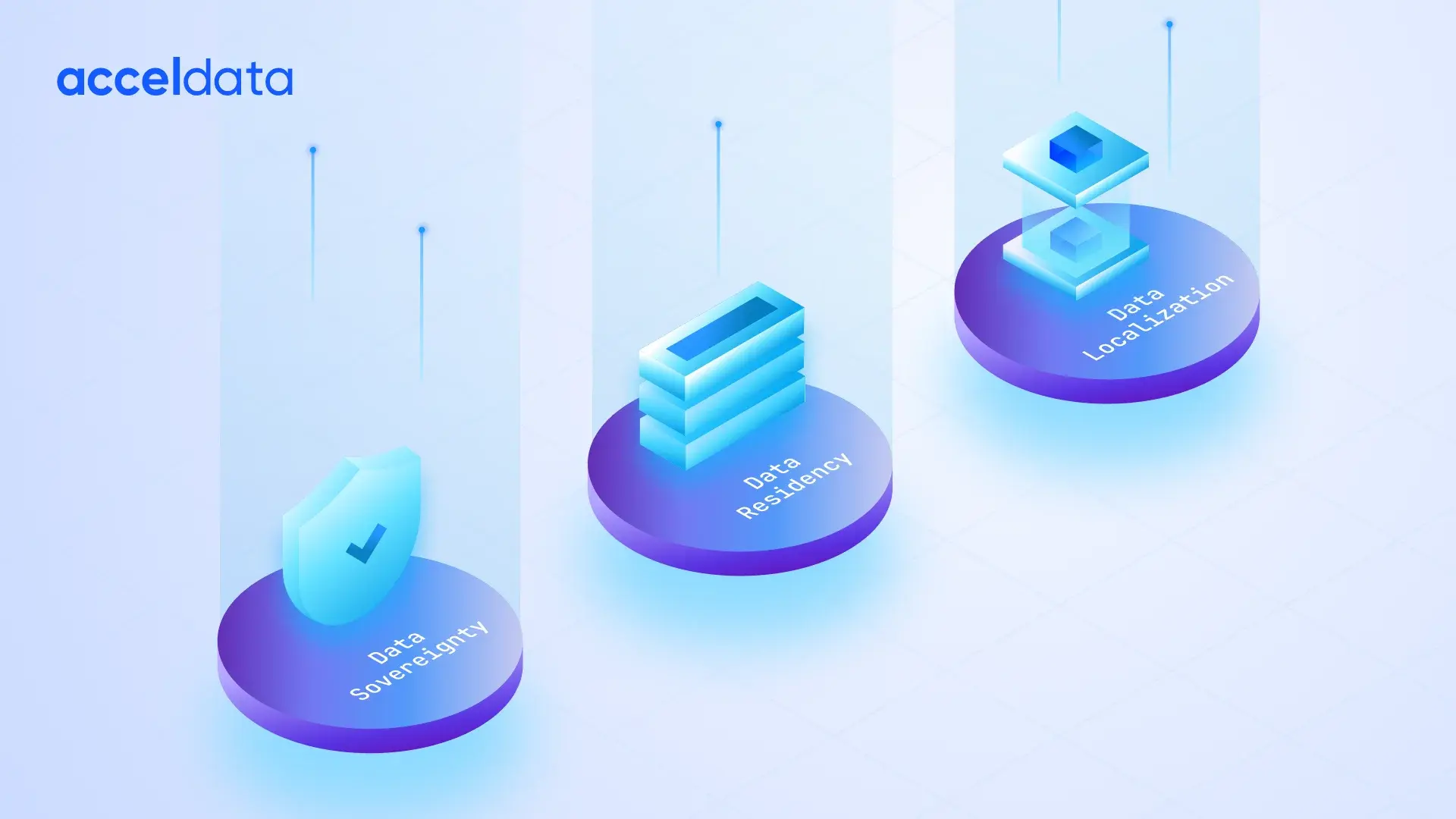
Data localization is a legal requirement governing where certain data must stay, data residency describes where data is stored by choice or requirement, and data sovereignty determines which legal and operational authorities control it.
The key distinction in data sovereignty vs. data residency is that location alone does not establish control, since data can sit in an approved region and still fall within another jurisdiction's reach.
Data residency vs. data localization comes down to obligation: residency describes where data is, while localization dictates where the law requires it to stay or be handled.
Here's how the three compare:
Why Do Data Sovereignty, Data Residency, and Data Localization Get Confused in AI Infrastructure Conversations?
The three terms get confused in AI infrastructure conversations because AI workloads keep moving data after it is stored, so a system can meet residency on paper while prompts, embeddings, and logs pass through services outside the customer's control.
A typical AI execution path can involve several such boundaries:
Source data → Training/RAG → Embeddings → Inference → Agent/tool calls → Outputs → Logs/telemetry
This means AI data sovereignty cannot be determined by checking the storage region alone. Understanding what sovereign data means for AI infrastructure starts with tracing what happens to data at each step of that path. Control can change hands at several points along the way:
- Training and RAG: Source data or retrieved context may be staged or processed in another environment.
- Embeddings and retrieval: Data may be sent to an external embedding model, vector database, or retrieval service.
- Inference and agents: Prompts, retrieved context, or tool inputs may reach external model endpoints and services.
- Logs and telemetry: Inference logs, agent activity, or operational telemetry may leave the environment even when source data does not.
This is why sovereign AI infrastructure requires visibility beyond where GPUs and databases physically sit. Data, model interactions, retrieval, tool calls, and runtime signals all form part of the sovereignty boundary.
Put differently, your AI is only as sovereign as the data beneath it, and meeting AI data residency requirements at the storage layer covers only the first step of that path.
What's the Compliance Risk of Treating Data Sovereignty, Data Residency, and Data Localization as Interchangeable?
Treating the three as interchangeable lets a team pass a residency check and still fail a sovereignty audit, because residency confirms where data sits while sovereignty requires proof of who can access, process, and move it.
Under GDPR Chapter V, transfers of personal data to third countries must meet specific conditions, so keeping the original dataset in an approved region does not cover what happens when it moves elsewhere for processing.
The EU AI Act adds dataset obligations of its own: Article 10 sets data governance requirements for training, validation, and testing data in high-risk systems, without imposing a blanket requirement to keep AI data in the EU.
Together, these rules push AI teams to answer four separate questions.
Where is the data stored?
This establishes residency, and it is the only question a storage-region check actually answers.
Where is the data processed?
Model endpoints, embedding services, and other processing layers may sit in a different jurisdiction from the storage region, bringing another set of laws into play.
Who can access the data?
Provider or administrative access can extend beyond the storage environment, which is often where sovereignty gaps first appear.
Where can the data move?
Replication, failover, and downstream use can carry data into new environments, each with its own transfer requirements.
These questions are getting harder to treat as edge cases. Cisco's 2026 Data and Privacy Benchmark Study found that 81% of organizations face heightened demand for data localization, so enterprises need to track where data goes throughout a workload, not just where it starts.
Keeping controls consistent across platforms is the other obstacle. When access, processing, and movement policies vary by platform, proving that sovereignty controls stay intact becomes much harder.
How Does a VPC-Native Architecture Turn Sovereignty From a Policy Into an Enforced Fact?
A VPC-native architecture turns sovereignty into an enforced fact by running compute and storage inside the customer's own cloud account and keeping the vendor's control plane out of the data plane, so the boundary is set by infrastructure rather than by contract.
That separation changes what the vendor can reach and what has to leave the customer's environment. A VPC-native data platform handles each of the usual exposure points differently:
- Customer data: Workloads execute against data inside the customer's environment rather than moving it to vendor-managed infrastructure.
- Query logs and metadata: Operational information remains within the same controlled boundary instead of being exported for vendor-side processing.
- Telemetry: Metrics and other operational signals stay in the customer's environment even though the platform is vendor-managed.
- Processing: Compute runs where the data lives, giving the enterprise control over where regulated or sensitive data is processed.
- Data egress: Keeping execution inside the customer perimeter reduces the paths through which data can move into vendor infrastructure.
The result is a clear chain from policy promise → architectural boundary → enforceable control. Instead of relying on a vendor statement that data will remain in a particular region, teams can examine whether the architecture itself prevents the data plane from crossing that boundary.
That is the principle behind a VPC-native architecture that keeps data from leaving your control. For sovereign AI infrastructure, that boundary also needs to hold across cloud, hybrid, and on-prem environments.
See how Acceldata's xLake is built around this split-plane model, running compute where your data already lives, whether that's AWS, Azure, GCP, or on-prem.
Why Do Multi-Cloud Governance Policies Fail to Hold Sovereignty, Residency, and Localization Together?
Multi-cloud governance policies fail to hold sovereignty, residency, and localization together because each cloud enforces identity, access, and metadata in its own way, so a rule that satisfies all three in one environment can silently break in another.
A policy can be defined once and centrally, but enforcement still runs through each platform's native controls. Three gaps tend to emerge as a result:
- Fragmented visibility: Teams cannot consistently see where regulated data resides, where workloads process it, or when either crosses jurisdictional boundaries.
- Inconsistent enforcement: The same policy may be interpreted or enforced differently across environments, creating gaps in access, processing, or movement controls.
- Siloed metadata: Classification, lineage, ownership, and policy context may remain within individual platforms instead of following the data and workload.
This is where design-time and runtime governance serve different purposes. Design-time governance defines the rule, while runtime governance evaluates and enforces it as data is queried, processed, or moved.
Without that runtime layer, a centrally defined policy can still produce different outcomes across clouds. Understanding why multi-cloud governance policies fail across cloud boundaries starts with closing that gap between policy definition and execution.
How Should Organizations Keep Pace as Sovereignty, Residency, and Localization Rules Keep Changing?
Organizations keep pace by treating compliance classification as a standing, automated practice that flags when requirements need a fresh review, rather than as a one-time infrastructure exercise.
Regulations change, but so do the data, services, and processing paths that determine which requirements apply. Teams should reassess their requirements whenever one of these triggers occurs:
- A new jurisdiction where data is stored, processed, or accessed
- A new data classification that changes how information must be handled
- A new model or AI service that introduces another processing or access path
- A changed processing location for an existing workload
- A new downstream use that changes how data is consumed or shared
- An updated regulation affecting storage, processing, access, or cross-border transfers
Cross-border requirements also vary by jurisdiction, from outright localization mandates to transfer mechanisms such as adequacy decisions, standard contractual clauses, and binding corporate rules.
Automating these checks gives compliance teams a repeatable way to reassess the rules as data moves into new jurisdictions, services, and processing environments. That ongoing review is central to how organizations keep up with changing data compliance laws without waiting for the next audit cycle.
For pipelines and AI systems that run continuously, the classification has to stay attached to data and workloads as the infrastructure around them changes.
Turning Sovereignty Into a Technical Fact With Acceldata
Sovereignty, residency, and localization often get treated as one problem, but conflating them means a team can be fully compliant on paper and still not know who can touch its data once AI workloads are involved. Retrieval, inference, agent activity, and telemetry can all cross boundaries even when source data stays put.
Before evaluating sovereign AI infrastructure, teams should:
- Define sovereignty, residency, and localization before any vendor conversation.
- Ask vendors to demonstrate enforcement, not just certifications.
- Map where inference, embeddings, agent state, logs, and telemetry travel.
- Reassess requirements as infrastructure, jurisdictions, or regulations change.
Acceldata's xLake platform deploys inside the customer's VPC, so query logs, metadata, training data, and operational telemetry never move into vendor-managed infrastructure, while its Tunnel Client lets Acceldata manage the control plane through a one-way connection with zero access to the customer data plane.
Book a demo and see how xLake's VPC-native architecture turns data sovereignty into a verifiable, enforced fact.
Data Sovereignty vs. Data Residency: Frequently Asked Questions
Is data localization the same thing as data residency?
No. Data residency refers to where data is stored, while data localization generally involves legal or regulatory requirements that require certain data to be stored or processed within a specific jurisdiction.
Does data sovereignty require data to physically stay inside one country?
No. Data sovereignty is primarily about which country’s laws and regulatory authority govern data, while physical storage within one country may be required by specific data localization rules.
How does the EU AI Act change data residency requirements for AI systems?
The EU AI Act does not create blanket data residency requirements for AI. For relevant high-risk systems, it sets data-governance requirements for training, validation, and testing datasets rather than generally requiring them to remain within the EU.
Can a cloud-hosted AI system ever be considered fully data sovereign?
Yes, a cloud-hosted AI system can be considered data sovereign if it provides enforceable controls over data location, processing, access, encryption keys, and administrative operations within the required jurisdiction. However, using a local cloud region alone does not establish full sovereignty if the provider retains cross-border access or operational control.
What should you ask a vendor to verify a data sovereignty claim?
Ask where data is stored and processed, who can access it, where encryption keys are controlled, and whether support or administrative operations can cross jurisdictional boundaries. Also ask for contractual commitments, subprocessors, government-access procedures, and evidence that these controls apply to backups, logs, metadata, and AI workloads.