


Key Takeaways
- Multi-cloud growth is driving the need for centralized governance oversight across distributed environments.
- AWS, Azure, and GCP can turn one governance policy into three different implementations.
- Native governance tools work within platform boundaries, leaving cross-cloud consistency unresolved.
- Multi-cloud data governance works best when policies are defined centrally and enforced where data runs.
- Shared governance visibility can expose policy gaps, redundant data, inefficient workloads, and unnecessary cloud spend.
A customer dataset classified as restricted can mean three different things at once: one set of access permissions in AWS, different masking rules in Azure, and a separate query policy in GCP.
Multi-cloud data management routinely turns one governance rule into three separate enforcement outcomes, even though the underlying business rule never changed.
Teams end up reconciling separate controls, checking whether policies still mean the same thing, and catching gaps as data moves between clouds. A common governance architecture keeps that policy consistent without forcing every cloud to work the same way.
What Does Multi-Cloud Data Management Mean, and Why Does Governance Break Down Across AWS, Azure, and GCP?
Multi-cloud data management is the practice of managing and governing data across two or more cloud providers, such as AWS, Azure, and GCP, while keeping access, security, and governance policies consistent.
That consistency breaks down because every cloud enforces its own identity, access, and policy systems independently, so the same requirement often ends up managed differently across providers:
- Access rules can vary as roles and permissions change between clouds.
- Data policies such as masking and retention may require separate configurations.
- Governance visibility becomes fragmented across different tools and environments.
Why Does Data Governance Fragment the Moment You Operate Across Multiple Cloud Providers?
Data governance fragments the moment an enterprise policy has to pass through separate, independently controlled cloud environments, because each cloud enforces that same policy on its own terms.
The gaps usually show up in the following places:
- Enforcement: The same access rule can produce different permissions when each cloud implements it independently.
- Lineage: End-to-end traceability can break when data moves between clouds and lineage records remain trapped within separate systems.
- Definitions: Shared terms such as "customer," "sensitive," or "restricted" can take on different meanings when metadata and governance standards are managed separately.
- Data controls: Masking, retention, and access requirements do not automatically travel with the dataset, leaving teams to recreate and synchronize them.
These are the kinds of disconnects behind why data silos break governance across systems, now enough of an executive concern that a masking gap in one cloud tends to surface first in an audit finding, not an engineering retrospective. The problem is not simply having multiple clouds; it is keeping the same governance intent intact as data crosses them.
Why Doesn't a Single Cloud Provider's Native Governance Tool Solve Multi-Cloud Consistency?
A single cloud provider's native governance tool doesn't solve multi-cloud consistency because its authority stops at that platform's own boundary, however strong its capabilities are inside it.
The key difference is where that governance authority begins and ends:
Metadata and lineage records like these are typically scoped to a single region or deployment, and don't extend past it without extra configuration. The same boundary shows up in how Acceldata extended Apache Ranger governance to Amazon S3, which compiled Ranger's Hadoop-only policies into native bucket rules instead of relying on an agent that could never reach past it alone.
Multi-cloud governance cannot stop at making data accessible across clouds; it needs a shared policy model that preserves the same intent across every cloud, engine, and environment.
What Does it Mean to Manage Governance as a Control Plane Instead of Per-Cloud Tooling?
A governance control plane is a shared layer where governance policies are defined and coordinated centrally, while enforcement happens where data is stored, processed, or accessed.
That matters because separate catalogs and policy engines can leave teams synchronizing rules manually across environments. An enterprise governance control plane provides a common policy model while allowing controls to be applied close to the data.
A useful way to understand the architecture is as a continuous five-step cycle:
- Define: Set common classifications, permissions, residency requirements, and ownership rules.
- Evaluate: Check each request against identity, data sensitivity, location, and workload context.
- Enforce: Apply the resulting decision through the controls available in the execution environment.
- Observe: Record policy decisions, violations, lineage, and changes as workloads run.
- Prove: Maintain consistent evidence showing what policy was applied, where, and with what result.
The Evaluate and Enforce steps matter most for cross-cloud enforcement: a policy written at design time establishes what should happen, while runtime governance decides what should happen now and applies it as data is ingested, transformed, or consumed.
Should Multi-Cloud Governance be Centralized, Decentralized, or Federated Across Business Domains?
Federated governance is the right default for multi-cloud, balancing the central accountability of a centralized model with the domain autonomy of a decentralized one.
The three models differ mainly in where authority sits and how much freedom domains retain:
Federated governance offers a practical middle ground for complex estates; this approach to mastering decentralized data governance across enterprise domains works through in more depth. The organizational and technical layers stay distinct: federated governance decides who owns decisions, while the control plane decides how shared policies get enforced.
How Do You Keep Governance Enforced Consistently as Data Moves Through Pipelines Across Clouds?
You keep governance enforced consistently across pipelines by building policy-as-code and standardized templates into the pipeline, instead of checking compliance only after it finishes.
At runtime, enforcement follows the data through three stages:
1. Ingestion: Classify data as it enters
Sensitive data is classified the moment it enters the pipeline and tagged with its ownership and policy context. This happens before any transformation runs, not reconstructed later during an audit.
2. Transformation: Validate every change
The pipeline checks whether a change is permitted for the data's classification, user, location, and workload before it proceeds. This blocks a disallowed transformation outright instead of flagging it afterward.
3. Consumption: Enforce at the point of use
Masking, access restrictions, and other controls apply before data reaches an analyst, application, or AI workload, not after. Enforcement stays tied to the moment of use, regardless of cloud or engine.
The same pattern appears in implementing data governance across modern data pipelines, which shows how these controls get built into pipeline design instead of bolted on afterward.
What Does Metadata Governance Need to Look Like When AI Workloads Span Multiple Clouds?
When AI workloads span clouds, metadata governance needs to connect the data an AI system uses with its meaning, ownership, processing history, and model relationships.
The following metadata layers provide that context:
Together, these layers create cross-cloud lineage that teams can follow from source data through transformation to model or retrieval context to AI output. This becomes harder when AI pipelines create more copies of the same data across environments:
Forrester's zero-copy research identifies copy-heavy pipelines as a source of greater governance risk, cost, and slower AI delivery.
Lineage must also reflect what is happening now, not what metadata looked like when first cataloged, a challenge that strengthening metadata governance for cloud-native AI addresses in more depth.
How Do You Optimize Cost Without Losing Governance Control Across Multiple Clouds?
You optimize cost without losing governance control by using the same visibility, asset inventory, lineage, and ownership metadata to answer both questions at once instead of treating them as separate initiatives.
With that context, automated compliance checks and continuous monitoring can surface:
- Redundant data copies that add storage and transfer costs across clouds.
- Inefficient workload placement where processing runs in a more expensive environment than necessary.
- Idle or underused resources that continue consuming a budget without enough business value.
How to optimize cloud data management and reduce costs walks through what combination of visibility and ownership looks like in practice.
How Can a Single Control Plane Enforce Governance Consistently Across AWS, Azure, and GCP?
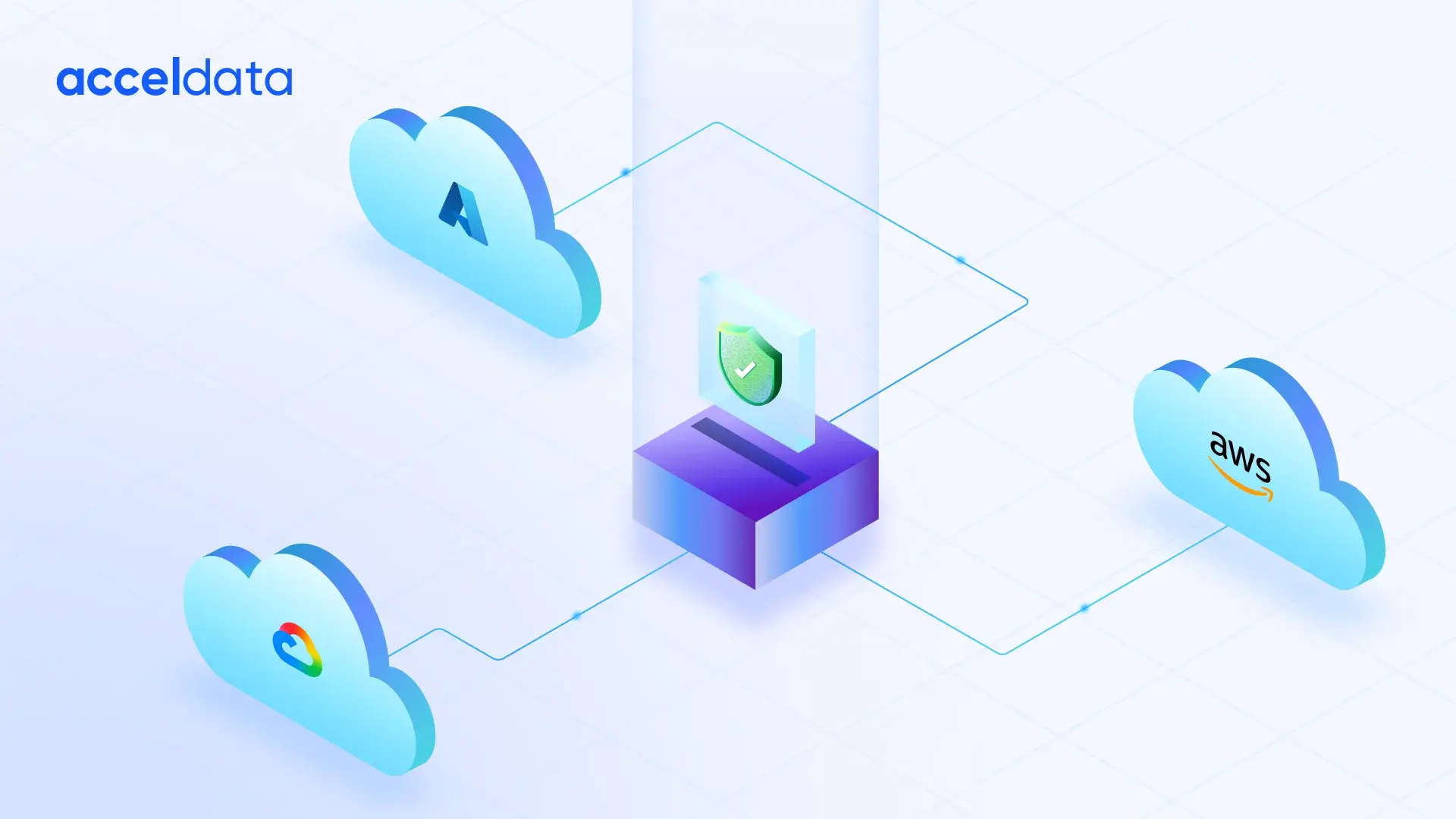
A single control plane enforces governance consistently across AWS, Azure, and GCP by defining policy once and applying it identically wherever the workload runs.
See how xGovern applies this as a single control plane across on-premises, AWS, Azure, and GCP, coordinating one policy across every engine it governs.
The model connects these functions:
Define once
Common classifications, access conditions, and quality rules are set once, centrally, instead of being recreated per cloud or engine. This is the same policy layer referenced throughout this article.
Evaluate in context
Each request is checked against identity, sensitivity, location, and workload context before a decision is made. This turns a static policy into a runtime decision reflecting what is actually happening.
Enforce where data runs
The decision applies through the controls available wherever the workload runs, not by moving data to a central system first. This follows Acceldata's own distributed policy architecture, which executes governance, quality, and security policies where data resides.
Record what happened
Enforcement connects back to lineage and audit context, tracing what policy applied, where, and with what outcome. That traceability turns a workload-level log into evidence a compliance team can use.
Acceldata ran into this same problem with an enterprise operating across several data platforms.
A global semiconductors leader was dealing with inconsistent data across Oracle ERP and several other enterprise platforms, which affected the reliability of business-critical reporting. Acceldata standardized governance and compliance scoring across 25 enterprise KPIs, lifting sales-forecast confidence from 20% to 90% in 60 days.
Keeping Multi-Cloud Data Governance Consistent with Acceldata
Multi-cloud happened before most organizations had a governance architecture ready for it, and per-cloud tooling can only govern its own boundary. One policy should not become three outcomes because data moves across AWS, Azure, and GCP.
That consistency comes down to a few practices:
- Defining governance once, centrally, and enforcing it everywhere instead of reconciling settings later.
- Choosing a federated model that balances domain autonomy with a non-negotiable baseline.
- Embedding enforcement into pipelines and metadata instead of auditing after data moves.
Acceldata's xGovern coordinates one policy across every engine and cloud from a single control plane, keeping enforcement close to the data.
Book a demo and see how xGovern enforces one governance policy consistently across AWS, Azure, and GCP from a single control plane.
Frequently Asked Questions
Does a governance control plane need to be installed separately on every cloud you use?
Not necessarily. A control plane can be deployed once and connected to execution environments across every cloud it needs to reach, rather than reconfigured separately for each provider. The exact model still depends on the platform and architecture in use.
How is multi-cloud governance different from multi-cloud data integration?
Multi-cloud data integration and multi-cloud governance solve different problems: integration connects and synchronizes data between cloud environments, while governance decides who can access that data, how it is classified, and how long it is retained. Strong integration alone does not guarantee consistent governance.
Does a control plane replace each cloud provider's native identity and access management, or work alongside it?
A governance control plane typically works alongside native IAM rather than replacing it, coordinating enterprise policy centrally while each cloud's own identity and access systems continue handling local enforcement.
How do you handle data residency requirements that differ by region under one governance model?
Residency requirements get encoded as policy conditions based on data classification, location, and permitted processing region, so the policy itself stays common across regions. The underlying storage, access, and infrastructure controls may still require region-specific configuration.
What is the first governance policy most teams should standardize when moving from single-cloud to multi-cloud?
Most teams should start with a shared data classification model and glossary. Agreeing on what terms such as public, confidential, restricted, or customer data mean creates the common foundation every other policy depends on, and prevents the definition conflicts that fragment governance across clouds.