




.svg)




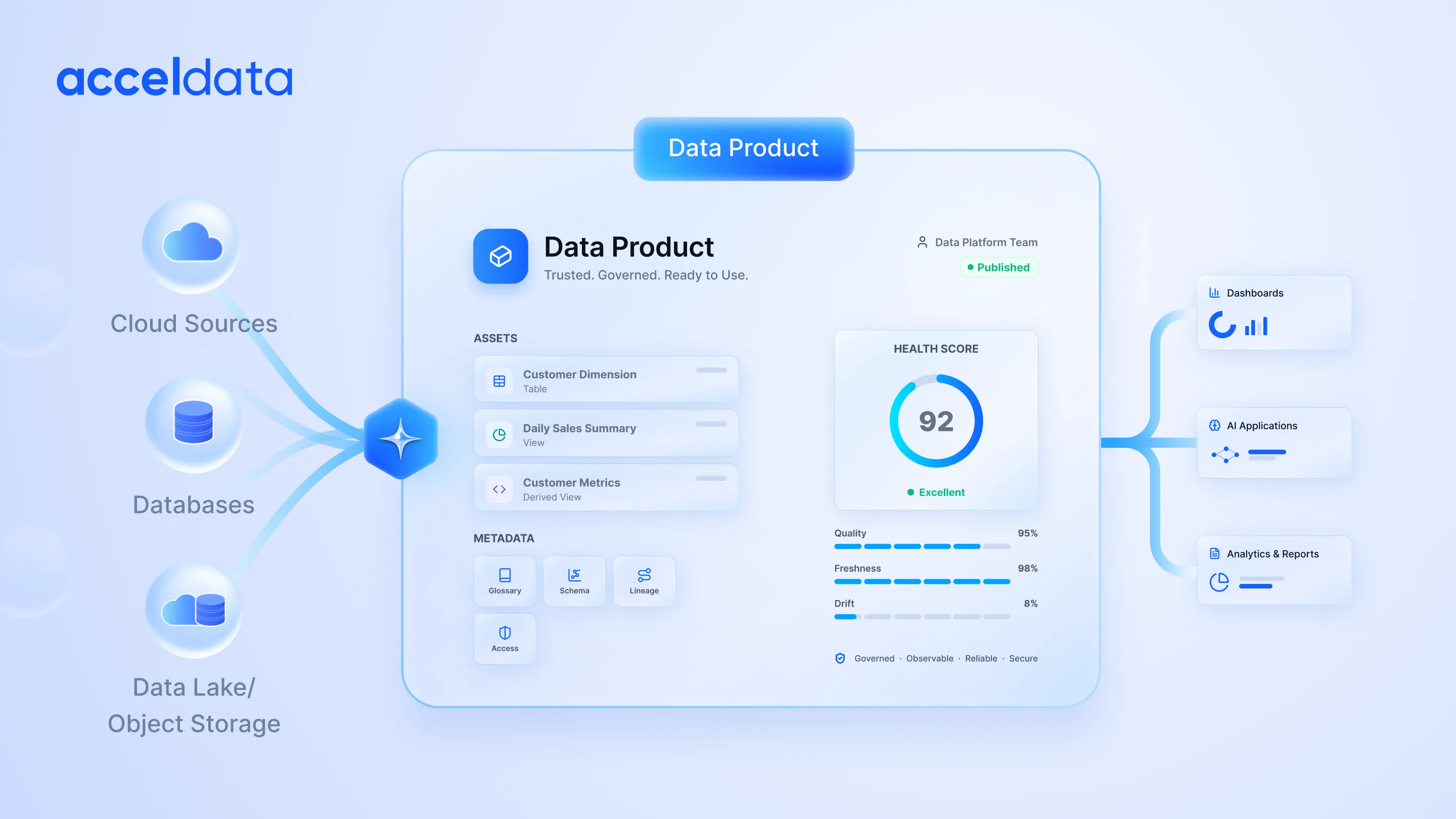
When data governance is elevated from a standalone tool to a centralized control plane, it shifts from passive oversight to active coordination and enforcement. This architectural change enables consistent, real-time governance across thousands of data assets, pipelines, and platforms.
Organizations invest millions in data catalogs and policy managers, yet data quality issues and security gaps persist. Most governance initiatives fail because they rely on passive tools rather than active architecture.
This failure occurs because traditional tools offer visibility without authority. A catalog can tell you that a sensitive file exists in S3, but it cannot stop a rogue script from copying it to a public bucket.
To solve this, modern enterprises are re-architecting data governance as a control plane. This approach decouples governance logic from individual platforms, creating a centralized brain that coordinates decisions and enforces policies dynamically across the entire enterprise data governance architecture.
How Data Governance Is Commonly Treated Today
In the current landscape, governance is often implemented as an afterthought or a compliance checklist. It manifests as a collection of disparate tools that catalog data but fail to control it.
Governance as a Tool or Platform
Organizations typically view governance as a software category: a "tool" to buy. They implement catalogs to index assets and policy managers to document rules. However, these tools operate "out of band," sitting alongside the data rather than within the execution path. They are libraries of intent, not engines of action.
Siloed Adoption Across Teams
Governance responsibilities are fragmented. The security team uses IAM tools for access, the data engineering team uses testing frameworks for quality, and the legal team uses spreadsheets for compliance. This fragmentation means there is no unified centralized governance model to reconcile conflicting policies or provide a single source of truth for enforcement.
Limited Authority Over Data Behavior
Traditional governance tools have visibility but lack control. They can tell you that a dataset contains PII, but they cannot stop a user from querying it. They operate on a model of recommendation ("Please fix this schema") rather than enforcement ("Schema violation blocked"), leaving the actual governance burden on human stewards.
What Does It Mean to Treat Governance as a Control Plane?
Treating governance as a control plane transforms it from a passive repository into an active architectural layer. It borrows the "control plane vs. data plane" concept from networking and applies it to data management.
Definition of a Governance Control Plane
A data governance control plane is a centralized logic layer that orchestrates governance decisions across distributed systems. It does not store the data (the data plane) or move the data (the pipeline). Instead, it holds the policies, evaluates the context, and issues commands to the execution layers. It is the "air traffic controller" that ensures safety and efficiency without flying the planes itself.
Control Plane vs Data Plane in Governance
The distinction is critical for scalability.
- The Control Plane (Governance): Defines what must happen (e.g., "No PII in Bronze Layer") and decides when to enforce it.
- The Data Plane (Platforms): Executes how it happens (e.g., Snowflake masking a column or Airflow blocking a job).
- By separating these concerns, the governance logic becomes portable and consistent, regardless of the underlying technology.
Governance as an Active System, Not a Repository
A repository waits for updates; a control plane is always on. It operates as an active system that continuously ingests signals—metadata, logs, usage patterns—and triggers event-driven enforcement. If a user's behavior changes or a pipeline drifts, the control plane reacts in real time to maintain the desired state.
Reference Enterprise Data Governance Architecture for a Control Plane
To operationalize this concept, organizations must implement a specific architectural reference model. This model connects the central policy engine to the distributed data estate.
The Signal Ingestion Layer
The control plane needs eyes. It ingests metadata, lineage, quality scores, and access logs from across the stack (Snowflake, Kafka, Airflow, Databricks). This real-time telemetry feeds the xLake Reasoning Engine, providing the situational awareness needed for context-aware decisions.
The Policy Evaluation Engine
This is the brain. It evaluates incoming signals against defined policies. Using contextual memory, it understands that a "high volume query" from the CFO during quarter-close is valid, while the same query from a junior analyst is a risk. It determines the appropriate action based on risk, intent, and priority.
The Governance Execution Layer
This is where enforcement happens. The governance execution layer comprises distributed agents and enforcement adapters that reside within the data platforms. When the Policy Engine issues a "Block" command, the Resolve capability triggers the appropriate action—such as killing a query, quarantining a file, or revoking an access token—directly within the native platform.
Architectural Shifts Enabled by a Governance Control Plane
Adopting this mindset requires moving away from monolithic suites toward modular, interconnected architectures. This shift allows governance to scale horizontally alongside the data stack.
Centralized Policy Logic, Distributed Enforcement
The defining characteristic of a control plane is "write once, enforce everywhere." Policies are defined centrally in the Policy engine but enforced locally by distributed agents. A single policy regarding data retention can be enforced simultaneously on an S3 bucket, a Kafka topic, and a Redshift cluster, ensuring consistency across the hybrid environment.
Signal-Driven Governance Decisions
A control plane runs on data, specifically metadata and observability signals. By integrating with data observability, the control plane gains the situational awareness needed to make smart decisions. It uses metrics such as freshness, volume, and schema drift as inputs to governance logic, creating a dynamic feedback loop between system health and policy enforcement.
Decoupling Governance from Individual Tools
When governance is embedded hard into a specific platform (e.g., relying solely on a data warehouse's native governance), the organization becomes vendor-locked. A control plane abstracts governance logic away from the specific tool. This ensures that governance policies survive platform migrations and technology refreshes, providing long-term architectural stability.
What Changes When Governance Becomes a Control Plane
The transition to a control plane model fundamentally alters the operational dynamics of data teams. It shifts the posture from reactive cleanup to proactive management.
From Visibility to Authority
The most significant change is the shift from observation to action. A control plane has the authority to intervene. It can block a non-compliant deployment, revoke access to a suspicious user, or trigger an automated Data Quality Agent action to fix a quality issue. Governance stops being a suggestion and becomes a system constraint.
From Periodic Checks to Continuous Control
Traditional governance relies on periodic audits or weekly reviews. A control plane operates continuously. Enforcement happens at the moment of creation (ingestion) and the moment of consumption (query). There are no "audit windows" because compliance is validated with every transaction, ensuring the system is always in a known good state.
From Static Rules to Adaptive Governance
Static rules are brittle; control planes are adaptive. Because the control plane continuously ingests observability signals, it can adjust its behavior based on context. For example, it might enforce strict blocking rules during normal business hours but switch to "alert-only" mode during a critical system recovery window to prevent impeding operations.
Impact on Key Governance Capabilities
Elevating governance to a control plane upgrades every aspect of data management. It brings agility and precision to capabilities that were previously manual and clumsy.
Data Access and Usage Control
Access control evolves from static lists to dynamic decisions. The control plane can enforce Attribute-Based Access Control (ABAC) in real time. It evaluates the user, the data sensitivity, and the current context (e.g., "Is this query coming from a trusted IP?"). If the context implies risk, the control plane can dynamically mask data or block the query, providing granular security that static RBAC cannot match.
Data Quality and Reliability Governance
Quality moves from "detect and report" to "detect and prevent." Data quality agents connected to the control plane can stop bad data at the source. If a file arrives with a schema violation, the control plane blocks it from entering the data lake, preventing the pollution of downstream assets and ensuring reliability for consumers.
Privacy, Security, and Compliance
Compliance becomes an automated by-product of operations. The control plane enforces privacy policies, such as PII masking, on the fly. It also generates a continuous stream of evidence—logs of every policy evaluation and enforcement action—that can be instantly produced for auditors, eliminating the "fire drill" of manual compliance reporting.
Why Tool-Centric Governance Models Break at Scale
As data estates grow, the cracks in the tool-centric model widen. Organizations that fail to adopt a control plane architecture eventually hit a "governance wall."
Fragmented Enforcement Logic
When every platform (Snowflake, Databricks, Tableau) has its own separate governance settings, keeping them synchronized is impossible. A policy update must be manually applied in ten different places. This fragmentation inevitably leads to drift, where data is secure in one system but exposed in another.
Governance Teams as Bottlenecks
Tool-centric governance relies on humans to operate the tools. As data volume grows exponentially, the governance team cannot hire fast enough to keep up. They become the bottleneck for every access request and schema change, slowing down the business and incentivizing teams to bypass governance entirely.
Inability to Govern Real-Time and AI Workloads
Static tools cannot govern dynamic workloads. AI models and streaming pipelines change too fast for manual tool-based governance. Only a governance control plane operating at machine speed can enforce policies on:
- Real-time Streams: Validating schemas on the fly in Kafka or Kinesis.
- Feature Stores: Ensuring that features served to models in production match the training data baseline.
- Model Inputs: Blocking inference requests that contain out-of-distribution data or PII, preventing model poisoning.
Governance Control Plane vs Governance Tool (Comparison Table)
The table below outlines the fundamental operational differences between legacy tool-centric approaches and the modern control plane architecture.
| Dimension | Governance Tool | Governance Control Plane |
|---|---|---|
| Role | Visibility & Management | Decision & Enforcement |
| Enforcement | Manual / Indirect | Automated / Direct |
| Scalability | Limited by Adoption | Scales with Architecture |
| Real-Time Support | Weak | Native |
| AI Readiness | Low | High |
| Integration | Siloed / Point-to-Point | Universal / Hub-and-Spoke |
| Philosophy | Passive Documentation | Active Orchestration |
Organizational Impact of a Control-Plane Approach
The shift to a control plane is not just technical; it transforms the culture and efficiency of the data organization.
Clearer Ownership and Accountability
A control plane forces organizations to define explicit policies. This clarity creates defined responsibility boundaries. The business owns the policy definition (the "what"), while the platform team owns the control plane configuration (the "how"). This reduces handoffs and finger-pointing when issues arise.
Faster Data Enablement with Guardrails
Developers and analysts can move faster because safety is automated. Self-service becomes a reality when governance is baked into the infrastructure. Users do not need to wait for approval tickets because the control plane automatically checks their actions against the guardrails, granting access or deploying code instantly if policies are met.
Reduced Governance Overhead
By automating enforcement decisions, the operational cost of governance drops significantly. Humans are removed from the loop of routine approvals. This allows the governance team to shrink or refocus on high-value strategy rather than low-value administration.
Challenges in Adopting a Governance Control Plane
Transitioning to this architecture requires overcoming significant inertia. The table below identifies the primary hurdles and strategies for overcoming them.
| Challenge | Solution | Implementation Tip |
|---|---|---|
| Rearchitecting Governance Thinking | Shift from a project mindset to a product mindset. | Appoint a "Product Manager for Data Governance" to drive the control plane as a platform capability. |
| Integrating Legacy Systems | Use abstraction layers or proxy agents. | Wrap legacy databases in an API layer or use CDC (Change Data Capture) streams to feed the control plane signals. |
| Cultural Fear of Automation | Implement "Shadow Mode" first. | Run the control plane in "Log-Only" mode for 30 days to prove it makes correct decisions before enabling active blocking. |
| Defining Policy-as-Code | Adopt standard policy languages (e.g., OPA/Rego). | Start with a simple library of 5 core policies (e.g., PII Check, Schema Check) rather than trying to boil the ocean. |
Best Practices for Building a Governance Control Plane
Success depends on a strategic rollout that prioritizes value and stability. Follow these practices to ensure a smooth transition from tool-based to control-plane governance.
Start with High-Impact Enforcement Use Cases
Do not try to build a universal control plane on day one. Pick one critical pain point, such as "preventing schema drift in the ingestion layer."
- Why it is a best practice: Solving a tangible problem builds immediate political capital.
- Example: A fintech company started by simply blocking any JSON file with missing "Transaction_ID" fields. This single control saved the engineering team 10 hours of debugging per week, proving the value of the architecture instantly.
Use Observability Signals as Governance Inputs
Governance cannot be blind. Ensure the control plane is tightly coupled with automated discovery and observability.
- Why it is a best practice: Blind rules create false positives. Observability provides context.
- Example: Instead of a static rule that says "Block all queries > 5 minutes," use observability to see who is running the query. If the signal shows it is the "Monthly Financial Close" service account, the control plane can dynamically allow the long-running query to proceed.
Treat Governance Policies as Executable Assets
Stop writing policies in PDF documents. Adopt "Policy-as-Code."
- Why it is a best practice: Code is versionable, testable, and repeatable. PDFs are not.
- Example: Store all governance policies in a Git repository. When a policy needs updating (e.g., a new GDPR rule), a developer submits a Pull Request. The policy is tested in a staging environment against sample data before being merged and deployed to the production control plane.
The Long-Term Impact of Control-Plane Governance
Treating governance as a control plane shifts the enterprise from reactive cleanup to proactive architecture. It ensures that policies are not just documented but physically embedded into the execution of every data pipeline and AI model.
This foundational shift transforms governance from a bureaucratic bottleneck into a scalable enabler of trust and speed. High-performing AI organizations are significantly more likely than others to prioritize risk management and governance frameworks.
Acceldata provides the foundational architecture for this shift. With Agentic Data Management, Acceldata serves as the intelligent control plane that unifies observability, policy, and action across the modern data stack.
By leveraging multi-agent orchestration and planning capabilities, Acceldata empowers enterprises to move from passive oversight to active, autonomous control.
Book a demo to see a governance control plane in action.
FAQs
How is a governance control plane different from a data catalog?
A catalog is a passive map of your data assets. A governance control plane is an active system that enforces rules upon those assets. The catalog informs the control plane, but the control plane takes the action.
Does a control plane replace governance tools?
Not necessarily. It orchestrates them. A control plane might use a catalog as a metadata source or an IAM tool as an enforcement point. It sits above individual tools to provide unified logic.
Can governance control planes work across hybrid and multi-cloud environments?
Yes. This is their primary value. By abstracting policy logic away from the underlying platform, a control plane can enforce the same rules on-premise, in AWS, and in Azure consistently.
Is this approach necessary for non-AI data platforms?
Yes, but it is critical for AI. Even for traditional analytics, a control plane reduces overhead and improves quality. However, for AI, where data inputs and model behaviors are highly dynamic, a control plane is effectively mandatory for safe operation.


.png)