




Enterprise data platforms are being asked to change at the foundation.
Java and Python runtimes are moving forward. Long-standing tools such as Oozie, Sqoop, and Zeppelin are giving way to modern replacements. Data integration, orchestration, and machine learning are expected to meet the same security and governance standards as everything else. And every change still has to land without disrupting production.
The latest Acceldata Open Data Platform (ODP) releases help teams modernize that foundation while keeping production workloads running.
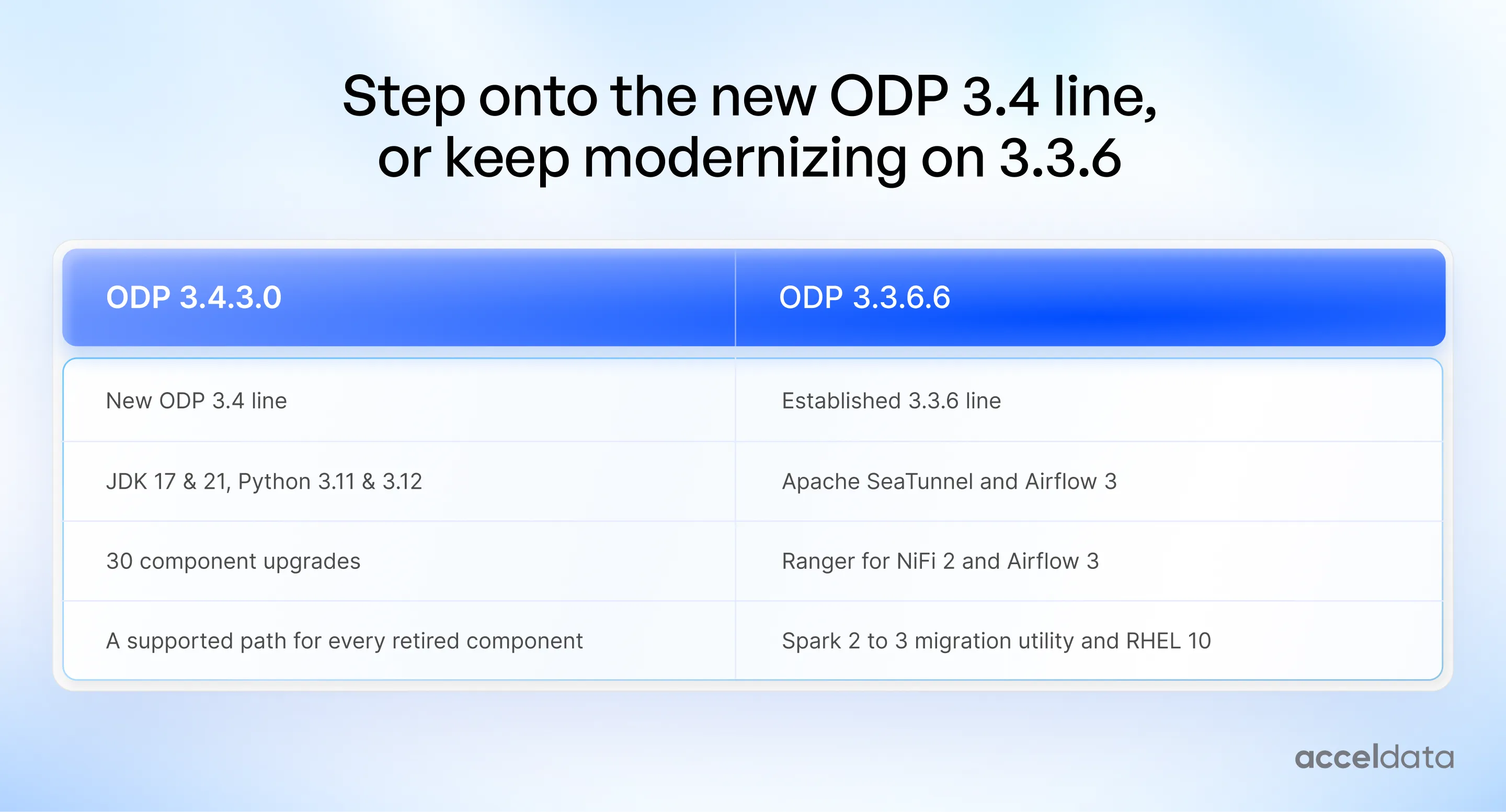
ODP 3.4.3.0 introduces the new ODP 3.4 line. It adds native support for JDK 17 and JDK 21 and Python 3.11 and 3.12, upgrades 30 components across the stack (including Hadoop 3.4.3, Airflow 3.2.2, Flink 2.2.1, Trino 481, and Ranger 2.9.0), integrates Apache SeaTunnel, and gives every retired component a supported path forward.
ODP 3.3.6.6 brings key new capabilities to the established 3.3.6 line: Apache SeaTunnel, Apache Airflow 3 alongside Airflow 2, Ranger governance for NiFi 2 and Airflow 3, MLflow authentication and RBAC, a Spark 2 to Spark 3 migration utility, and RHEL 10 support.
Together, these releases resolve more than 5,600 CVEs and give teams a choice: step onto the next-generation platform now, or keep modernizing on the line they already run.
Two Paths Forward with ODP
Part A: ODP 3.4.3.0
Start the next generation of ODP
ODP 3.4.3.0 is the first release of the ODP 3.4 line, engineered for next-generation infrastructure, unified data integration, and enterprise-grade security.
Recent releases added capabilities on top of an established foundation. ODP 3.4 refreshes the foundation itself: the runtimes, the core storage and compute layer, and the set of components the platform is built around. It also carries forward recent additions from the 3.3.6 line, including Spark 4, Spark Connect, Apache Celeborn, Apache Superset, and Kafka 4.
For a closer look at the most recent 3.3.6 capabilities, read the ODP 3.3.6.5-1 release blog.
Run on modern runtimes
ODP 3.4.3.0 adds native support for both long-term support Java runtimes, JDK 17 and JDK 21.
Support for both Python 3.11 and 3.12 lets teams run ODP on the Python version that fits their environment.
Runtime support often decides how long a platform can stay current. Older Java and Python versions narrow the libraries teams can use, complicate security reviews, and create friction with the rest of the enterprise software estate.
The release also extends database support to PostgreSQL 16 and 17, MariaDB 11.1 through 11.4, and Oracle Database 23c and 23ai, so the platform keeps pace with the databases organizations already standardize on.
Modernize the core with Hadoop 3.4.3
Hadoop sits at the core of ODP, so keeping it current benefits much of the platform.
The release upgrades Apache Hadoop from 3.3.6 to 3.4.3, bringing in 2,046 Apache JIRA fixes.
It adds Observer NameNode support for Router-Based Federation, helping large federated clusters handle read-heavy workloads, and moves the S3A connector to AWS SDK v2 for cloud object storage access.
For teams running large production clusters, these fixes and the move to AWS SDK v2 keep the core stable and cloud storage access on a supported footing.
Modernize real-time streaming and processing
Streaming platforms carry some of the most time-sensitive workloads in the enterprise, and their architecture is changing. Kafka is moving away from ZooKeeper, and Flink is separating state from compute.
Apache Kafka 3.9.2 (from 3.7.2) adds zero-downtime ZooKeeper-to-KRaft migration tooling, a dynamic KRaft controller quorum, and dynamic ZSTD and LZ4 compression controls.
Moving off ZooKeeper is a major operational change for any Kafka deployment. Kafka 3.9.2 lets teams make that move on the familiar Kafka 3 line, ahead of Kafka 4. Teams ready to go further can choose KRaft-native Kafka 4 instead.
Apache Flink 2.2.1 (from 1.19.1) introduces disaggregated state management with ForSt, which keeps streaming state on remote distributed file systems or object storage with local caching. Flink SQL also gains ML_PREDICT and materialized tables.
Separating state from compute makes large stateful jobs easier to scale, while ML_PREDICT brings model inference directly into streaming SQL.
Build a faster, more open lakehouse
Open table formats such as Iceberg are most useful when every engine can work with the same tables. ODP 3.4.3.0 strengthens that support across its query engines.
Trino 481 (from 472) supports Iceberg v3 tables and Lakehouse connectors, with native cloud storage file systems that avoid legacy Hadoop overhead. Impala 4.5.0 (from 4.4.1) adds native Iceberg MERGE INTO for row-level changes and improves catalog metadata caching. ClickHouse 26.3 LTS brings lightweight UPDATEs for MergeTree tables, Iceberg support, and schema evolution.
On the storage side, Apache Ozone 2.2.1 (from 2.1.0) delivers 914 new features, improvements, and fixes, including erasure coding and Storage Container Manager (SCM) performance improvements.
Together, these updates let teams apply row-level changes, use open table formats, and run real-time analytics, without tying their data to a single processing engine.
Orchestrate and integrate data in one place
Pipelines often depend on a patchwork of tools: one to schedule work, another to bulk-load data, and others for streaming ingestion and change data capture. Each adds its own interface, upgrade cycle, and security model.
Apache Airflow 3.2.2 (from 2.8.3) brings a new React UI and API server, native DAG versioning, and asset-aware scheduling. Teams get a clearer record of how pipelines change over time, and can trigger work when the data it depends on is ready rather than on a fixed clock.
Apache SeaTunnel 2.3.13 is now natively integrated for unified batch, streaming, and change data capture (CDC) synchronization across diverse sources. Instead of stitching together separate tools for bulk loads, streaming ingestion, and CDC, teams can handle all three with a single engine managed inside ODP.
Extend governance to dataflows and machine learning
Governance is only as strong as its biggest gap. Dataflows and machine learning experiments without proper access controls create blind spots for security and compliance teams.
Apache Ranger 2.9.0 (from 2.5.0) moves to Tomcat 9.x, adds an authz-remote library for thin-client plugin integration, and expands the service configuration UI.
ODP 3.4.3.0 also adds Ranger plugin support for NiFi 2 and NiFi 2 Registry, bringing centralized Ranger authorization to NiFi 2 dataflows. This enterprise security capability is not yet available in upstream Apache NiFi 2.x.
MLflow 3.16.0 (from 3.1.0) adds support for MLflow authentication and role-based access control (RBAC).
The result: NiFi 2 dataflows come under the same Ranger policies as the rest of the data estate, and ML experiments gain access controls of their own.
Retire legacy components with a supported path forward
A new release line is also the right moment to simplify. ODP 3.4 deprecates several legacy components, and every one of them has a fully supported replacement within ODP.
For orchestration and ingestion, Oozie gives way to Airflow 3.2.2, and Sqoop gives way to Apache SeaTunnel, which handles batch, streaming, and real-time CDC in a single engine. ODP documentation includes guidance for converting Oozie workflows into Airflow DAGs.
For streaming and dataflows, Kafka 2 moves to Kafka 3.9.2 or KRaft-native Kafka 4, and NiFi 1.x moves to NiFi 2.8.0, with Python processors, a Git-based flow registry, and a modern Jetty 12 and Spring 7 runtime. ODP documentation includes upgrade tooling for moving NiFi 1.x flows to NiFi 2.
For analytics, notebooks, and storage, Druid is replaced by Pinot 1.5.1 for real-time OLAP with upserts and multi-stage joins, and by ClickHouse 26.3 LTS for columnar analytics. Zeppelin gives way to multi-user JupyterHub 5.5.0, and Ozone 1.x gives way to Ozone 2.2.1.
This leaves teams with a cleaner, more current stack to operate, and a clear destination for every workload that depends on a retired component.
Part B: ODP 3.3.6.6
Bring new capabilities to the 3.3.6 line
Not every team is ready to move to a new major release line, and they should not have to wait for the capabilities that matter most.
ODP 3.3.6.6 strengthens ingestion, governance, and analytics on the established 3.3.6 line. It brings several headline additions from ODP 3.4, along with new migration tooling and expanded OS support. It builds on ODP 3.3.6.5-1, which introduced Kafka 4.3.0, Hive 4.1.0, Iceberg V3, and expanded Ranger governance.
Unify data integration with SeaTunnel
Apache SeaTunnel 2.3.13 arrives on the 3.3.6 line, natively integrated for unified batch, streaming, and CDC data synchronization across diverse sources.
Teams can consolidate their ingestion patterns onto a single engine today, without first moving to a new release line.
Run Airflow 3 alongside Airflow 2
ODP 3.3.6.6 includes Apache Airflow 3.2.2 alongside Airflow 2.8.3. Airflow 3 brings a new React UI and API server, native DAG versioning, and asset-aware scheduling.
Shipping both versions side by side means existing DAGs keep running while teams adopt Airflow 3 at their own pace. Native Ranger authorization for Airflow 3 brings Airflow 3 under centralized Ranger access policies.
Extend governance to NiFi 2 and MLflow
The release adds Ranger plugin support for NiFi 2 and NiFi 2 Registry, bringing centralized authorization to NiFi 2 dataflows on the 3.3.6 line. This enterprise capability is not yet available in upstream Apache NiFi 2.x.
MLflow 3.16.0 (from 3.1.0) adds multiple bug fixes, plus MLflow’s built-in authentication and RBAC, now managed through Ambari.
Together, these changes close governance gaps for dataflow and machine learning teams.
Speed up real-time analytics with Pinot 1.5.1
Apache Pinot 1.5.1 (from 1.4.0) improves query performance and flexibility through Multi-stage Query Engine enhancements, better joins and aggregations, optimized upsert and deduplication, and advanced indexing.
These improvements matter most for teams running real-time analytics with complex joins, upserts, and deduplication.
Move Spark 2 workloads forward
A new Spark 2 to Spark 3 migration utility helps move existing workloads to Spark 3. It covers Scala applications built with sbt, Java applications built with Maven, and PySpark applications, with a step to review and validate changes before applying them.
Spark 2 code often lingers because migration is tedious and risky. A guided utility reduces that effort and makes it easier to retire Spark 2.
For teams looking to get more from Spark, see how Gluten + Velox improved query speed and resource efficiency in performance tests, detailed in Acceldata’s Spark performance whitepaper.
Expand platform support
ODP 3.3.6.6 extends OS support to RHEL 10, which requires Python 3.12 and JDK 17.
The release also completes the previously announced removal of Ozone 1.x. ODP 3.3.6.6 runs Apache Ozone 2.1.0 through an improved Ozone service management pack.
Strengthen Security Across the ODP Stack
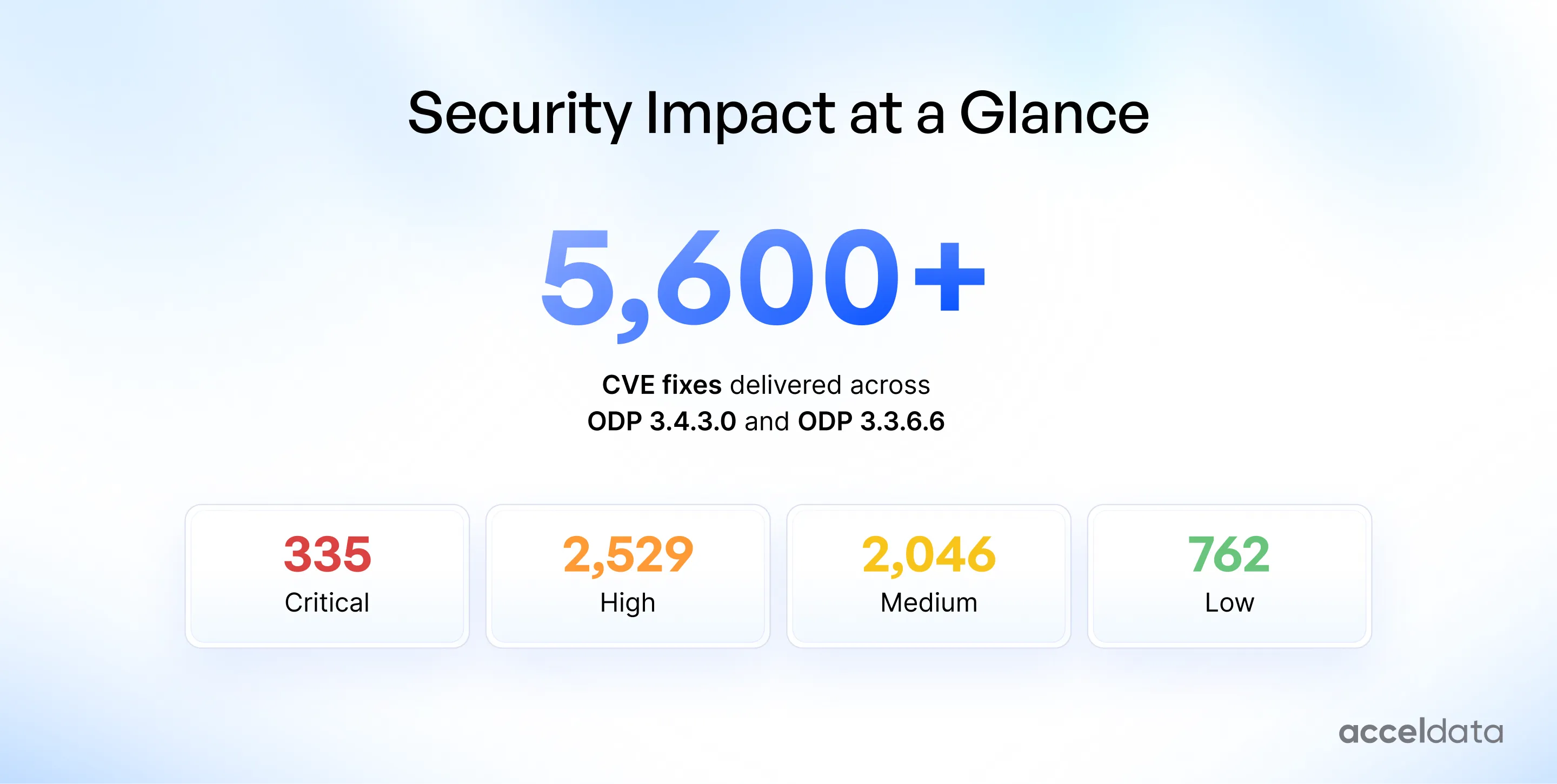
Together, ODP 3.4.3.0 and ODP 3.3.6.6 deliver more than 5,600 CVE fixes: 2,411 in ODP 3.4.3.0 and 3,261 in ODP 3.3.6.6. That includes 335 Critical and 2,529 High severity fixes, reinforcing security across both release lines.
Modernize on the path that fits your environment
The latest releases give teams two ways to keep moving forward.
Teams ready for the next generation can adopt ODP 3.4.3.0 for modern Java and Python runtimes, a refreshed Hadoop core, 30 upgraded components, and a simpler stack with a supported replacement for every retired component. Documented upgrade paths are available from both the 3.3.6 and 3.2.3 lines.
Teams staying on the 3.3.6 line can adopt ODP 3.3.6.6 to add SeaTunnel, Airflow 3, broader Ranger governance, MLflow access controls, Spark 2 migration tooling, and RHEL 10 support.
Beyond individual releases, Acceldata ODP provides an open-source foundation for Hadoop modernization with flexible deployment across on-premises, cloud, hybrid, and Kubernetes environments. ODP also supports in-place, sidecar, and forklift migration approaches, so modernization can align with existing infrastructure, workloads, and business requirements.
This gives organizations a practical way to adopt modern capabilities, retire aging components, preserve existing data and application investments, and stay in control of how their platform evolves.
Learn more about Acceldata Open Data Platform
Learn more
For complete technical details, enhancements, fixes, and upgrade guidance, see the release notes for ODP 3.4.3.0 and ODP 3.3.6.6.
Book a free consultation to see how ODP fits your environment and supports your modernization roadmap.