


Key Takeaways
- Sovereign data requires consistent governance as data and workloads cross cloud boundaries.
- Identity, storage, compute, and catalog boundaries are common points where centralized enforcement breaks.
- Cross-cloud data movement can create new sovereignty risks and cloud egress costs.
- AI sovereignty must extend across data used for training, fine-tuning, retrieval, and inference.
- Multi-cloud adoption is growing faster than many organizations can coordinate governance across environments.
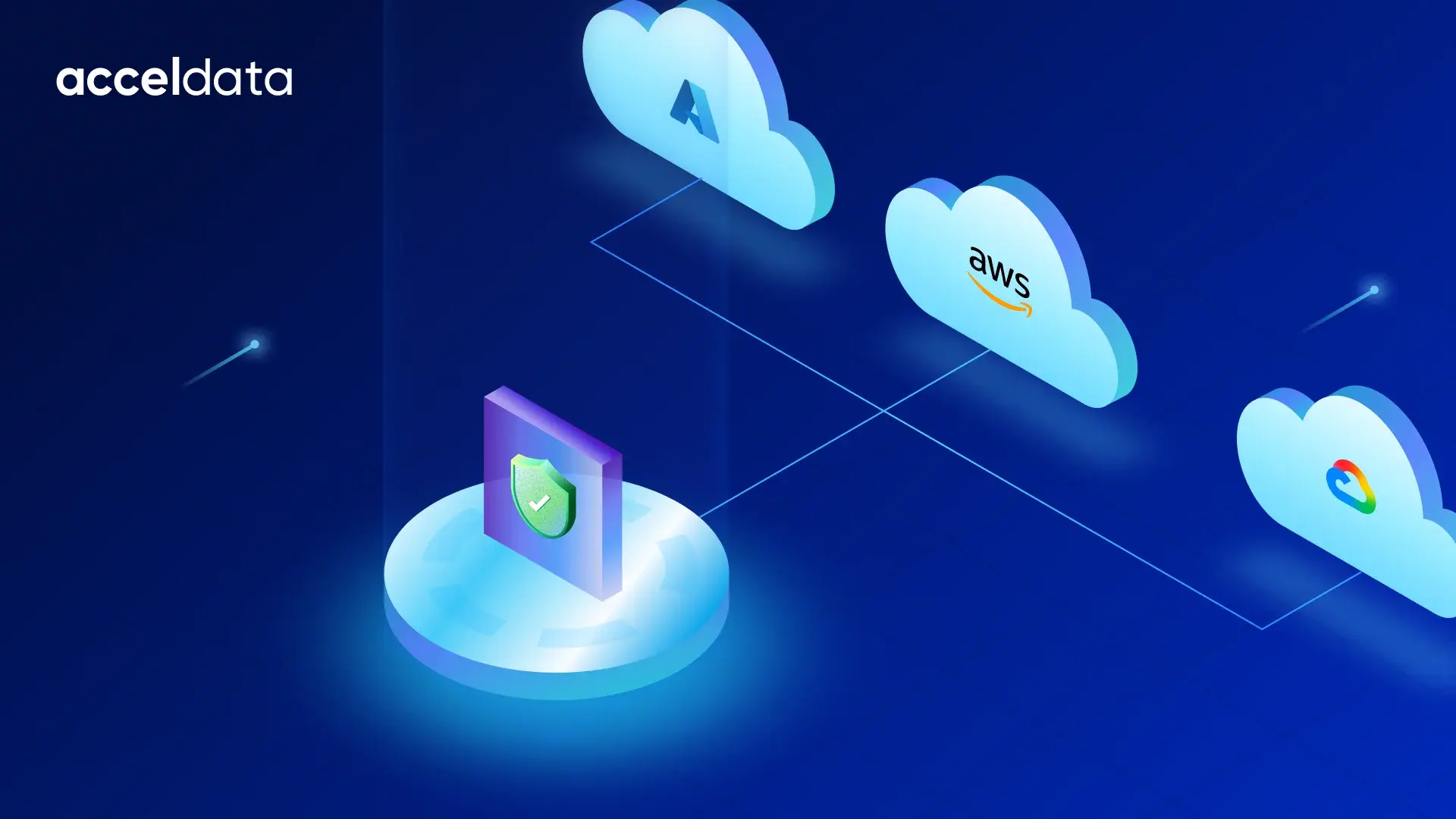
Your AI workload trains on data in AWS, calls a model in Azure, and retrieves context from GCP, and each cloud enforces its own controls over that sovereign data. But can you prove those controls still hold once data and workloads cross cloud boundaries?
Keeping sovereign data under control takes more than meeting residency rules in each environment.
A multi-cloud data sovereignty strategy needs consistent governance, controlled data movement, and runtime visibility across the entire workflow, plus an architecture that brings processing to governed data wherever possible instead of repeatedly moving sensitive data to the compute.
What Does AI Data Sovereignty Mean Across a Multi-Cloud Environment?
AI data sovereignty means maintaining the same legal and technical control over data as AI workloads move across cloud providers. Data residency tells you where data physically sits. Data sovereignty determines who controls it, who can access it, and how it can be used or moved.
For AI workloads, that boundary extends beyond source data. Sovereign AI data governance must account for:
- Training and fine-tuning data
- Prompts and retrieved context
- Embeddings and vector indexes
- Inference outputs
- Logs and telemetry
This matters because a data governance gap can travel downstream into an AI decision or autonomous action.
Why Does Centralized Governance Break Down Once Data Spans Multiple Clouds?
Centralized governance breaks down because a single policy engine or catalog cannot enforce identical controls once identity, storage, compute, and cataloging systems differ from cloud to cloud.
That is why centralized governance hits a multi-cloud ceiling: one place to define policies does not guarantee those controls work across architectures that were never built to share them.
The gaps typically appear in the following places:
- Identity: AWS IAM, Microsoft Entra ID, and Google Cloud IAM use different authorization models, so mapping users and roles across them can create access and audit gaps.
- Storage: Policies tied to one storage service do not automatically carry over when data moves to another cloud.
- Compute: A new engine can fall outside governance coverage if the existing tool cannot enforce policies there.
- Catalog: A central catalog may show where data exists without extending the same policy enforcement to every environment.
Residency adds another complication, since cloud regions do not always map neatly to jurisdictional requirements, which can leave teams managing policy exceptions and approvals manually.
Why Do Governance Policies Enforce Inconsistently Across Cloud Boundaries?
Governance policies enforce inconsistently across cloud boundaries because AWS, Azure, and GCP interpret access, storage, and compute through different mechanisms, so the same policy may be enforced correctly in one cloud but only partially in another.
The following gaps commonly create that inconsistency:
- Fragmented visibility: Per-cloud monitoring can miss what happens when data crosses from one environment to another.
- Different enforcement models: A control available in one cloud may require different configurations or have no direct equivalent elsewhere.
- Lineage gaps: Transfers between storage systems, catalogs, and compute engines can interrupt the metadata needed to track where governed data came from and where it went.
- Identity inconsistencies: Users and service accounts can receive different permissions when identities and roles are mapped between providers.
This is where runtime governance becomes important. Defining an EU residency policy centrally is only the starting point. The policy must also be evaluated when a workload queries, transforms, or moves that data. Otherwise, governance policies can lose consistency across cloud boundaries even when every cloud started with the same requirement.
How Does Cloud Egress Pricing Undermine a Multi-Cloud Sovereignty Strategy?
Cloud egress pricing undermines a multi-cloud sovereignty strategy by taxing exactly the data movement that keeping workloads distributed requires, and every transfer reopens a governance boundary that access, residency, and policy controls have to cover again.
Consider a common pattern: governed data lives in Cloud A while the compute to process it runs in Cloud B. Moving the data creates a cross-cloud transfer, introducing both an egress charge and another point where governance must be enforced.
Repeating this across workloads is why cloud egress costs are the hidden tax on your data strategy. The architectural question, then, is whether the data needs to move at all. Moving compute closer to governed data can reduce unnecessary transfers while keeping processing closer to the data's existing governance boundary.
This also cuts two common sources of infrastructure overhead: lock-in costs that make moving workloads harder, and placement that leaves workloads running where the stack lives rather than where cost and policy suggest they belong.
Why is Multi-Cloud Adoption Outpacing Governance Maturity at Most Enterprises?
Multi-cloud environments often grow faster than the governance around them. A merger introduces another provider, application teams choose different clouds, or existing workloads remain where they were originally built.
Multi-cloud environments oftenbecome more complex over time when organizations go through mergers, inherit infrastructure from earlier technology decisions, and manage applications across separate teams. This ensures businesses end up managing multiple cloud platforms that were not originally designed to work together.
As the environment expands, governance has more boundaries to cover:
- Identities and permissions differ between providers.
- Data and workloads can move across jurisdictions.
- Lineage must continue across separate platforms.
- Policies need consistent enforcement wherever AI workloads run.
The sovereignty challenge is already evident. IBM’s 2026 study of 1,000 senior executives found that 68% consider meeting data residency and sovereignty requirements across geographies challenging.
The same gap shows up inside individual enterprises, too. A platform team can pass a compliance review in AWS, then discover months later that a newly adopted GCP service was never brought under the same policy set, because no one owned governance across the addition.
For a multi-cloud compliance strategy, governance cannot be something added after the cloud estate expands. It has to account for how data, identities, policies, and AI workloads already operate across those environments.
How Does Multi-Cloud Data Observability Support a Sovereignty Strategy?
Multi-cloud data observability supports a sovereignty strategy by giving teams the evidence to trace where data moved, where workloads ran, and what systems they interacted with across cloud boundaries, so sovereignty claims can be demonstrated rather than assumed.
A useful sovereignty audit trail brings four signals together:
- Telemetry: Shows where workloads executed and which infrastructure, services, and data systems they touched.
- Lineage: Traces source data through transformations and downstream movement, preserving visibility as data crosses clouds.
- Data quality: Shows the state of data when an AI workload consumed it, helping teams trace unreliable outputs back to underlying data issues.
- Cost visibility: Connects cross-cloud activity with provider billing, so teams can see when workload placement or data movement also creates additional costs.
Together, these signals help teams compare policy with actual behavior. A residency rule may define where customer data is allowed to go; observability provides the evidence to determine whether a pipeline, query, or AI workload actually followed that path.
Maintaining this evidence becomes harder when workloads span different environments. Multi-cloud data observability for hybrid workloads helps teams follow data and workload behavior across those boundaries instead of investigating each platform separately.
That visibility also has value beyond sovereignty audits, letting platform teams investigate reliability, performance, and cost without treating them as separate problems.
What Architecture Keeps Data Sovereign Across Multiple Clouds?
A strong multi-cloud sovereignty architecture keeps the data layer portable, runs processing close to governed data where practical, and enforces policy where workloads execute. This reduces the need to centralize sensitive enterprise data inside another vendor-controlled environment.
Five architectural choices make that possible:
1. Keep storage open
S3-compatible object storage lets organizations retain data in environments chosen for their residency, security, and operational requirements without tying storage to one compute platform.
2. Use open table formats
Formats such as Apache Iceberg separate stored data from the engines that process it, so teams can run different workloads against the same governed data without first converting it into a proprietary format.
3. Place compute based on the data
When processing can move instead of data, workload placement can account for residency, data gravity, policy, and cost, reducing unnecessary cross-cloud transfers and the governance boundaries those transfers create.
4. Enforce governance at runtime
Placement alone does not make data sovereign; policies still need to apply when workloads query, transform, or process governed data, including after execution moves to another cloud.
5. Keep processing inside the customer-controlled boundary
Zero egress means customer data and processing stay within customer-controlled cloud environments instead of routing through a vendor-managed data plane.
These layers reinforce each other: open formats preserve portability, placement reduces unnecessary movement, and runtime governance keeps policy attached to processing, giving the strategy more control over where data stays and where computation happens.
Architecture principle: Keeping data in an approved location solves only part of the sovereignty problem. The architecture also needs to keep that data portable, determine which workloads can process it, and enforce the same governance requirements wherever that processing occurs.
Acceldata applies this model through its xLake platform, a vendor-neutral, VPC-native data platform that runs xCompute as its execution layer inside customer environments, keeping storage and compute inside the customer's own network boundary.
See Acceldata's open, multi-cloud data platform architecture for how that model works across distributed environments.
Why is AI Sovereignty Only as Strong as the Data Layer Beneath It?
AI sovereignty is only as strong as the data layer beneath it because every model safeguard still depends on how well the data feeding it was governed, and no model-level control can protect data that already left a governed boundary earlier in the pipeline.
Sovereign AI data governance must therefore cover the following critical stages:
- Training: Where is training data stored and processed?
- Fine-tuning: Where are proprietary examples and resulting model artifacts retained?
- Inference: Where do prompts, retrieved context, outputs, and logs go?
The boundary extends further. Embeddings, vector indexes, telemetry, and intermediate agent state can also contain or derive information from sovereign data. This broader data layer is critical because AI is only as sovereign as the data beneath it.
As AI systems take on more actions, that connection carries greater consequences. A data issue that once affected a report can now influence a model response or autonomous action, making lineage back to the underlying data essential for tracing what happened.
Building a Multi-Cloud Data Sovereignty Strategy With Acceldata
A multi-cloud data sovereignty strategy becomes fragile whenever organizations stretch a single-cloud governance model across identity systems, storage layers, execution engines, and policy boundaries it was never built to cross.
Start with three priorities:
- Treat identity and access as cross-cloud requirements, keeping permissions consistent as users, services, and workloads move between environments.
- Measure egress exposure before creating new data paths, so you know when cross-cloud processing moves governed data or creates another control boundary.
- Require end-to-end lineage and observability that trace every environment an AI workload touches and the data it uses.
Acceldata's xLake brings compute, governance, and data quality closer to where data resides, reducing the need to centralize enterprise data or move it unnecessarily between clouds. The goal is simple: move less governed data, while keeping control wherever AI runs.
Book a demo to see how xLake supports open formats and a zero-egress architecture designed to keep data under customer control across multi-cloud environments.
AI Data Sovereignty Across Multi-Cloud Environments: Frequently Asked Questions
Does a multi-cloud sovereignty strategy require moving data out of the clouds it already sits in?
No, a multi-cloud sovereignty strategy does not necessarily require moving data out of the clouds where it already resides. Instead, it can use jurisdiction-aware controls, regional hosting, encryption, and workload placement to keep sensitive data within approved legal and geographic boundaries.
Is multi-cloud data sovereignty mainly a governance problem, or also a cost problem?
Multi-cloud data sovereignty is both a governance and cost consideration, since compliance requirements can shape where data is stored, processed, and transferred. Meeting those requirements across multiple clouds can increase costs through duplicated infrastructure, data-transfer fees, regional services, and additional monitoring and controls.
Can one governance tool secure data across AWS, Azure, and GCP without separate configurations per cloud?
A unified governance tool can provide consistent policies across AWS, Azure, and GCP, but cloud-specific configurations are still usually required for identity, permissions, encryption, and native controls. The level of centralization depends on how deeply the tool integrates with each cloud and which sovereignty requirements it needs to enforce.
Does adopting multi-cloud make AI data sovereignty harder to maintain than staying on one cloud?
Yes, multi-cloud can make AI data sovereignty harder to maintain because data, models, workloads, and processing may span different jurisdictions and provider-specific controls. A single-cloud environment can reduce that complexity, although sovereignty still depends on regional hosting, access controls, data flows, and applicable regulations.
How is data sovereignty different from data residency in a multi-cloud context?
Data residency refers to where data is physically stored or processed, while data sovereignty refers to which laws and legal authorities govern that data. In a multi-cloud environment, data can remain in a required geographic region while still being subject to another jurisdiction through the cloud provider’s legal structure or access arrangements.