



.svg)



A vendor support engineer asks for temporary access during a production issue. Your team approves it because the platform already meets your residency and compliance requirements. Hours later, you realize query logs and workload metadata were still visible outside your environment. That changes the conversation fast.
Gartner predicts 65% of governments will introduce technological sovereignty requirements by 2028. For modern AI systems, the sovereign AI data center definition goes far beyond where data is stored.
Real sovereign AI infrastructure controls who can see workloads, how processing happens, and whether anything leaves your boundary at all.
What Sovereign Data Means, and What It Doesn't
You will hear plenty of vendors say your data stays protected because it is encrypted or stored in a specific region. That is only part of the story.
The real sovereign data meaning comes down to operational control. Your team should control where AI workloads run, who can access them, what gets logged, and whether any data leaves the environment during processing.
That control usually breaks into three areas:
| Sovereignty area | What it means in practice | What it does not mean |
|---|---|---|
| Residency | Data, models, and AI workloads stay inside infrastructure boundaries you choose | Simply selecting a cloud region or a sovereign cloud provider |
| Access | Vendors, support teams, and external control planes cannot view prompts, logs, metadata, or workloads without explicit approval | Assuming encryption alone removes vendor data access risk AI concerns |
| Portability | You can move workloads and data across environments without getting locked into proprietary tooling or formats | Depending entirely on one managed platform or closed ecosystem |
This is where many sovereignty claims break down. A platform may say “data never leaves VPC,” yet still expose telemetry, query logs, or operational metadata through vendor-managed services. Real sovereign AI infrastructure depends on enforceable architectural boundaries, not policy language alone.
That is also why enterprises now review workload isolation and operational access controls as part of data sovereignty compliance efforts. For example, Acceldata's security and network compliance focus heavily on controlled connectivity and customer-managed deployment boundaries.
Why AI Workloads Raise the Sovereignty Stakes
A traditional analytics pipeline mostly works with stored datasets. AI systems behave differently. They constantly process prompts, responses, embeddings, runtime queries, and operational logs. That expands the sovereignty boundary far beyond the storage location alone.
The biggest risks appear at three stages:
- Training: Proprietary datasets may move into external processing environments during model training. That can expose customer records, internal documents, or regulated business data.
- Fine-tuning: Teams adapting foundation models on private datasets need proof the provider cannot inspect prompts, training inputs, or model interactions.
- Inference: Everyday queries often contain forecasts, financial figures, contracts, support tickets, or operational plans. Logging and telemetry can quietly create ongoing vendor data access risk AI teams fail to account for.
Why this matters for enterprise AI teams:
- Inference creates a continuous exposure surface because every interaction generates metadata, logs, and operational telemetry somewhere.
- Some AI providers retain prompts or runtime activity for monitoring, debugging, or abuse detection under specific conditions.
- Even when raw datasets stay protected, prompts, query histories, and operational metadata may still leave the control boundary.
- Modern data sovereignty compliance reviews now examine processing activity, not just where data is stored.
- Many enterprises now prefer a VPC native data platform approach to keep inference, orchestration, and telemetry closer to customer-controlled infrastructure.
This is changing how organizations evaluate sovereign AI infrastructure. Security teams increasingly ask whether prompts stay inside the environment, whether telemetry leaves the VPC, and whether vendors can inspect runtime activity during large-scale AI data analytics operations.
What a VPC-Native Architecture Actually Provides
A real VPC native data platform keeps compute, storage, and AI workloads inside the infrastructure your organization controls. The provider deploys and manages the platform, but the environment stays inside your cloud account and VPC. That changes the sovereignty model because operational access becomes restricted by architecture, not trust alone.
In practical terms, a VPC-native setup usually means:
- AI workloads run inside your VPC, not the vendor’s environment.
- No public inbound ports are required for orchestration.
- Networking and IAM policies remain customer-controlled.
- Query logs, prompts, and runtime metadata stay closer to the workload boundary.
- Exposure from cross-account telemetry pipelines is reduced.
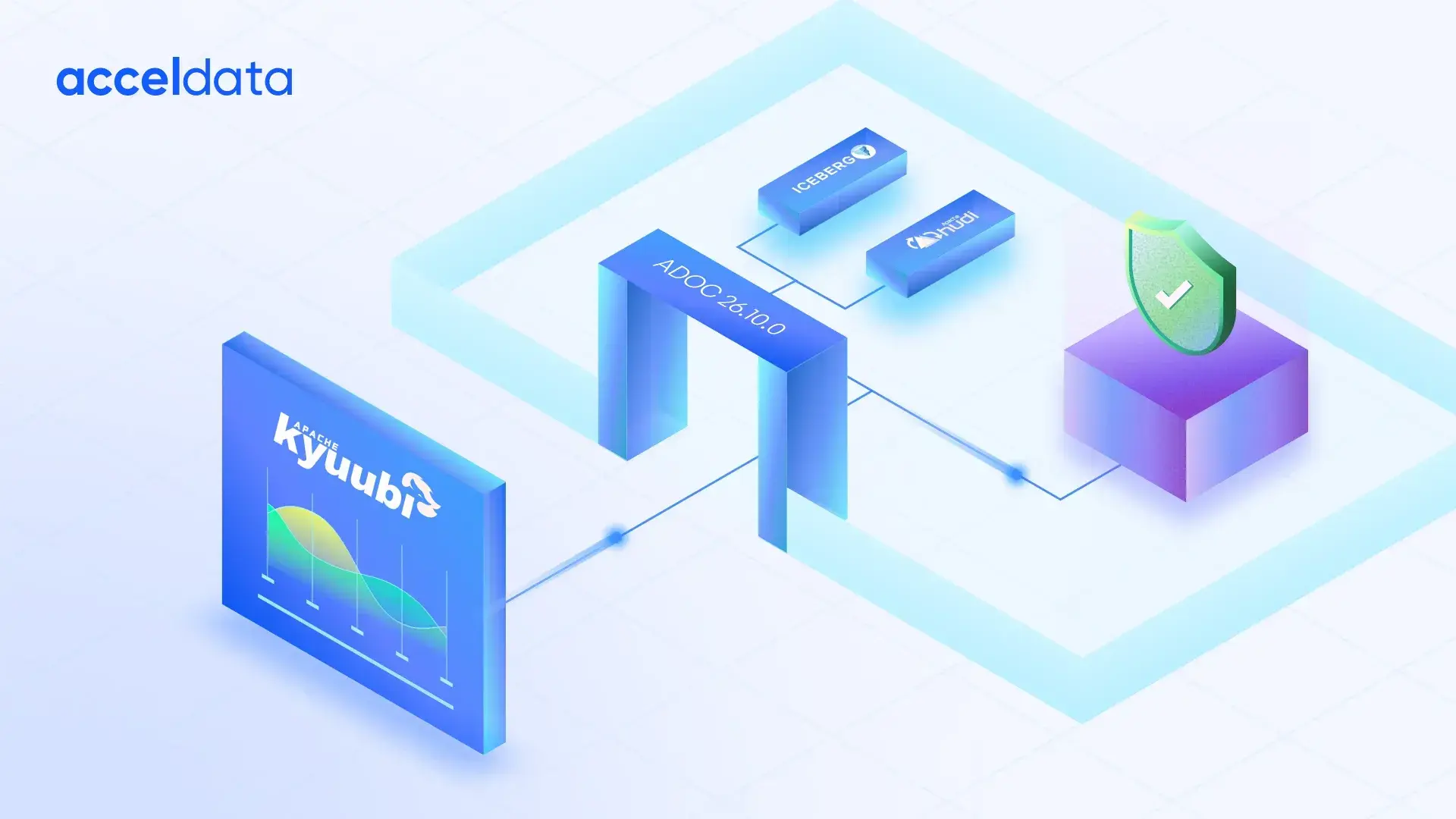
This is the approach behind ADOC architecture, where the data plane stays inside the customer’s VPC and orchestration happens through an outbound-only mTLS connection.
Building on that model, Acceldata xLake's Tunnel Client architecture keeps AI and data workloads inside customer-controlled infrastructure, without exposing inbound access to Acceldata’s control plane. That separation helps reduce ongoing vendor data access risk AI teams often struggle to verify in managed environments.
How deployment models compare:
| Deployment model | Where workloads run | What may still leave the boundary | Sovereignty posture |
|---|---|---|---|
| Managed platform | Vendor-controlled environment | Logs, telemetry, metadata, and sometimes workload activity | Lowest operational control |
| Hybrid model | Customer VPC with vendor-managed control services | Operational metadata and aggregated telemetry | Better residency control, mixed access control |
| VPC-native model | Customer account and VPC | Minimal outbound orchestration traffic when tightly enforced | Strongest control over access, telemetry, and workload boundaries |
A sovereign data platform still requires careful review of telemetry exports, support access, and IAM permissions. But a VPC-native model gives enterprises a much stronger foundation for data sovereignty compliance because the control boundary stays inside customer-managed infrastructure.
Data Sovereignty Compliance: What Regulations Actually Require
Most compliance frameworks focus on one core idea: control. Regulators want proof that your organization can govern who accessed the data, where processing happened, and how activity was audited.
But there is a catch. Meeting residency requirements alone does not guarantee sovereignty.
Here’s where major frameworks focus their attention:
- GDPR: Cross-border processing, transfer controls, and visibility into where data moves during operations.
- HIPAA: Strict access controls, audit trails, and accountability around sensitive healthcare data.
- Financial services regulations: Inspection rights, operational oversight, and the ability to audit outsourced environments end-to-end.
The enterprises are putting more attention on runtime controls inside modern AI data governance programs. AI workloads continuously generate prompts, logs, telemetry, and operational metadata during processing. Even when data stays in-region, those operational layers may still create exposure.
What regulators increasingly expect teams to demonstrate:
- Who accessed the workload
- Where processing occurred
- Whether telemetry left the environment
- How audit activity is tracked
- Whether third-party access can be restricted and verified
This is also why compliance teams preparing for SOC 2 and HIPAA readiness now review runtime infrastructure much more closely. The focus is shifting from “Where is the data stored?” to “Who can still see or process it?”
A tightly controlled VPC native data platform helps reduce those risks because workloads, telemetry, and orchestration stay closer to customer-managed boundaries. That gives enterprises a stronger operational foundation for long-term data sovereignty compliance and a more defensible sovereign data platform strategy.
Sovereign Cloud vs Private AI Cloud: What the Distinction Means
A sovereign cloud platform focuses on jurisdiction. The provider operates infrastructure under regional rules, local staffing requirements, and strict operational controls. These environments are often built for governments and heavily regulated sectors.
A private AI cloud focuses on architectural isolation instead. AI workloads run inside the customer’s cloud account, VPC, or VNet, giving enterprises more direct control over networking, access, and processing boundaries.
For most enterprise AI teams, the private AI cloud model is more practical because it works within existing cloud-native data environments.
What enterprises usually prioritize in this model:
- Customer-controlled IAM and networking
- AI inference inside approved environments
- Lower telemetry exposure
- Open formats that reduce lock-in
- Better workload isolation while optimizing data workflows
That combination gives organizations a stronger foundation for long-term sovereign AI infrastructure planning.
Sovereignty Is Not a Marketing Claim — It's a Deployment Architecture
The real sovereign AI data center definition comes down to architectural control. Can you enforce residency, restrict access, and avoid proprietary lock-in inside the actual deployment environment?
That usually requires:
- A VPC native data platform
- No inbound vendor access to the data plane
- Open formats such as Parquet, Iceberg, and Delta
- Customer-controlled governance and audit visibility
That is the model behind Acceldata xLake's VPC-native deployment and Tunnel Client architecture, where workloads stay inside customer-controlled environments.
See how xDP delivers genuine sovereign AI infrastructure. Book a demo to evaluate your current sovereignty exposure across AI workloads and telemetry.
Sovereign Data and AI Infrastructure: Frequently Asked Questions
What does sovereign data mean in the context of AI?
Sovereign data in AI means your organization retains operational control over all data in training, fine-tuning, and inference, including prompts, responses, and logs, with no third-party access without explicit, auditable, customer-granted authorization.
What is the difference between data sovereignty and data residency?
Data residency specifies where data is stored geographically. Data sovereignty covers who can access and operate on that data. Residency is one component of sovereignty, not a substitute for it.
What is a VPC-native data platform?
A VPC-native data platform deploys all compute and storage within the customer's cloud account and VPC. The platform provider orchestrates workloads through an outbound-initiated connection without requiring inbound access to the data plane.
What is the difference between a sovereign cloud and a private AI cloud?
Sovereign cloud applies jurisdictional and operational constraints to a cloud provider's operations. Private AI cloud gives the enterprise architectural control within a public cloud VPC, providing sovereignty through isolation rather than jurisdictional governance.
How does xDP's architecture deliver data sovereignty?
xDP deploys within the customer's VPC. Acceldata's control plane communicates through an outbound-initiated connection that enables workload orchestration without requiring standing inbound access pathways into your data environment.