




.svg)



A year ago, companies raced to get access to the best AI models. Now, most enterprises can use the same models through the same APIs. The real gap is forming somewhere else, within the proprietary data those models learn from and the infrastructure that controls it.
That is one reason sovereign cloud spending keeps rising. Worldwide spending on sovereign cloud IaaS will reach USD 80.4 billion in 2026 as companies push for more digital independence.
For you, enterprise data sovereignty now decides how securely you handle AI model training data and how hard your AI advantage is to copy.
Why Model Capability Is No Longer the Differentiator
The performance gap between top foundation models is shrinking fast. Stanford’s 2026 AI Index found that leading models now sit within 25 Elo points on the LMSYS Chatbot Arena leaderboard, a benchmark based on real user preferences. For enterprise teams, that changes the competitive equation. Access to a strong model is becoming easier to buy.
What is harder to replicate is the proprietary context behind it. Your customer behavior, operational history, internal processes, and industry knowledge create a stronger data moat than model access alone.
But proprietary data only stays valuable when you control how it moves through AI systems.
The next AI leaders will not win because they found a slightly better model. They will win because they protected the proprietary data, making those models useful in the first place.
What Proprietary Data as a Competitive Moat Actually Requires
Proprietary data only becomes a real competitive moat, data sovereignty, and AI advantage when it stays exclusive to your business. Many enterprises lose that exclusivity without realizing it.
Their fine-tuning datasets, embeddings, prompts, and model artifacts still pass through infrastructure they do not fully control.
That creates a gap between owning data and actually protecting it. To keep proprietary AI data exclusive, you need infrastructure controls that stay inside your own boundaries:
- VPC/VNet-native processing keeps AI workloads inside the infrastructure your team governs directly.
- Single-tenant execution reduces the risk of sensitive workloads sharing compute environments with other organizations.
- Open formats like Apache Iceberg make it easier to move data and AI pipelines without rebuilding them around one vendor’s stack.
- Strong AI data governance practices help you track lineage, prompts, outputs, and access across AI systems.
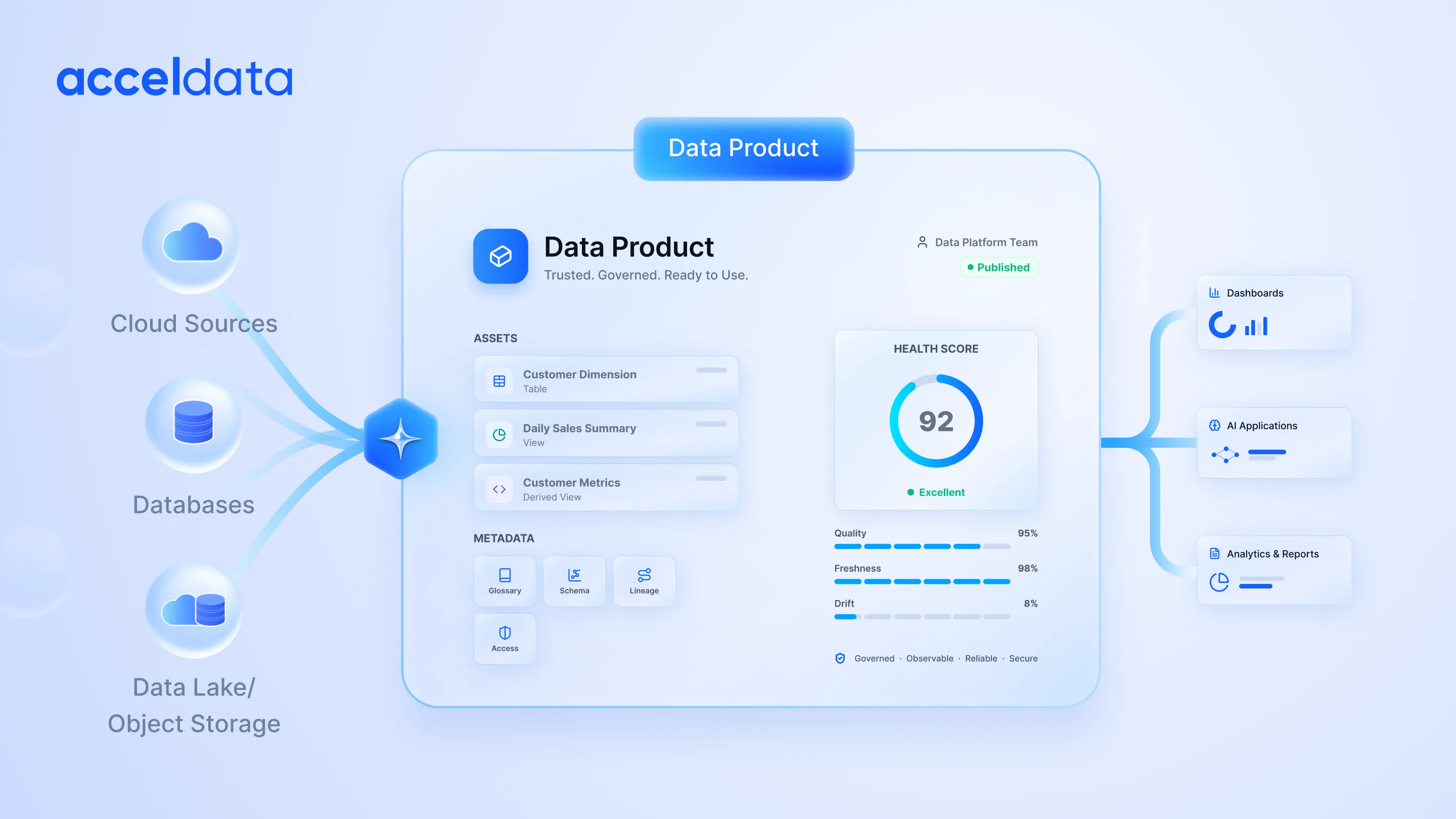
Those controls become more important as enterprises scale, fine-tuning and retrieval workflows across clouds. Acceldata’s xLake platform architecture supports that model through VPC-native deployment, single-tenant execution, and open-format data infrastructure designed to avoid proprietary lock-in.
That gives teams tighter control over how proprietary AI data moves, trains, and stays governed across environments. Without those controls, enterprise data sovereignty becomes difficult to enforce in practice, especially as AI workloads grow more distributed.
Fine-Tuning on Proprietary Data: The Sovereignty Risk Most Teams Miss
Fine-tuning changes the sovereignty conversation completely. During inference, your model responds to data. During fine-tuning, your proprietary customer records, operational workflows, pricing logic, and internal knowledge help shape the model itself. Many enterprises still run those workloads on infrastructure they do not fully control.
Fine-tuning data sovereignty depends on more than access controls alone. Teams also need visibility into datasets, lineage, and model artifacts across AI workflows, especially as autonomous systems scale.
Discussions around agentic AI governance compliance increasingly focus on those governance gaps, while systems like Acceldata’s Discover Assets page help teams track governed AI assets across environments. Without those controls, AI training on proprietary data security becomes harder to maintain at scale.
Multi-Cloud Data Sovereignty: Why Single-Cloud Dependency Is a Strategy Risk
Many AI workloads look portable until teams try moving them. Then the dependencies appear: provider-specific storage, governance tooling, orchestration layers, and training pipelines that do not transfer cleanly across environments.
That weakens multi-cloud data sovereignty and limits long-term flexibility. Portable AI infrastructure usually depends on three decisions:
- Open table formats like Apache Iceberg so datasets remain readable across engines and clouds.
- Kubernetes-native compute, so pipelines move across on-prem and public cloud environments with minimal rewrites.
- Governance controls that work consistently outside one provider’s ecosystem.
The push toward portable cloud-native data architectures reflects that shift. Enterprises want an AI infrastructure they can move, govern, and scale without rebuilding workloads around one vendor’s stack.
Deployment consistency matters too. Kubernetes-based orchestration approaches, including patterns similar to Pulse Kubernetes-based deployment, help teams standardize AI execution across distributed environments instead of redesigning pipelines cloud by cloud.
LLM Training Data Compliance: The Regulatory Dimension of Data Sovereignty
AI training data is now part of the compliance conversation, not just the infrastructure conversation. Regulations like GDPR, CCPA, and HIPAA increasingly apply to how enterprises collect, process, retain, and remove data used in AI systems.
For example, GDPR’s right to erasure requires organizations to identify and delete specific personal records when requested. That becomes difficult once data spreads across training datasets, feature stores, embeddings, and downstream AI pipelines.
For enterprise teams, LLM training data compliance usually depends on three capabilities:
- Clear lineage tracking to identify where sensitive records entered AI workflows.
- Access controls that limit how training datasets move across systems.
- Dependency tracing to understand which downstream assets used that data.
Financial services and healthcare environments face even tighter oversight because regulated data may appear inside fine-tuning pipelines or retrieval systems.
That’s the reason governance and auditability are becoming core parts of enterprise AI data sovereignty solutions. Workflows built around a stronger AI data governance process make it easier to manage deletion requests, access reviews, and policy enforcement across AI systems.
Visibility also matters at the pipeline level. Systems where Acceldata's platform supports column-level lineage and dependency tracing give teams a clearer view into how sensitive records move through training and inference workflows.
The AI Advantage Is in the Data. Sovereignty Is How You Keep It
Foundation models are getting easier to access. Proprietary enterprise data is not. Long-term AI advantage will come from how well you govern, protect, and use that data across training, fine-tuning, and inference workflows.
That requires VPC-native processing, isolated execution environments, open formats, and lineage strong enough to support auditability at scale.
Acceldata’s xLake platform, built on the x-Lake architecture, supports that foundation through sovereign infrastructure for governed AI workloads. If enterprise data sovereignty becomes the deciding factor in AI strategy, the infrastructure underneath it matters just as much.
Book a demo to see how xLake supports sovereign AI infrastructure across clouds and pipelines.
Data Sovereignty and the AI Race: Frequently Asked Questions
Why is data sovereignty important for enterprise AI strategy?
As model capabilities converge, the durable AI advantage shifts to proprietary data. Enterprise data sovereignty preserves that data's exclusivity, ensuring your training assets remain a competitive moat no competitor can access or replicate.
What is the risk of fine-tuning AI models on a managed platform?
Managed platforms may have access to fine-tuning datasets or model artifacts depending on their architecture. Separately, fine-tuned weights can encode sensitive training data, making them vulnerable to membership inference and extraction attacks.
What does multi-cloud data sovereignty mean for AI?
Multi-cloud data sovereignty means your training data and pipelines are portable across cloud environments, enabled by open formats like Iceberg and Kubernetes-native compute rather than proprietary vendor dependencies.
How does GDPR affect AI training data compliance?
GDPR's right to erasure requires identifying and removing personal data from training datasets and downstream copies. Achieving LLM training data compliance at scale demands lineage and provenance practices that most AI pipelines do not maintain.
What does a competitive moat based on data sovereignty look like in practice?
Proprietary data processed in your VPC, stored in open formats, with full lineage tracking and access controls ensuring no external party can access your training datasets or model artifacts.


.png)