


Key Takeaways
- Multi-cloud cataloging and classification are common, but consistent policy enforcement across clouds is the harder test.
- Buying a commercial platform typically shortens deployment compared with the many months an in-house build can take.
- A platform that only flags a violation still leaves the fix to a person, so detection alone does not amount to enforcement.
- A genuinely multi-cloud platform applies one policy definition across every cloud and engine without forcing data or workloads onto a new platform.
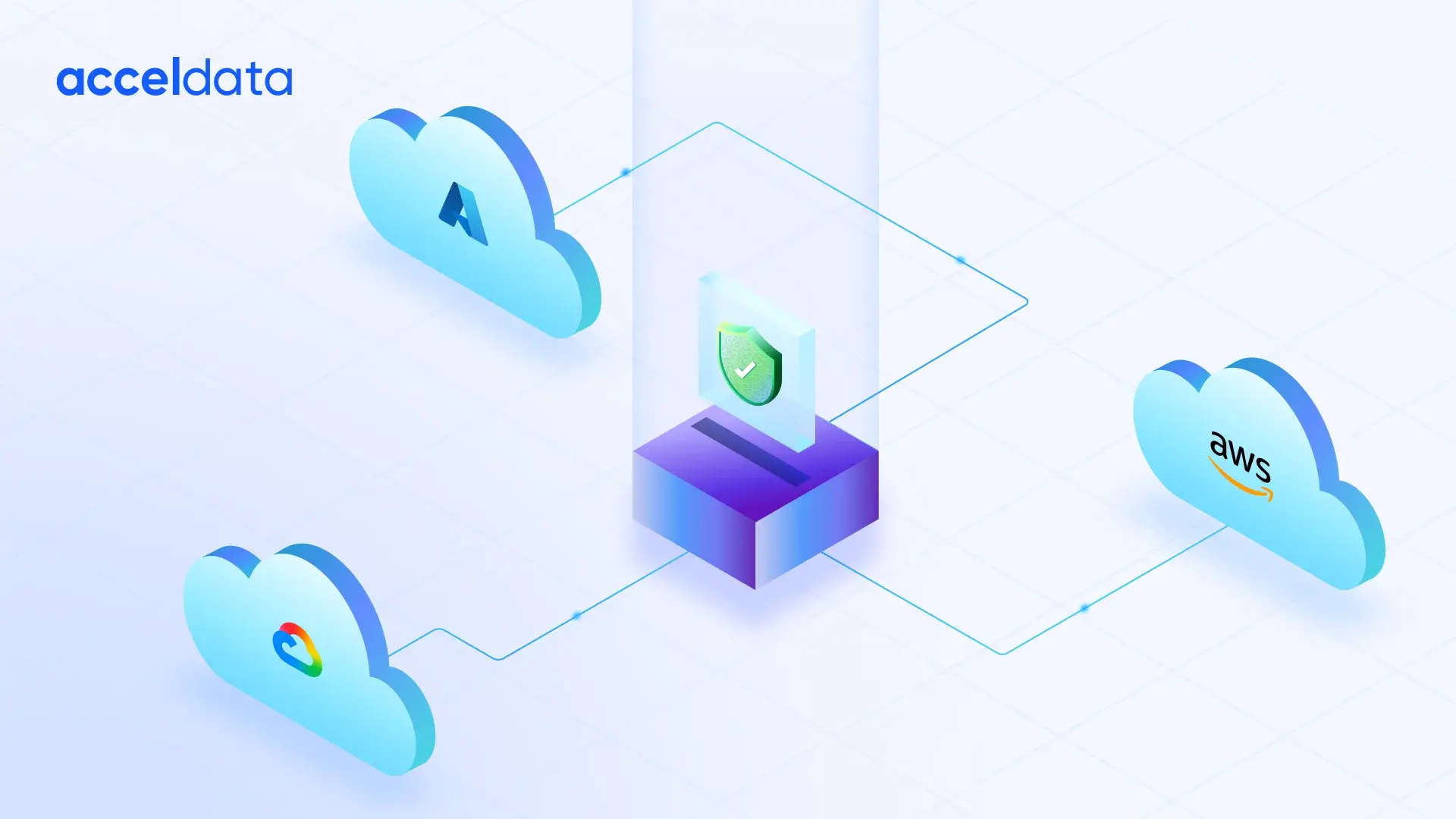
In a vendor demo, data governance platforms for multi-cloud estates can look remarkably similar, with catalogs, lineage, classifications, and policy controls all checking the right boxes. The shortlist separates when the same policy must work across AWS, Azure, and GCP without being recreated for each environment.
A platform may identify sensitive data everywhere yet enforce access, masking, or residency rules differently in each cloud. Buyers should look beyond policy visibility and ask a harder question: will the same policy produce the same outcome wherever the data runs?
What Makes a Data Governance Platform Genuinely Multi-Cloud Rather Than Multi-Cloud in Name Only?
A data governance platform is genuinely multi-cloud when one policy definition produces the same enforcement outcome on every cloud and engine it covers, while a platform that is multi-cloud in name only governs its own ecosystem well and treats the rest as connectors.
Platform-native tools are typically optimized for single-platform estates, so connecting to AWS, Azure, and GCP only counts if the same policy behaves identically in each. The same boundary appears in how Acceldata extended Apache Ranger governance to Amazon S3, where Ranger policies were compiled into native bucket rules instead of an agent that Ranger's Hadoop-oriented design could not reach.
Discovery shows where governed data exists, and policy definition sets what should happen to it, but only runtime governance applies those controls as data moves.
Three tests separate the two: whether one policy yields consistent outcomes across clouds, whether on-premises infrastructure needs separate policy logic, and whether federated queries can bypass the governance layer.
10 Questions You Should Ask Before Buying a Data Governance Platform for a Multi-Cloud Estate
Ask every vendor 10 questions covering cross-cloud policy consistency, native coverage, lineage continuity, enforcement points, automation, compliance support, production scale, support and roadmap, three-year cost, and buy-versus-build, and ask for proof wherever a claim can be demonstrated.
A vendor can check every box for cataloging, lineage, and access controls yet still struggle to apply them consistently, so these questions test how governance behaves in your actual environments:
- Cross-cloud consistency: Can you enforce the same masking policy identically on workloads in two different clouds, shown live rather than described?
- Native coverage: Which catalogs, engines, storage systems, and query layers are supported natively, and where will custom connectors add engineering overhead?
- Lineage continuity: How do lineage and metadata stay connected when data crosses clouds instead of disappearing at the boundary?
- Enforcement point: Where are access controls enforced during execution, and can workloads bypass them?
- Automation: Which governance actions are automated, and which are only flagged for someone to fix?
- Compliance coverage: Which requirements, such as GDPR, HIPAA, SOC 2, and CCPA, does the platform support, and how much evidence must your team manage separately?
- Proven scale: What volume of assets, policies, queries, and workloads has the platform handled in production?
- Support and roadmap: What support model applies, and which AI capabilities exist today rather than on a roadmap?
- Three-year cost: What will licensing, implementation, integrations, professional services, and administration cost over three years?
- Buy versus build: How does buying compare with owning integrations, policy updates, and cross-cloud consistency internally?
These questions adapt the broader 10 questions to ask before buying a data governance platform into concrete tests for a multi-cloud estate.
Should You Buy or Build a Data Governance Platform for a Multi-Cloud Estate?
Buying is the better choice for most enterprises running a growing multi-cloud estate, and building makes sense only for organizations with a dedicated platform team and a multi-year runway to maintain it.
The tradeoff shows up well beyond initial implementation, and the timeline row below follows the figures in purchase vs. build: a practical guide to data governance platforms:
Building is especially hard to justify across a multi-cloud estate, because every added cloud, engine, identity system, and policy surface becomes an integration the team must keep aligned long after the first release.
What Operational Gains Should You Expect From a Multi-Cloud Data Governance Platform?
A multi-cloud data governance platform delivers three operational gains: quality issues caught before they reach consumption, faster decisions from one trusted source of truth, and stronger collaboration through a shared governance hub.
Teams unlocking operational excellence with a data governance platform get these gains only when definitions mean the same thing in every cloud, since a customer record classified one way in AWS and governed differently in Azure leaves engineers reconciling policies and business users doubting which version to trust.
1. Quality issues caught before they travel downstream
Consistent validation across environments keeps a quality rule from disappearing when data moves to another cloud or processing engine.
A global pharmaceutical leader that gained unified visibility into more than 15,000 pipelines and 40,000 data assets achieved an 85% improvement in mean time to detection.
2. Faster decisions from one trusted source of truth
Shared definitions, lineage, and policies give teams the same context across clouds. That makes it quicker to judge whether data is ready for analytics, AI, or operational use.
3. One governance language across teams
Engineering, security, governance, and business teams can work from common policies instead of translating controls for each cloud. Exceptions then get resolved once rather than repeated in every environment.
Which Vendors Lead the Cloud Data Governance Market, and How Do They Handle Multi-Cloud?
The leading options range from catalog-first platforms such as Informatica, Collibra, Alation, and Atlan to platform-native Databricks Unity Catalog and execution-layer Acceldata xGovern, and they differ mainly in where each one enforces policy across clouds.
Gartner's first Magic Quadrant for Data and Analytics Governance Platforms, published in January 2025, evaluated 16 vendors, confirming a distinct category rather than a subset of data catalogs. Enforcement location is therefore the sharper test when comparing leading vendors of cloud data governance tools with automated compliance.
Acceldata xGovern
Acceldata's xGovern works at the execution layer, sitting between engines and data so reads, writes, and execute operations pass through the governance layer before a workload proceeds. Spark, Trino, Jupyter, and Airflow are governed through a central catalog, and identical governance policies apply across on-premises Kubernetes, EKS, AKS, and GKE in a single deployment.
Informatica
Informatica combines cataloging, automated lineage, classification, and policy management, and its Data Access Management capability adds enforcement by pushing policies into supported data platforms. The buying question is enforcement coverage: which systems in your estate can receive those controls directly, and what happens when a target falls outside that coverage?
Databricks Unity Catalog
Unity Catalog provides strong runtime controls within the Databricks ecosystem, including privileges, attribute-based access control, row filters, column masks, and workspace restrictions. For enterprises standardized on Databricks that platform-native model can simplify governance, while a heterogeneous estate should assess how much of its governance must extend to workloads running outside it.
Collibra
Collibra Protect lets teams define no-code protection standards and access rules centrally, then translates them into native controls in supported sources such as AWS Lake Formation, with enforcement at the source through masking and row-level access. Buyers should compare its current source coverage against every cloud, database, and engine in their own estate.
Alation
Alation combines its catalog, lineage, policy center, workflows, classification, and access controls, and its current positioning includes row-level access controls and dynamic masking. Buyers should ask where those controls are technically enforced across their specific platforms and whether the same policy can travel between environments without being recreated.
Atlan
Atlan provides an active metadata layer with lineage, policy management, and governance workflows, and its Policy Center monitors governed assets against compliance rules and raises incidents when they are violated. Some controls still depend on approvals, webhooks, or the connected system to grant or revoke access, so buyers should separate that orchestration from controls enforced directly when data is queried.
Can Your Agentic Data Platform Enforce Governance, or Only Detect Violations?
An agentic data platform enforces governance only when it can act on a violation while the workload is still running, and a platform that stops at flagging the violation only detects it.
Vendors often blur three separate capabilities together under the label agentic, and only the last one acts in time to prevent damage:
Teams asking can your agentic data platform enforce governance? should test the execution path itself, because autonomous systems act on data immediately and a policy checked after execution may arrive too late.
Put three filter questions to every vendor: whether the platform can act without a human approval gate, whether it reasons through workload and data context instead of applying a fixed rule, and whether it triggers on the event itself rather than on a scheduled scan.
Why Does Data Governance Tool Adoption Fail Even After You Have Already Bought a Platform?
Data governance tool adoption fails after purchase because the platform ends up as a passive dashboard beside the workflow instead of a control inside it, so engineers route around it by acknowledging alerts, querying data through another engine, or building shadow pipelines.
The loop below explains why governance tool adoption fails without active enforcement: policy exists → workload bypasses it → violation is detected → someone must remediate it → another exception appears.
Every manual handoff in that loop gives governance another chance to be delayed or bypassed. Policy creation is rarely the weak point; the gap sits between defining a policy and making workloads obey it.
See how Acceldata's xGovern closes that gap at runtime by evaluating read, write, and execute operations against policy as workloads run, which turns governance from something engineers are asked to follow into a control the execution path must pass through.
Choosing a Data Governance Platform for Multi-Cloud Environments with Acceldata
Most shortlists compare vendors on cataloging, lineage, and dashboards, which look similar, while the real test for data governance platforms for multi-cloud environments arrives when a policy must hold across a cloud boundary.
Before deciding, test each platform against the following questions:
- Can it enforce the same policy across two clouds without rewriting it?
- Does enforcement take action, or only alert someone?
- Does the buy-versus-build math include ongoing policy maintenance?
- Can you add an environment without re-platforming data or workloads?
Acceldata's xGovern applies one policy definition across engines such as Spark, Trino, Jupyter, and Airflow, with consistent deployment across cloud and on-premises Kubernetes, closing the loop on why governance tool adoption fails without active enforcement.
Book a demo and see xGovern enforce one policy across your own multi-cloud estate.
Frequently Asked Questions (FAQs)
Does a lower sticker price on a data governance platform mean a lower total cost of ownership?
No. A lower sticker price can still lead to a higher total cost of ownership once implementation, integration, maintenance, support, and the operational effort required to enforce governance are factored in.
How long does it realistically take to deploy a data governance platform across a multi-cloud estate specifically?
A multi-cloud data governance platform can take several months to deploy fully, depending on the number of clouds, data sources, policies, integrations, and teams involved. A limited rollout may take weeks, while enterprise-wide deployment typically requires 3–12 months to reach consistent governance across the estate.
Can a data catalog by itself serve as a data governance platform?
A data catalog provides visibility into data assets, but it does not by itself enforce policies, manage access, or monitor governance controls across the environment. A data governance platform typically combines cataloging with policy management, enforcement, compliance, and ongoing monitoring.
Should a highly regulated industry, like healthcare or financial services, evaluate these platforms differently?
Yes. Highly regulated industries should place greater weight on policy enforcement, auditability, access controls, lineage, and compliance coverage rather than evaluating platforms primarily on features or price.
Does adopting a multi-cloud governance platform mean replacing cloud-native tools like Unity Catalog or Microsoft Purview?
No. A multi-cloud governance platform can complement cloud-native tools such as Unity Catalog or Microsoft Purview by providing consistent policies and visibility across environments without requiring those tools to be replaced.