




.svg)


.png)
Enterprise data platforms need to keep evolving without disrupting the workloads businesses already depend on.
Streaming architectures are changing. Open table formats are becoming foundational to modern lakehouses. Data increasingly spans on-premises and cloud environments. At the same time, reliability, governance, and operational simplicity need to advance alongside new capabilities.
The latest Acceldata Open Data Platform (ODP) releases move both release lines forward.
ODP 3.3.6.5-1 advances the 3.3.6 line with Apache Kafka 4.3.0, Apache Hive 4.1.0, Apache Iceberg V3, expanded Ranger governance, Hue-Trino integration, and improvements to platform operations and upgrades.
ODP 3.2.3.7-2 and ODP 3.2.3.7-3 bring significant modernization to established environments with Hive 4.0.1, Iceberg 1.6.1 across multiple engines, NiFi Registry high availability, more granular Ranger controls, easier Mpack upgrades, improved administration, and stronger data-integrity safeguards.
Together, these releases give teams more ways to modernize without forcing every workload onto the same timeline.

ODP lets teams move forward on the path that fits their environment.
Part A: ODP 3.3.6.5-1
Advance streaming, lakehouse, and governance
ODP 3.3.6.5-1 builds on the modernization introduced with 3.3.6.4-1, which brought Spark 4.1.1, Spark Connect, Apache Celeborn, Apache Superset, NiFi 2.7.2, Ozone 2.1.0, expanded JupyterHub capabilities, broader high availability, and Kafka Tiered Storage with S3.
The latest release takes the next step across streaming, open lakehouse architectures, governance, analytics, and day-to-day platform operations.
For a closer look at the capabilities introduced in the previous release, read the ODP 3.3.6.4-1 release blog.
Modernize real-time streaming with Kafka 4.3
Real-time data increasingly powers operational analytics, event-driven applications, and high-volume data pipelines.
The release adds Apache Kafka 4.3.0, giving teams a newer streaming foundation within the integrated ODP environment.
For organizations already operating Kafka alongside Hadoop, the streaming layer can evolve with the broader data platform instead of becoming another independently managed technology silo. Teams can support newer real-time workloads while maintaining a more unified platform architecture.
Build a more open lakehouse with Hive 4.1 and Iceberg V3
Modern lakehouses depend on open data architectures that enable organizations to access, process, and analyze data across diverse engines and workloads.
With Apache Hive 4.1.0 and Apache Iceberg V3 support across the ODP stack, teams can modernize existing Hive environments while adopting newer open table format capabilities and lakehouse patterns. Iceberg V3 extends the foundation for evolving data models and richer analytical workloads while maintaining the openness and interoperability Iceberg is designed to provide across engines and implementations.
This gives organizations a practical path to modernize their lakehouse architecture while keeping data portable and accessible across engines. Teams can adopt new analytical capabilities at their own pace without tying their data strategy to a single processing engine or proprietary storage architecture.
Extend governance across hybrid environments
As data expands from Hadoop into cloud storage and modern streaming platforms, governance needs to move with it.
ODP 3.3.6.5-1 expands Apache Ranger integrations across Google Cloud Storage (GCS), Azure Blob File System (ABFS), and Kafka 4, along with more granular storage-level access controls.
This helps teams apply more consistent policies across on-premises and cloud environments while reducing disconnected authorization models across the data estate.
For a related engineering deep dive, read How Acceldata Extended Apache Ranger Governance to Amazon S3
Make modern analytics easier to access
Trino integration with Hue gives analysts and data engineers a familiar interface for interactive querying.
Bringing a modern query engine into an established workflow makes newer analytics capabilities easier to adopt without introducing another disconnected user experience.
Simplify platform operations and upgrades
Modernization also needs to make the platform easier to operate.
Improvements to Ozone management, Ambari administration, and Mpack upgrade workflows help reduce routine operational effort as environments grow and evolve.
For teams running large production clusters, simpler lifecycle management makes it easier to keep the platform current while introducing new capabilities.
Part B: ODP 3.2.3.7-2/3
Modernize established environments
Production environments often move on different timelines.
ODP 3.2.3.7-2 and ODP 3.2.3.7-3 bring meaningful new capabilities to the established 3.2.3 line, allowing teams to advance analytics, lakehouse support, resilience, governance, and operations while retaining their existing release path.
ODP 3.2.3.7-2 supports Python 2 environments, while ODP 3.2.3.7-3 provides the corresponding Python 3 release.
Bring Hive and Iceberg forward
The releases upgrade Apache Hive to 4.0.1, bringing improved cost-based optimization, vectorized SQL execution, and automated background ACID compaction.
They also integrate Apache Iceberg 1.6.1 across key engines including Hive, Impala, Spark, and Trino, extending open lakehouse capabilities such as schema evolution and time-travel queries across the broader data platform.
This gives organizations a practical path to modernize analytical workloads while preserving interoperability across existing applications and engines. Teams can adopt open lakehouse architectures without disrupting their existing data and operational investments.
Improve resilience and governance
The releases extend high availability to NiFi Registry, strengthening continuity for teams that rely on version-controlled NiFi dataflows.
They also add Ranger Read/Write Storage Types, enabling more granular separation of storage-level read and write privileges for Hive workloads.
Together, these capabilities improve production resilience while giving administrators finer control over governed data within the Ranger framework already in place.
Make upgrades and administration easier
Keeping individual services current can become one of the biggest sources of complexity in a long-running Hadoop environment.
ODP 3.2.3.7 adds Mpack upgrade support for Spark 3, Impala, Kafka 3, and Pinot, helping streamline upgrades across commonly deployed services.
Ambari improvements provide better visibility into client installations, upgrade workflows, task tracking, and configuration groups.
These changes reduce operational friction and make established environments easier to maintain and evolve over time.
Strengthen data integrity and everyday usability
NiFi adds content MD5 checksum validation for PutGCSObject, helping verify data integrity as objects are written to Google Cloud Storage.
The releases also adopt the modernized Apache Zeppelin WebUI, improving the interactive notebook experience for engineers, analysts, and other data users.
Together, these updates address practical day-to-day needs: dependable data movement and a better experience working with the platform.
Strengthen Security Across the ODP Stack
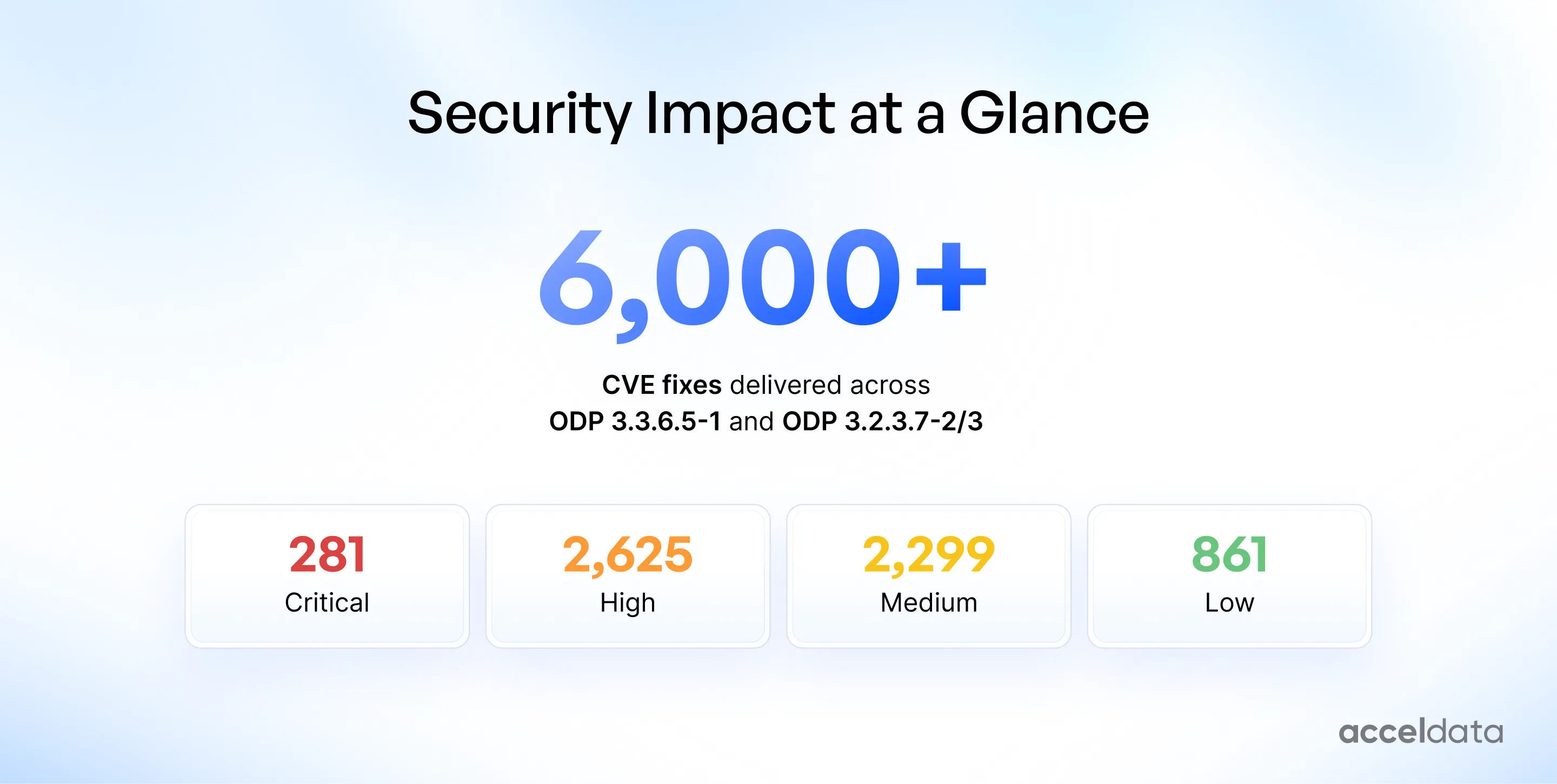
Together, ODP 3.3.6.5-1 and ODP 3.2.3.7-2/3 deliver 6,000+ CVE fixes, reinforcing security across the platform.
Modernize on the path that fits your environment
The latest releases give teams flexibility in how they keep moving forward.
Teams on the 3.3.6 line can bring newer streaming, lakehouse, governance, and analytics capabilities into their environment with ODP 3.3.6.5-1.
Teams maintaining 3.2.3 environments can modernize Hive and Iceberg, improve resilience and governance, simplify upgrades, and strengthen data integrity with ODP 3.2.3.7-2 or ODP 3.2.3.7-3.
Beyond individual releases, Acceldata ODP provides an open-source foundation for Hadoop modernization with flexible deployment across on-premises, cloud, hybrid, and Kubernetes environments. ODP also supports in-place, sidecar, and forklift migration approaches, allowing modernization to align with existing infrastructure, workloads, and business requirements.
This gives organizations a practical way to introduce modern capabilities, reduce operational complexity, preserve existing data and application investments, and maintain greater control over how their platform evolves.
Learn more about Acceldata Open Data Platform
Learn more
For complete technical details, enhancements, fixes, and upgrade guidance, see the release notes for ODP 3.3.6.5-1, ODP 3.2.3.7-2, and ODP 3.2.3.7-3.
Book a free consultation to see how ODP fits your environment and supports your modernization roadmap.