




.svg)



Legacy Hadoop environments still power critical enterprise analytics. But as data volumes grow and AI moves from experimentation to production, many teams face rising costs, growing operational complexity, and performance ceilings that make it harder to deliver real-time analytics and AI outcomes.
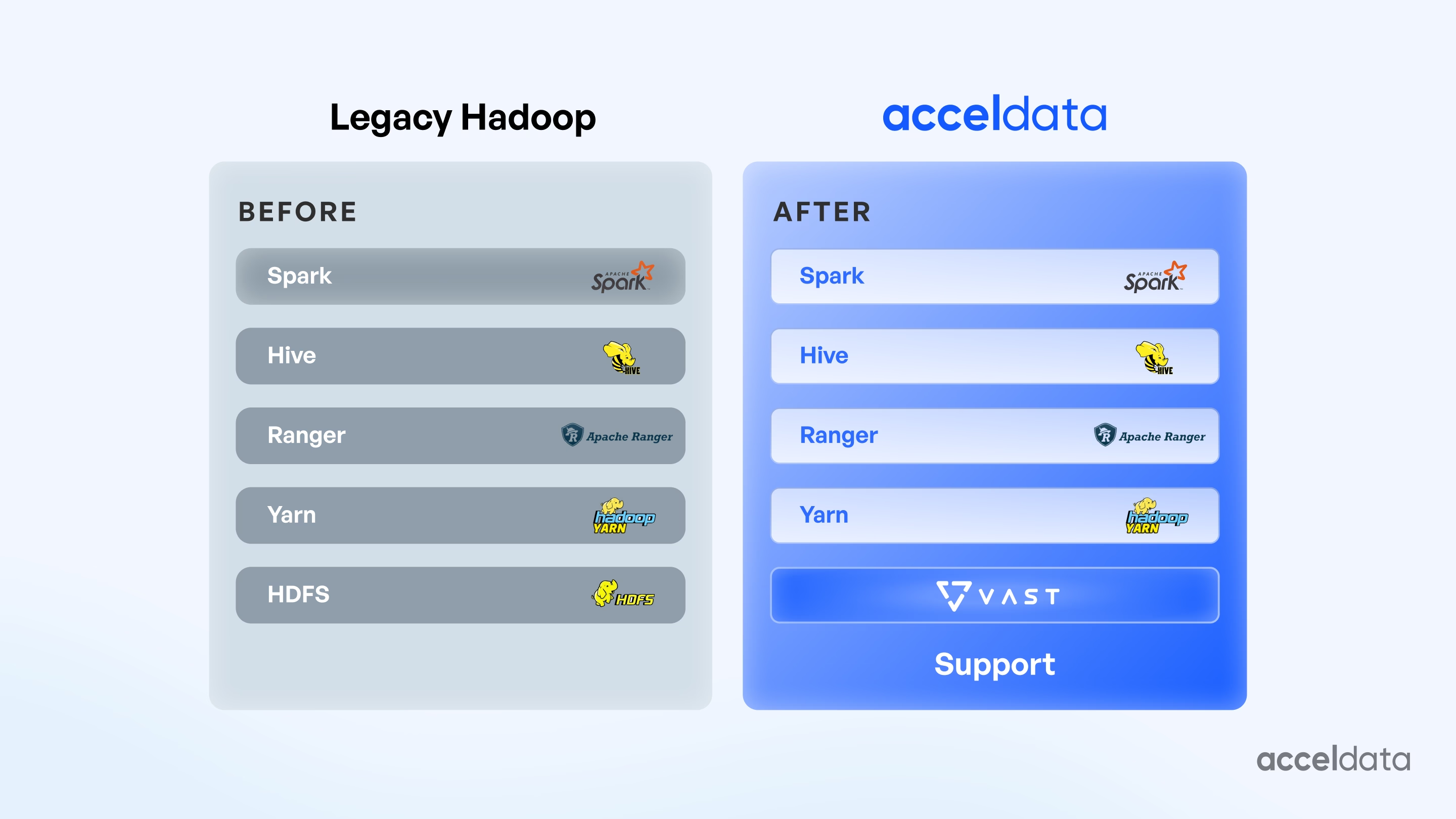
Acceldata and VAST Data are working together to provide a practical, low-risk path to modernize legacy Hadoop—helping teams simplify operations, reduce costs, and build an AI-ready foundation without a disruptive rip-and-replace.
The joint approach: assess, optimize, then modernize
Most modernization journeys aren’t a single cutover. Teams need an approach that keeps Spark/Hive workloads running while improving the platform underneath them.
That’s why the joint solution is designed to help teams:
- Assess what’s running today (workloads, reliability, performance, operational risk)
- Optimize the current environment to reduce waste and stabilize operations
- Modernize in phases to a modern, AI-ready foundation
The joint value proposition: what you get with Acceldata + VAST Data
As part of this collaboration, Acceldata is joining the VAST Cosmos Community, a global community of developers, builders, and experts in innovative AI solutions, as a Technology Partner. VAST Data’s Cosmos Partner Program was designed to help customers deploy validated solutions on the VAST AI Operating System with greater confidence and speed.
Through Cosmos, Acceldata and VAST Data will align on solution integration, reference architectures, and go-to-market support so teams modernizing legacy Hadoop can take a phased path to an AI-ready foundation with clearer outcomes and fewer deployment and operational surprises.
1) End-to-end support across the full data stack
Modernization isn’t only about infrastructure—it’s about keeping everything above it running cleanly. Acceldata + VAST Data are positioned to deliver seamless support from infrastructure to applications, reducing vendor/tool sprawl and day-2 operational burden.
2) Major cost reduction through simplification
Depending on environment and starting point, published solution materials indicate the joint approach can deliver:
- 50%+ lower support costs compared to legacy Hadoop environments
- 60%+ lower infrastructure costs compared to HDFS-based systems
The core driver is simplification: fewer moving parts, less firefighting, and a modern foundation designed to run efficiently at scale.
3) AI-ready architecture without ripping out what works
The joint approach helps teams modernize toward an AI-ready platform while protecting existing workloads. By unifying structured and unstructured data under one platform and access model, teams can reduce silos that slow AI adoption and scale analytics without stitching together disjoint systems.
What each platform brings (and why the combination works)
What Acceldata brings: modernization, observability, and optimization
Acceldata provides the operational layer to modernize and run big data environments with confidence—across legacy and modern stacks:
- ADM (Agentic Data Management): an intelligent operating layer that applies automation and AI-driven insights across data and infrastructure to prevent issues, optimize cost, and improve performance.
- ODP (Open Data Platform): an open-source Hadoop distribution built for modern environments, spanning ingestion, storage, compute, and security, with Ambari-based management.
- Pulse: real-time compute and infrastructure observability to improve reliability, accelerate triage, and optimize resource usage across big data services.
- ADOC (Acceldata Data Observability Cloud): end-to-end visibility into data health, quality, and performance across hybrid and multi-cloud environments.
Together, these capabilities help teams improve reliability, reduce firefighting, and optimize cost across legacy and modern data stacks.
What VAST Data brings: a unified data platform built for scale and AI
VAST Data provides a unified AI Operating System spanning key layers in the data stack, designed to eliminate the usual tradeoffs between performance, scale, and cost:
- DataStore: multi-protocol file object, block, tables, and streaming data storage
- DataBase: a hyperscale structured data solution that unifies transactional and analytical workloads and includes vector database capabilities for AI-driven retrieval and search
- DataEngine: a serverless, event-driven compute framework built into VAST AI OS – bringing logic and state together to activate files, objects, and tables the moment they change – transforming data into action for continuous, intelligent workflows
- DataSpace: a global namespace across core, cloud, and edge environments that accelerates access to data services
This unified foundation is built to support a broad range of workloads—from high-throughput ingestion and streaming patterns to large-scale analytics—without the complexity of stitching together multiple point systems.
What customers can expect
Every environment is different, but the collaboration is designed to consistently deliver improvements in three areas:
1) Lower cost and less operational complexity
By simplifying the architecture and reducing day-2 overhead, the joint approach targets both infrastructure and operational cost reduction. Published materials cite outcomes such as 50%+ lower support costs and 60%+ lower infrastructure costs depending on starting point and environment.
2) Better performance for analytics and AI workloads
The combined stack targets performance at both the compute and data foundation layers—improving throughput and responsiveness for modern analytics and AI-adjacent workloads while reducing inefficiency that drives unnecessary expansion.
3) A more efficient and resilient data foundation
A unified, modern data platform reduces the fragility and overhead that accumulate over time in legacy Hadoop ecosystems—helping teams operate with fewer bottlenecks, fewer moving parts, and greater confidence as data grows.
Common modernization paths supported
Customers typically adopt modernization in phases based on where they’re starting. Common paths include:
- Hadoop modernization: replace costly legacy components with a modern, open alternative over time
- Cost-optimized infrastructure for analytics and AI: run large-scale workloads on a simplified, high-throughput platform
- Data consolidation for secure and scalable operations: reduce silos by unifying data under one platform and access model
- Real-time observability for hybrid and multi-cloud pipelines: eliminate blind spots and shorten triage cycles with live visibility
Example modernization pattern: phased change without disruption
A common pattern is to keep core services that teams rely on today—such as Spark, Hive, and enterprise security controls—while modernizing the underlying foundation and improving operational clarity. This enables modernization in waves, reducing risk while delivering measurable improvements along the way.
Modernizing legacy Hadoop doesn’t have to be disruptive. With Acceldata and VAST Data, teams can take a phased approach that improves reliability and cost efficiency today—while building a clear path to an AI-ready foundation.
Ready to modernize?
Explore how ODP (Open Data Platform) enables a phased, low-risk approach to modernizing legacy Hadoop.
Want guidance tailored to your environment? Book an expert consultation to map the right modernization plan for your workloads and priorities.