.svg)



The data product conversation just changed. For years, the goal was discovery: make data findable, catalogued, and shareable. The tools that exist today surface what exists and who owns it. What they do not tell you is whether the data is actually reliable right now. And they cannot gate what reaches a consumer.
That limitation was tolerable when the consumer was a human analyst, but it becomes a critical gap when the consumer is an autonomous agent. If the trust signal is not baked into the product itself — a live score, a lifecycle gate, a freshness check — the agent acts on bad data with no one to catch it.
The core differentiation: Every other data product solution solves for discovery at buildtime. Acceldata solves for trust at runtime.
The answer is runtime plus hybrid. Single-platform solutions govern what lives inside their walls. Acceldata governs the estate as it actually exists, across clouds, engines, and on-premises sources, as a single scored, governed object.
The 26.5.0 and 26.6.0 releases make this concrete across three governance layers:
- Data Products at the product level: scores at runtime, gates what leaves it, and carries its own proof of reliability into every enterprise system that consumes it.
- ServiceNow integration at the enterprise workflow level: connects runtime quality signals, from across the hybrid estate, into the compliance and asset management workflows the business already runs.
- OpenLineage expansion at the hybrid lineage level: closes the lineage gaps underneath the product, so the trust claim holds across the full hybrid estate, not just within a single platform.
01 Data Products — Governed, Scored, and Production-Ready
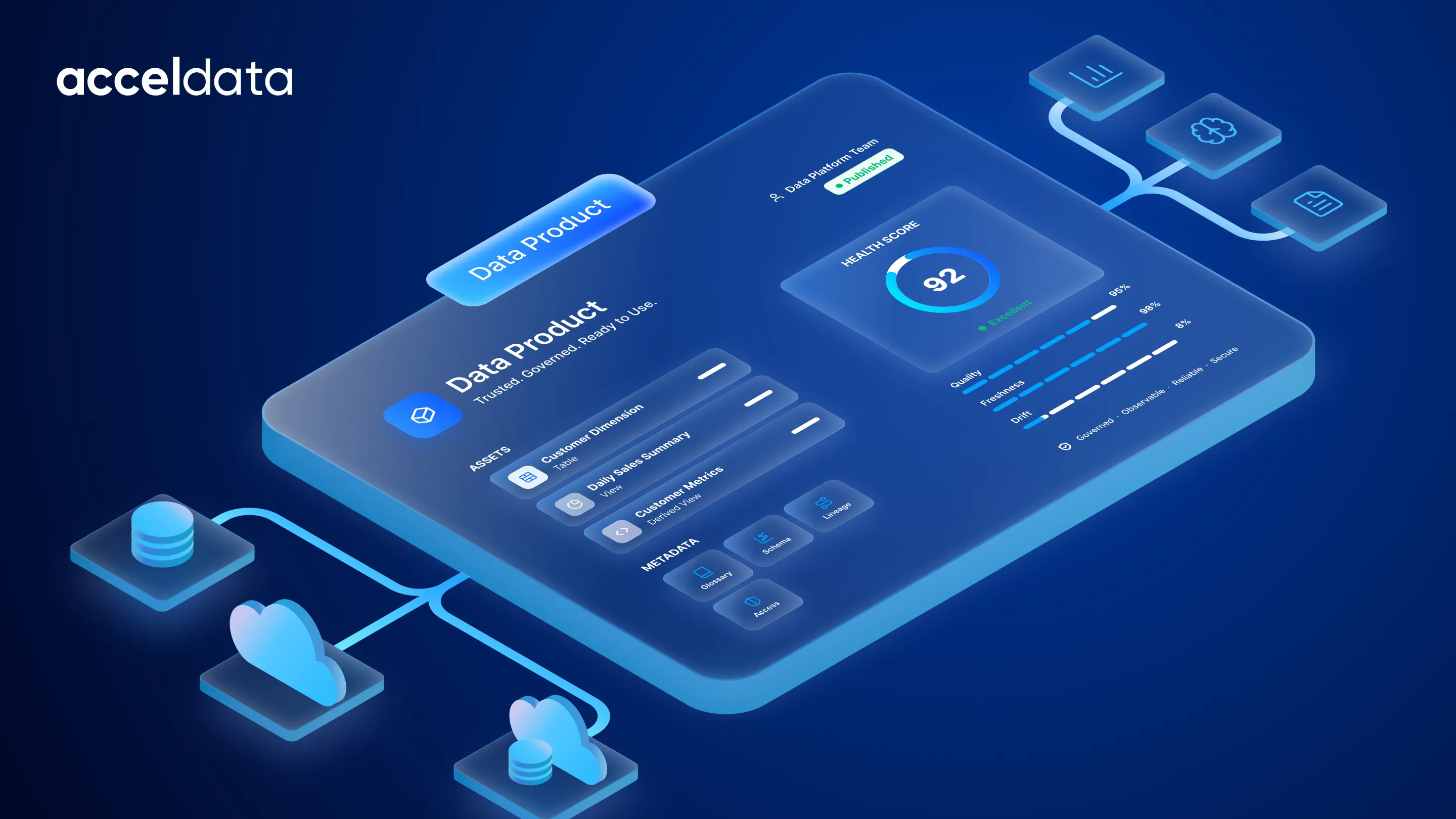
Most data product frameworks stop at buildtime curation — defining, documenting, and certifying a product once, at a point in time. Acceldata Data Products go beyond curation to prove reliability at runtime. The Health Score is not assigned by a steward or inherited from a tag. It is calculated continuously from live Data Quality, Freshness, Schema Drift, and Data Drift signals across every member asset. When something slips, the score reflects it before a consumer reports it. The lifecycle gate ensures nothing below standard leaves the product.
And it works across the full estate. The same runtime score applies whether the underlying assets live in cloud, hybrid, or a legacy on-premises system. Governed as one object, not per platform.
For Agentic AI systems operating across a hybrid environment, this is the difference between a product that claims to be trusted and one that proves it at runtime, everywhere it matters.
What’s included:
- Quality SLAs across five policy types so a Head of Data Products can hold reliability commitments next quarter, not just report on today.
- Draft-to-Published lifecycle gates so a Domain Data Steward controls what reaches consumers.
- Entity-level versioning and audit logs so compliance evidence exists before the review, not after the scramble.
- Role-based access across four distinct roles so accountability is explicit.
- Lineage and policy views so a Data Engineer traces failures upstream and sees what is actually being enforced.
- Marketplace with documentation, reviews, and ratings where consumers evaluate products by health, not just by name.
02 ServiceNow Data Catalog Integration — Observability into Enterprise Governance Workflows
Data products deliver trust at the data layer. Information delivered via data products is increasingly being consumed by business process workflows, such as operations, finance, compliance, and customer service, those workflows increasingly run on platforms like ServiceNow.
When data context and workflow context live in separate systems, a single reliability issue can ripple through business processes with no clear path to the root cause.
In 26.6.0, through its integration with ServiceNow Data Catalog, Acceldata synchronizes data quality and reliability scores directly to cataloged assets, so data health is visible alongside business metadata and governance workflows, not in a separate tool.
AI agents on the ServiceNow platform can automatically consume data product assets that have been tagged and approved, ensuring they always operate on data that meets the right quality thresholds. When a reliability issue is detected, incident context passes into ServiceNow automatically, surfacing downstream business impact and accelerating resolution.
03 OpenLineage Support — Expanded Coverage Across the Modern Data Stack
Lineage is only useful if it follows the data. Enterprise pipelines move data from streaming systems through transformation layers into open table formats and analytical warehouses, often across cloud boundaries. ADOC 26.6.0 extends OpenLineage support to four platforms common in these architectures, connecting pipeline lineage to catalog assets across every stage.
Every platform added to OpenLineage support is another source the Data Product can see, score, and trust. For agentic AI systems drawing from hybrid estates, that coverage is not a lineage feature; it is what makes the product's runtime trust signal actually reliable.
Newly Supported Platforms
- Amazon Redshift: Pipelines reading from or writing to Redshift now correlate to catalog assets, making Redshift a connected node in multi-stage lineage traceable from ingestion to reporting.
- AWS Glue: ADOC processes symlink facets from Glue jobs to resolve catalog table identity even when the physical storage path (S3) and catalog entry differ — the mechanism that makes Glue correlation reliable.
- Google Cloud Pub/Sub: Streaming ingestion steps identified by project and topic/subscription are now correlated to catalog assets, bringing event sources into the same lineage graph as downstream layers.
- Apache Iceberg: Supports both REST catalog and Glue-registered Iceberg tables using catalog and symlink facets. Both input and output tables are correlated.
A complete streaming-to-warehouse pipeline — Pub/Sub → Glue → Iceberg → Redshift — is now traceable as a single connected lineage view in ADOC, without manual cross-system reconstruction.
In This Release
Full details for each capability are available in the dedicated announcements below.
🎯 Data Products — GA • 26.5.0
A runtime reliability engine, not a catalog label. Every Data Product carries a continuously calculated Health Score, a lifecycle gate that controls what reaches consumers, and audit evidence that exists before the review — governing assets across clouds, engines, and on-premises sources as one scored object.
→ Read the full Data Products announcement →
🔗 ServiceNow Data Catalog Integration — New • 26.6.0
Data product trust, extended into the enterprise workflow layer. Acceldata synchronizes runtime quality and reliability scores into ServiceNow Data Catalog — so AI agents always consume approved, quality-thresholded data, and reliability incidents surface with business impact context, not just a technical alert.
→ Read the full ServiceNow announcement →
🕸 OpenLineage Asset Correlation — Expanded • 26.6.0
A Data Product Health Score is only as complete as the lineage underneath it. Asset Correlation now covers Redshift, AWS Glue, Google Cloud Pub/Sub, and Apache Iceberg — making a full streaming-to-warehouse pipeline traceable as a single connected lineage view, across the hybrid estate.
→ Read the full OpenLineage announcement →
Across 26.5.0 and 26.6.0: data products that carry their own proof of reliability, governance workflows that extend into enterprise systems, and lineage that follows the data across every layer of the stack. All capabilities are available now — reach out to your Acceldata Customer Success contact or visit the documentation portal for setup guides and details.
Acceldata • Data Observability Platform • acceldata.io • 26.5.0 & 26.6.0 Release • June – July 2026