




.svg)



PRODUCT UPDATE • ADOC 26.7.0
How Data Products V2 and the SDK Work
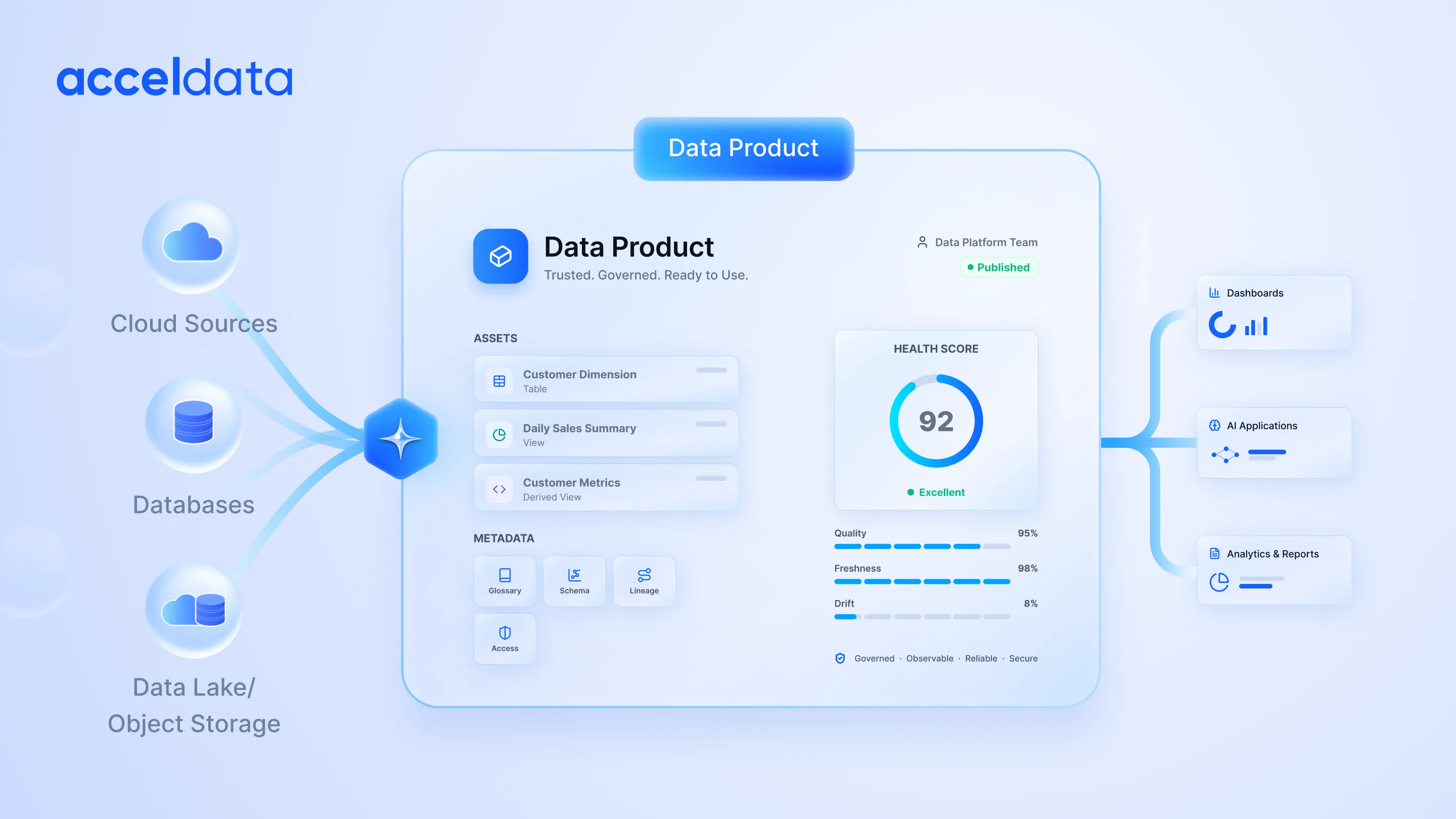
Data Products V2 draws a hard line between the consumer experience and the producer experience. The Marketplace is a read-only discovery surface where your consumers browse published products, read documentation, evaluate health scores, and request access. The management interface is where your product owners create, configure, publish, and govern. The two surfaces share no UI overlap — a user with consumer access cannot navigate to management functions, and cannot accidentally edit what they're browsing.
Lineage in V2 expands beyond upstream and downstream data assets to include the pipelines that produce the data and the BI reports that depend on it. A consumer browsing a Data Product sees the full flow: the pipeline that loaded the data, the transformation jobs that shaped it, and the Power BI or Tableau reports downstream. Each node is navigable — clicking a pipeline takes you directly to its run history, job status, and the quality policies correlated to that run.
Key distinction: Lineage in Data Products V2 is not a separate tab a consumer navigates to. It is embedded in the product view itself, scoped to the assets that compose the product. Provenance is part of the product — not an investigation a consumer has to initiate separately.
For automated systems and agents, the acceldata-sdk-python is the programmatic equivalent of the Marketplace. An agent that can browse, evaluate, and consume a Data Product through a typed, retrying SDK — with full pipeline-to-quality correlation available programmatically — has the same trust information a human consumer gets in the UI, in a form it can act on without human intervention.
What's New in 26.7.0
Separate Marketplace and Management Views
The Marketplace is the surface your data consumers interact with day to day. It is purpose-built for discovery and evaluation: search by business term or domain, filter by health score, read product documentation, and review ratings left by previous consumers. The management interface is where your data product owners operate — creating products, adding member assets, configuring quality SLAs, managing versioning, and controlling access. Within management, Modify and Delete permissions are now independent grants: you can give a team editing rights without giving them deletion rights.
The separation eliminates a class of governance failure that previously required user discipline to prevent. In a combined interface, a consumer with edit access could modify a published product they were only meant to read. Separating the surfaces makes that impossible by design. For regulated environments where published products represent compliance-relevant data, this is a structural risk reduction — not a policy you have to enforce manually.
Enhanced Lineage: Pipelines, Power BI, and Tableau
The lineage graph inside a Data Product now includes three new node types alongside upstream and downstream data assets: data pipelines, Power BI reports, and Tableau reports. Pipeline nodes surface the specific run that produced or loaded the data — with direct navigation to run history, job-level status, and the quality policies correlated to that run. BI report nodes show everything downstream that depends on this product, so a product owner can assess impact before making a change rather than discovering broken reports after.
For an agent consuming a Data Product, pipeline lineage is a provenance signal at the moment of consumption. An agent that can verify the pipeline producing the data completed its last run successfully — and that the quality policies correlated to that run passed — has a runtime trust signal beyond the health score. It knows not just that the product was trusted when it was built, but that the last run that produced it was clean.
acceldata-sdk-python (GA)
The acceldata-sdk-python is generated directly from ADOC's OpenAPI specifications, which means SDK coverage advances automatically with each platform release — no manual model maintenance required. The SDK ships with resource-oriented APIs: PipelineResource, AssetResource, DatasourceResource, and PolicyResource, each exposing consistent helpers for their domain. The built-in retry framework handles HTTP 429, 503, and 409 responses with exponential backoff — ten attempts by default, thirty-second initial backoff, ten-minute maximum — all configurable via RetryConfig.
Pipeline-to-policy correlation is the capability that closes the loop between execution and quality for agentic consumers. When a pipeline run completes, you attach the pipeline_run_id to the quality policies evaluated against that run's output. From the Data Product view, consumers see not just the current health score, but the specific pipeline run and the quality checks that produced it. An agent consuming the product programmatically retrieves the same correlation through the SDK before deciding whether to act on the data.
Key distinction: pipeline_run_id correlation is not automatic — it requires the pipeline to emit the run identifier and the quality policy to explicitly reference it. For teams already using OpenLineage, the run identifier is available in the lineage event. For teams using custom orchestration, the SDK's PipelineResource provides helpers to register runs and attach identifiers at execution time.
Migration from acceldata-sdk
The migration from the legacy acceldata-sdk to acceldata-sdk-python requires Python 3.10 or higher and a one-line import change: from acceldata.client.adoc_client import AdocClient replaces from acceldata_sdk.torch_client import TorchClient. The resource-oriented API structure replaces the previous flat client, so method calls will need updating — but the underlying operations map directly. The legacy jobSchedule.cronExpression (single string) and top-level schedule fields are deprecated in favour of jobSchedule.cronExpressions (list). Migrate any automation using either field before the 26.10.0 end-of-support date.
What This Looks Like in Practice
A Consumer Evaluating a Data Product Before Use
A business analyst in the Finance domain opens the Marketplace to find a product for a quarterly revenue analysis. They filter by domain and health score, open the product, and check the embedded lineage to confirm the pipeline that loaded the data completed successfully overnight and that the correlated quality policies passed. They request access and receive read-only permissions — without any path to accidentally modify the product they're using. The evaluation took five minutes and required no knowledge of the underlying schema or database location.
A Data Product Owner Assessing Downstream Impact Before a Schema Change
A data product owner plans to deprecate a column that no longer reflects the current business definition. Before making the change, they open the lineage graph and navigate to the Tableau and Power BI report nodes downstream. Four reports depend on the product. They notify the report owners, publish a deprecation notice in the product documentation, and set a timeline before releasing the updated version. The BI teams are informed before the change breaks anything — not after a support ticket arrives.
An Agentic System Verifying Trust Before Acting on Data
An agentic pipeline triggered to generate a financial risk summary calls the SDK before querying the Data Product. It retrieves the product's current health score, the pipeline_run_id of the last run correlated to the product's quality policies, and the pass/fail status of those policies. All checks pass. The agent proceeds, attaches the pipeline_run_id to its own execution record, and logs the trust state at the moment of consumption. When a downstream audit questions the output three weeks later, the agent has a complete provenance trail — from source pipeline through quality check to the moment of consumption.
Who Benefits
- Data consumers and analysts — a Marketplace built for discovery and evaluation; filter by health score and domain without navigating management functions or risking accidental edits
- Data product owners — independent Modify and Delete permissions; embedded pipeline and BI lineage to assess downstream impact before making changes
- Data engineers — pipeline-to-policy correlation via pipeline_run_id creates an end-to-end audit trail from execution through data quality result, accessible both in the UI and programmatically
- Developers building agentic systems — a typed, retrying SDK with OpenAPI-generated models that stays in sync with the platform automatically with each release
- Governance and compliance teams — a separation of consumer and producer surfaces that enforces access control by interface design; Modify and Delete permissions independently assignable
Getting Started
- Navigate to Data Products → Marketplace to explore the new consumer experience. Existing published products appear here automatically — no republishing required.
- Review permissions for existing Data Products under the management interface. Assign Modify and Delete independently for any roles that previously held combined edit access.
- Install the new SDK: pip install acceldata-sdk-python. Requires Python 3.10+.
- Update your import: replace from acceldata_sdk.torch_client import TorchClient with from acceldata.client.adoc_client import AdocClient.
- Migrate any automation using jobSchedule.cronExpression or the top-level schedule field to jobSchedule.cronExpressions before the 26.10.0 end-of-support date in October 2026.
For SDK reference documentation, pipeline_run_id correlation setup, and the full migration guide, see the Data Products and SDK documentation at docs.acceldata.io.