




.svg)



Most enterprises operate hybrid data environments—but very few observability platforms are designed to support them at scale. This guide explains what "hybrid-ready" really means and which platforms deliver.
Your dashboards look healthy. Your pipelines show green. But somewhere between an on-prem source system and a cloud analytics layer, data silently breaks. In hybrid environments, failure rarely happens in one place. It happens across boundaries.
Enterprises are moving fast toward distributed architectures. In fact, 50% of enterprises implementing distributed data architectures will adopt data observability tools by 2026, up from less than 20% in 2024. But most solutions still assume centralized access.
That is why hybrid data observability platforms matter. True on-prem and cloud data observability requires visibility, policy enforcement, and execution across trust zones. Without it, blind spots persist across your hybrid data stack.
Why Hybrid Data Observability Is Hard
Hybrid architectures promise flexibility, but they complicate execution. A Forrester TEI study reports 176% ROI over three years from hybrid integration tools supporting observability in hybrid cloud environments. The upside is clear. The complexity is greater.
Hybrid data observability platforms must operate across physical boundaries, network controls, and regulatory zones without assuming unrestricted access.
The core challenges include:
- Network and connectivity constraints: On-prem systems sit behind strict firewalls. Latency across data center networks can disrupt telemetry flows. Many observability platforms for on-prem and cloud assume direct connections that enterprise security teams will not allow.
- Security and data residency requirements: Regulated industries restrict where metadata and monitoring logic can execute. True on-prem and cloud data observability cannot rely on replicating sensitive data into a centralized SaaS layer.
- Fragmented metadata and lineage: Dependencies span SAP on-prem, cloud warehouses, and streaming systems. Without unified lineage and strong metadata management, impact analysis breaks down across hybrid data stacks.
- Inconsistent execution environments: Cloud-native agents do not always translate to legacy systems. Hybrid data observability tools must support distributed execution, not just centralized dashboards.
- Governance across trust boundaries: Policies must apply consistently across environments. Enterprise hybrid data monitoring fails when governance stops at the cloud edge.
The key insight is simple: hybrid observability fails when platforms assume centralized access. Reliable data observability for hybrid data stacks demands distributed intelligence that respects security, network, and compliance constraints.
What “Hybrid-Ready” Really Means for Observability Platforms
True on-prem and cloud data observability is not about adding connectors. It is about architecture. Hybrid data observability platforms must be designed for distributed execution, policy enforcement, and unified visibility from the start. Anything less creates blind spots across hybrid data stacks.
Hybrid-ready capabilities include:
- Distributed data collection and execution: Monitoring logic runs close to the data. Local collectors analyze signals, detect anomalies, and push only telemetry upstream. This model enables secure enterprise hybrid data monitoring without moving sensitive records across boundaries.
- Metadata-first monitoring: Instead of querying raw datasets continuously, platforms analyze schema changes, freshness patterns, and statistical profiles. This reduces movement while helping you optimize cloud data management and control cross-environment cost exposure.
- Secure, policy-aware connectivity: Access controls and masking rules must apply automatically across environments. In modern architectures influenced by agentic AI, monitoring workflows adapt to governance policies rather than bypassing them.
- Unified control plane: A single interface correlates signals across systems. Reliable data observability for hybrid data stacks requires consolidated alerts, lineage, and impact analysis, not fragmented dashboards.
When these capabilities are absent, hybrid observability breaks in predictable ways:
| Hybrid requirement | Why it matters | Failure mode if missing |
|---|---|---|
| Distributed execution | Respects network and security boundaries | Isolated systems remain unmonitored |
| Metadata-first design | Minimizes data movement and risk | Compliance violations and excess data transfer |
| Policy-aware connectivity | Enforces governance automatically | Manual reviews delay deployment |
| Unified control plane | Aligns signals across environments | Alert fatigue and fragmented visibility |
| Edge intelligence | Reduces latency for faster detection | Slow response and delayed remediation |
When execution respects boundaries, observability becomes proactive. That shift is why data observability defines AI-ready enterprises.
Architectural Patterns for Hybrid Data Observability
Not all hybrid data observability platforms are built the same. Architecture determines how well they handle network boundaries, governance controls, and cross-environment lineage. If you operate across legacy systems, modern cloud native data stacks, and distributed pipelines, the execution model matters as much as the features.
Centralized SaaS-Only Models
Pure SaaS observability platforms for on-prem and cloud run entirely in the vendor’s environment. Deployment is simple. There are no local components. This works for cloud-first teams.
In hybrid settings, limitations surface quickly. On-prem systems, including traditional relational database platforms, rarely allow unrestricted inbound access. VPN tunnels introduce latency, and security reviews slow expansion. These architectures often assume centralized visibility, which weakens comprehensive on-prem and cloud data observability.
Agent-Based Hybrid Models
Agent-based designs deploy lightweight collectors within each environment. Monitoring logic executes locally. Telemetry flows to a central control plane through encrypted channels.
This pattern supports secure enterprise hybrid data monitoring. Agents respect firewalls, reduce data movement, and maintain visibility across environments.
However, distributed components introduce operational overhead. You must manage upgrades, health checks, and lifecycle coordination. For complex estates, this trade-off is often necessary, especially as AI agents are redefining data management workflows across environments.
Federated Observability Architectures
Federated models distribute observability instances across environments. Each domain monitors itself. A federation layer unifies alerts, lineage, and governance policies.
This approach aligns well with mature data governance model strategies. It offers resilience and autonomy while enabling coordinated oversight. The challenge is orchestration.
Without careful design, federation can fragment signals instead of unifying them. Yet for large-scale data observability for hybrid data stacks, federation often provides the most scalable path.
Across these models, one principle remains consistent: centralized assumptions fail in distributed environments. That is why data observability is essential when hybrid complexity increases.
<Suggested infographic flow>
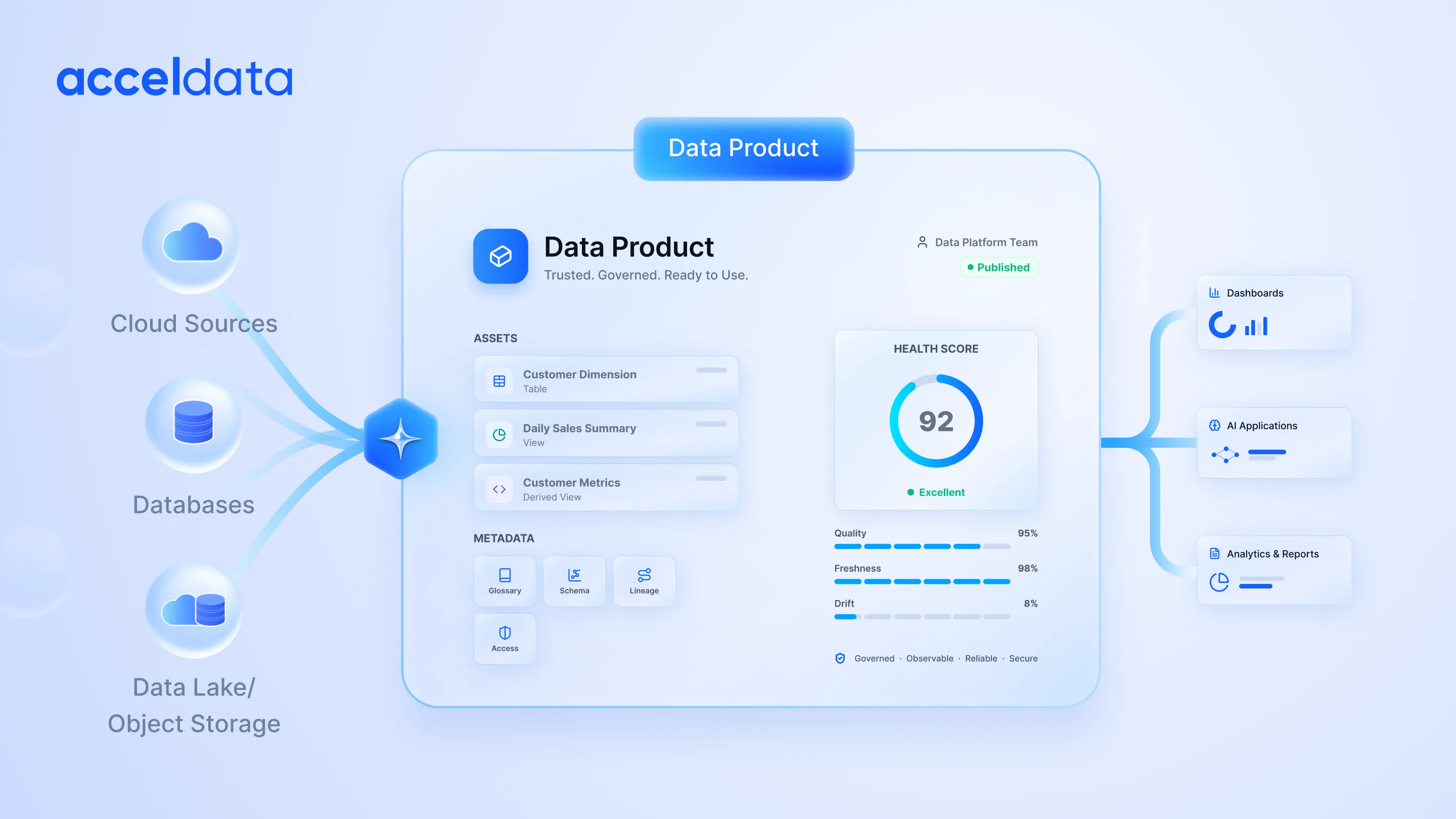
On-Prem Systems → Local Observability Agents → Secure Communication Layer → Unified Control Plane → Cloud Platforms. Include visual indicators for policy enforcement, lineage synchronization, and cross-environment alert correlation.
Observability Coverage in Hybrid Environments
Hybrid environments only deliver measurable impact when visibility spans the full data lifecycle. Potential EBITDA uplift from cloud, including hybrid observability, averages 20–30% across sectors by 2030. That value depends on disciplined enterprise hybrid data monitoring, not partial instrumentation.
Pipelines and Orchestration
Hybrid pipelines cross trust boundaries. An on-prem workflow may feed a cloud warehouse that powers analytics dashboards. Reliable on-prem and cloud data observability must automatically map those dependencies.
Effective coverage includes:
- Cross-environment job discovery through modern data orchestration tools
- Failure propagation tracking across legacy and cloud systems
- Reliability signals that help teams choose the right agentic AI data pipeline platform for distributed execution
Without this, incident triage becomes guesswork across environments.
Data Quality and Schema Drift
Data definitions must remain consistent everywhere. If validation rules diverge, downstream analytics degrade silently. Hybrid-ready platforms should:
- Enforce consistent policies using enterprise-grade data quality tools
- Detect schema drift before structural changes cascade
- Surface risk indicators tied to the hidden cost of poor data quality and governance
Strong hybrid data observability platforms treat quality as a cross-boundary control, not a warehouse-only feature.
Lineage and Impact Analysis
Hybrid estates require unified data lineage. You should trace a KPI from an on-prem source through transformations into cloud dashboards without switching systems. True data observability for hybrid data stacks must:
- Stitch lineage across environments
- Provide real-time impact analysis
- Correlate upstream changes with downstream alerts
Cost and Performance Signals
Hybrid coverage must extend to resource efficiency. Leading observability platforms for on-prem and cloud analyze query patterns, workload spikes, and consumption trends using metadata instead of intrusive scans. This lightweight approach improves reliability while preserving production performance.
Security, Compliance, and Governance in Hybrid Observability
Security defines whether hybrid observability succeeds or fails. Data observability for hybrid data stacks must enforce controls across environments, not just monitor them. In regulated enterprises, visibility without governance increases risk.
Hybrid security requires four non-negotiables:
- Zero-trust connectivity: Every component must authenticate and encrypt communication. Monitoring traffic between on-prem and cloud systems should use mutual authentication and policy validation. Modern approaches show how AI is transforming data access control and security, making policy enforcement continuous instead of manual.
- Role-based access control: Permissions must stay consistent across environments. If a user can access cloud dashboards, equivalent rules should govern on-prem sources. Mature hybrid data observability tools synchronize identity controls while respecting local authentication systems.
- Audit readiness: Every query, configuration change, and alert must generate traceable logs. Enterprise-grade on-prem and cloud data observability demands audit trails that span trust zones. Coordinated reporting strengthens AI data governance initiatives and simplifies compliance reviews.
- Data residency enforcement: Platforms must understand where data is allowed to travel. If regulations restrict cross-border access, enforcement must apply automatically, including metadata flows. Strong observability platforms for on-prem and cloud align with evolving cloud data security expectations without exposing sensitive assets.
Security is not an add-on capability of hybrid data observability platforms. It is the foundation that enables reliable enterprise hybrid data monitoring across distributed environments.
How Leading Platforms Approach Hybrid Observability
Leading observability platforms for on-prem and cloud converge on a similar principle: architecture matters more than connectors. Sustainable on-prem and cloud data observability depends on minimizing data movement, distributing execution, and enforcing governance consistently.
Common architectural patterns include:
- Metadata-driven monitoring: Instead of scanning raw datasets, platforms analyze structural signals such as schema changes, query logs, and workload behavior. This approach reduces risk while preserving visibility. It reflects how metadata management tools improve data compliance by using structural context instead of sensitive payloads.
- Edge-based execution: Monitoring logic runs close to the data source. Local collectors process telemetry and send summarized insights upstream. This reduces latency and respects security boundaries, which is critical for scalable enterprise hybrid data monitoring.
- Unified governance controls: Governance policies must apply consistently across domains. Mature hybrid data observability tools integrate with a broader data governance platform to enforce role-based access, masking, and audit requirements without duplicating controls.
- Minimal data movement: Effective hybrid data observability platforms prioritize telemetry over replication. They analyze metadata, logs, and statistical signals rather than copying full datasets. This design helps organizations streamline data governance for better compliance while reducing operational friction.
These architectural principles show that hybrid observability is not a feature checklist. It is a deliberate design choice. Platforms that respect boundaries while maintaining unified visibility are better positioned to support distributed data ecosystems.
Enterprise Evaluation Checklist for Hybrid Platforms
Choosing among hybrid data observability platforms requires architectural clarity. Feature lists rarely expose execution gaps. What determines long-term success is how the platform behaves under hybrid constraints, especially when visibility, governance, and performance intersect.
Enterprises evaluating observability platforms for on-prem and cloud should anchor discussions around a few critical questions:
- Where does monitoring logic execute?
- What data leaves on-prem environments?
- How is lineage unified across systems?
- How are policies enforced consistently?
These questions surface whether the design supports resilient on-prem and cloud data observability or depends on centralized assumptions.
Beyond architecture, evaluation must consider operational durability. Sustainable enterprise hybrid data monitoring demands clear ownership of distributed components, structured update processes, and defined failure-handling models when connectivity degrades.
Metadata-driven designs often provide a safer path. Reviewing a concrete metadata example clarifies whether the platform minimizes exposure while maintaining visibility across environments.
Governance maturity also matters. Alignment with modern AI data governance platforms helps ensure policies remain consistent across trust boundaries.
Ultimately, effective hybrid data observability tools reduce risk by embedding distributed execution, minimal data movement, and unified control into their core design. That foundation determines whether your hybrid observability strategy scales or fragments.
Common Mistakes Enterprises Make
Hybrid complexity exposes weak assumptions quickly. Many teams adopt hybrid data observability platforms but evaluate them through a cloud-only lens. Effective enterprise hybrid data monitoring requires architectural discipline, not shortcuts. When execution models ignore network, governance, and latency realities, gaps appear across environments.
Below are common mistakes and how to address them:
| Mistake | Impact | How to address it |
|---|---|---|
| Assuming cloud observability works on-prem | Centralized tools fail behind firewalls and segmented networks, weakening on-prem and cloud data observability | Validate local execution support and restricted-network compatibility |
| Over-centralizing execution | Latency spikes, security reviews, and single points of failure disrupt visibility | Adopt distributed processing within hybrid data observability tools |
| Ignoring network and security realities | Monitoring pipelines break under bandwidth limits or policy conflicts | Design for zero-trust access and minimal data movement |
| Treating hybrid as temporary | Underinvestment leads to fragmented controls and inconsistent governance | Plan long-term data observability for hybrid data stacks as a permanent architecture |
Hybrid environments are not transitional. Leading observability platforms for on-prem and cloud assume distribution, enforce governance at the edge, and reduce dependency on centralized access. Enterprises that recognize this early avoid costly redesigns later.
Make Hybrid Data Observability Measurable and Autonomous With Acceldata
Hybrid architectures are permanent. Visibility across boundaries now defines operational stability. Effective on-prem and cloud data observability requires distributed execution, minimal data movement, and unified governance. The most reliable hybrid data observability platforms treat monitoring as an embedded control layer, not an external add-on.
Acceldata delivers this through its Agentic Data Management Platform. Autonomous agents detect, diagnose, and remediate issues across environments while preserving security and policy controls.
Request a demo to see how Acceldata makes measurable, proactive hybrid observability part of daily operations.
FAQs
What is hybrid data observability?
Hybrid data observability involves monitoring and managing data quality, pipeline health, and lineage across both on-premises and cloud environments through unified platforms designed for distributed architectures.
Do cloud-native tools support on-prem data?
Most cloud-native tools struggle with on-premises data due to connectivity, security, and architectural assumptions. Purpose-built hybrid platforms use distributed agents and metadata-first approaches for comprehensive coverage.
How do enterprises secure hybrid observability?
Enterprises secure hybrid observability through zero-trust architectures, encrypted communications, role-based access controls, and policy-aware platforms that enforce data residency and compliance requirements automatically.
Which platforms handle hybrid environments best?
Platforms like Monte Carlo, Bigeye, and Acceldata lead in hybrid support through distributed architectures, metadata-driven monitoring, and unified governance across on-premises and cloud boundaries.
What architecture works best for hybrid observability?
Agent-based architectures with local execution and metadata-first monitoring provide the best balance of security, performance, and visibility for most hybrid enterprise environments.


.png)