




.svg)




Have you ever searched for a dataset across departments only to find it's stored in different systems—with different names, no documentation, and uncertain accuracy? That’s the kind of chaos an enterprise data catalog solves. Growing organizations collect more and more data, and this chaos can cost time, money, and trust.
The volume of data is increasing faster than ever, with an estimated 402.74 million terabytes created daily. A data catalog is essential to turn this flood of information into a useful, discoverable asset. If you’re serious about enterprise data management strategy, a well-designed catalog will be your backbone of data discovery, classification, and governance.
What Is An Enterprise Data Catalog?
An enterprise data catalog is a single, organized inventory of all data assets across your organization. It's designed to bring order to scattered, siloed datasets by providing a central place to find, understand, and manage all your data, no matter where it lives.
How it works
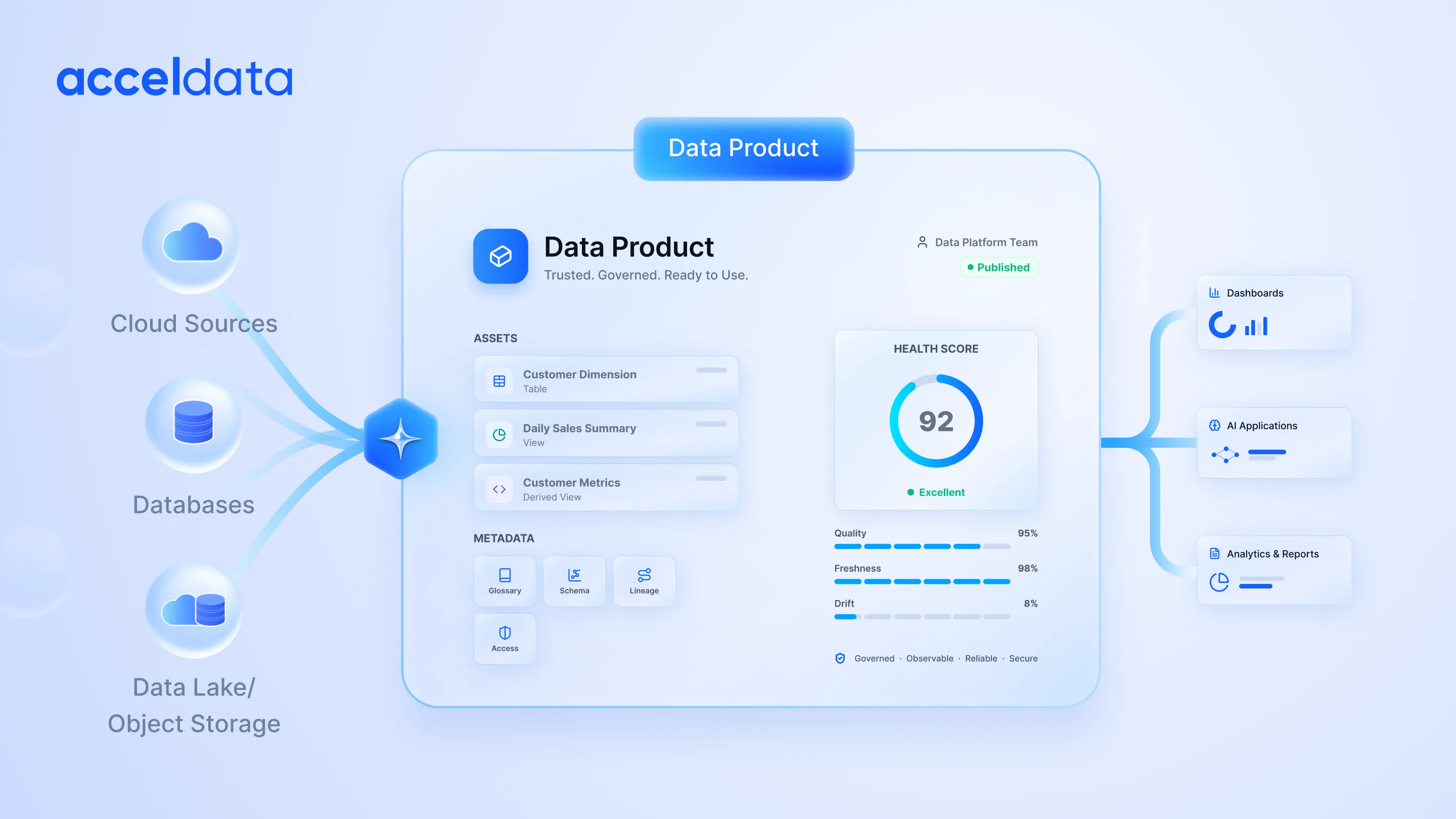
A data catalog acts like a living library for your organization's data, providing a single, trusted place to find, understand, and use it. It works by automatically scanning your data systems—whether databases or cloud storage—to collect metadata, i.e., information about your data. This metadata is then organized and enriched with valuable context, such as data lineage, usage statistics, and quality scores.
This makes it easy for anyone to find the data they need by searching with simple keywords or tags. Instead of manually searching through countless systems, you can quickly discover the right data for your projects, saving time and ensuring you’re working with accurate, up-to-date information.
Benefits of Building an Enterprise Data Catalog
Finding the right dataset often feels like searching for a needle in a haystack when data lives in silos—spread across systems, teams, and formats. An enterprise data catalog solves that by bringing everything together in one trusted place. Here are some benefits of building an enterprise data catalog.
Improved data discovery
Instead of your analysts pinging colleagues or digging through outdated spreadsheets, they can simply search the catalog and instantly see what data exists, where it came from, and how it has been used. This reduces the time spent on hunting for information.
Enhanced data governance
A data catalog doesn’t just organize your data, but also enforces crucial rules. By standardizing definitions, clarifying ownership, and applying strict access controls, you ensure your enterprise data governance framework and policies are consistently applied across your organization. This process builds trust, which is especially vital in regulated industries where compliance is non-negotiable.
Increased efficiency and collaboration
Without a data catalog, your teams would waste time by duplicating efforts, creating redundant datasets, or misinterpreting existing ones. By unifying data assets in one place, a data catalog enables your teams across functions to collaborate on the same verified information. That means fewer errors, less rework, and faster delivery of insights.
Better decision-making
When your leaders and analysts can quickly access clean, well-organized data, they can make smarter and faster decisions. A reliable data catalog ensures that strategies, forecasts, and operational choices are based on facts rather than guesswork.
Put simply, an enterprise data catalog goes beyond data organization. It turns your data into a shared resource that drives efficiency, encourages collaboration, and supports smarter business decisions.
How to Build an Effective Enterprise Data Catalog
Building a data catalog is about creating a foundation that makes your organization’s data accessible, trustworthy, and valuable. To get it right, you need to follow a few key steps.
Step 1: Define your data sources
Start by mapping out where your data lives, across databases, cloud platforms, applications, and even third-party systems. This step ensures nothing gets left behind and creates a clear inventory of what needs to be included. The goal is simple: know what you have before you try to organize it.
Step 2: Choose the right data cataloging tool
Choosing the right tool depends on your organization’s size, complexity, and integration needs. Look for data catalog tools that are easy to use, scale with your business, and connect seamlessly with your existing systems.
Step 3: Automate data cataloging
Manually updating a catalog is a recipe for outdated information. Automation helps capture metadata in real time as new data is added, ensuring your catalog stays current and reliable without constant manual input.
Step 4: Set up data governance policies
A catalog without rules quickly becomes cluttered and confusing. Define ownership, set access controls, and establish data quality standards from the start. This ensures your catalog stores data and governs your data effectively.
When these steps come together, you end up with more than just a searchable list of data assets. You create a living system that evolves with your organization, keeps information accurate, and turns scattered data into a unified, reliable resource for everyone.
Key Features of a Powerful Data Catalog
A strong enterprise data catalog makes data easier to find, trust, and use across your organization. The most effective catalogs share a few powerful features that drive real value.
Metadata management
Think of metadata as the “backstory” of your data. A data catalog organizes this information—like data definitions, lineage, and usage—so anyone can quickly understand where data comes from and how it should be used. This transparency builds confidence in decision-making.
Data search and discovery
Data is only valuable if people can find it. Modern catalogs offer intuitive search, filters, and tagging features that make locating the right dataset as simple as running a Google search, eliminating frustration and saving valuable time for teams.
Data quality and compliance tracking
With regulations tightening and data multiplying, staying compliant is critical. Catalogs track data quality metrics, ownership, and compliance status to help ensure your organization follows governance rules and avoids costly mistakes and breaches.
Collaboration and sharing
Data isn’t meant to sit in silos. Data catalogs make it easy for your teams to share assets, annotate datasets, and exchange insights—all in a secure, organized space. This turns the catalog into a shared workspace for collaboration.
Ultimately, these elements elevate the data catalog from a mere storage system to an enabler for efficiency, governance, and innovation.
Best Practices for Building and Maintaining an Enterprise Data Catalog
Building an enterprise data catalog is only half the job. The real value comes from how you maintain and use it over time. To get the most out of your catalog, here are a few best practices that can make all the difference.
- Regular updates and maintenance: A catalog is only useful if it reflects reality. Regularly update it with new data sources and review outdated entries so users can always trust what they find.
- User training and adoption: Even the best tool is wasted if people don’t know how to use it. Offer simple, role-based training so teams can quickly see how the catalog makes their work easier. Once employees experience the time savings, adoption usually follows naturally.
- Integrate with existing tools: Your catalog shouldn’t feel like “one more system” to log into. Connecting it with existing analytics, BI, and data management tools ensures it becomes part of everyday workflows instead of sitting on the sidelines.
- Focus on data quality: No catalog can fix bad data. Focus on feeding it with accurate, consistent, and well-defined data so that when teams pull insights, they know they’re working with trustworthy information.
When these best practices are in place, the catalog evolves from being just a directory of data to becoming a central nervous system for your organization’s data strategy.
Building Data Confidence: How Acceldata's Data Catalog Delivers Trust
An enterprise data catalog is the backbone of unifying your organization’s data. Done right, it strengthens governance, simplifies discovery, improves trust in data, and turns raw information into a true business asset. The magic happens when the right tool combines quality metadata, clear governance, and confident user adoption.
The real value shows up in impact. When your leaders and analysts can easily access accurate, well-organized data, they don’t just make decisions faster—they make them smarter and with greater confidence.
That’s where platforms like Acceldata’s Agentic Data Management come in. Beyond cataloging, it weaves in lineage tracking, collaboration, automation, and compliance, creating a solution that scales with your growth.
With features like automated governance, anomaly detection, and AI-ready pipelines, Acceldata ensures your data is accurate, reliable, and entirely compliant.
Get the confidence to scale analytics and AI safely with a ready-to-deploy solution built around key capabilities like:
- AI agents: Autonomously detect and act on data anomalies to optimize your AI and analytics workloads.
- xLake reasoning engine: Understands your business context, fundamentally transforming how data is processed.
- Business notebook: A collaborative space to interact with your data using natural language.
- Agent studio: Lets you build and deploy custom AI agents for tailored automation.
- Comprehensive data observability: Provides complete, real-time visibility into your data pipelines for health, quality, and compliance.
It's time to stop managing complexity and start accelerating innovation; choose Acceldata to unify your data and future-proof your business with confidence.
Ready to build your enterprise data catalog? Explore how Acceldata can supply not just a data catalog solution, but an active, living engine that powers data unification, compliance, and smarter operations:
Contact Acceldata to learn how our enterprise data catalog solutions can help unify your organization’s data, improve data discovery, and enhance governance.
FAQs
1. What is Data Catalog Software, and why is it important for organizations?
A data catalog is a searchable inventory of an organization's data assets, using metadata to provide context and location. It is crucial for improving data trust, enabling faster discovery, and ensuring compliance across all data usage.
2. How does data catalog software improve data discovery and governance?
For discovery, it provides a centralized, easy-to-search interface that enriches data with business terms and usage ratings. For governance, it automatically tracks data lineage and tags sensitive information, making it simple to enforce compliance and data quality policies.
3. What key features should I look for when choosing data catalog software?
Prioritize automated metadata harvesting, robust data lineage visualization, and comprehensive data quality/profiling capabilities. Also, look for an integrated business glossary and active, AI-powered governance to handle complexity.
4. How do I choose the right data catalog software for my organization?
Start by assessing your specific needs—whether they are compliance, quality, or discovery—and ensure the software integrates seamlessly with your entire data ecosystem. Choose a tool with an intuitive user experience and the scalability to support your future data growth and AI initiatives.
5. What are the best practices for implementing data catalog software successfully?
Begin implementation with a high-value project to quickly demonstrate success, and clearly define data stewardship roles and ownership across departments. Drive user adoption by focusing on a simple business glossary and positioning the catalog as a necessary tool for all smart decision-making.


.png)