




.svg)


Governance succeeds only when it is applied pragmatically. While theoretical frameworks emphasize councils and sprawling charters, things that work in real-world data governance are operational. Gartner predicts that by 2027, 80% of data and analytics governance initiatives will fail when they are not tied to clear business outcomes and crisis-level urgency.
You must move beyond "policing" and toward "enabling." Real-world success depends on embedding governance directly into your data lifecycle using automation to enforce contracts and detect sensitive data exposure.
This article explores the operational tactics that high-performing organizations use. We cover core principles that drive adoption and the specific tools that make governance scalable and self-sustaining.
Why Real-World Data Governance Differs From Theoretical Frameworks
Governance frameworks on paper rarely account for the messiness of actual operations. In theory, a central committee approves every schema change. In reality, a developer pushes a hotfix that breaks downstream dashboards because the approval process was too slow.
Organizational Constraints and Silos
Your data teams are likely fragmented. Marketing analytics uses one stack, finance uses another, and product engineering uses a third. A single, monolithic strategy often fails because it ignores these silos. What works is a federated approach where you set central standards but give local teams the autonomy to implement them using tools that fit their workflows.
Complex Data Ecosystems
Your data spans on-premise mainframes, multiple cloud providers, and streaming buses. Theoretical frameworks struggle to map policies across these diverse technologies. Real-world governance relies on Discovery capabilities that scan and classify your assets across this entire heterogeneous landscape automatically.
Speed vs. Control Tradeoffs
The business demands speed while governance demands control. If your governance slows down the delivery of insights, your business units will bypass it. Successful teams understand this tradeoff and focus on "guardrails" rather than "gates," using automated checks that prevent disasters without requiring manual sign-off for minor changes.

The Core Principles That Always Work in Real-World Governance
Certain universal truths distinguish successful programs from those that become "shelfware."
Start Small and Expand Gradually
The most effective programs start with a single, high-value use case. For example, ensuring 100% accuracy for your primary financial reporting dashboard builds credibility and proves value before you expand to less critical domains.
Assign Crystal-Clear Ownership
Data without an owner will eventually rot. You must ensure every critical dataset has an assigned steward responsible for its quality and security. This is an operational role supported by tools that alert the owner when issues arise.
Use Visible, Accessible Documentation
Documentation in a forgotten folder is useless. Effective governance brings documentation to you, embedding descriptions in your BI tools and displaying lineage in your query editor.
Build Governance Into Workflows, Not Around Them
Your governance checks should happen where your work happens. If your engineers use Git, your governance checks should run as pre-commit hooks. Forcing teams to log into a separate portal is a recipe for non-compliance.
Practical Governance Tactics Used by High-Performing Organizations
High-performing organizations treat governance as an engineering problem. You can adopt these tactics to improve your reliability and compliance.
Automated Data Quality Checks Where It Matters
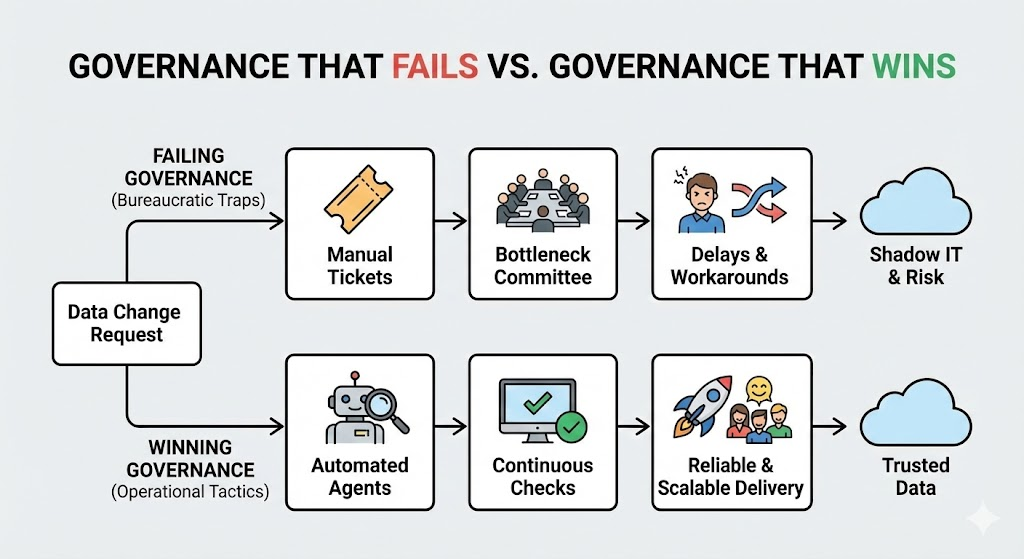
Instead of manual audits, you should deploy Data Quality Agents that run continuously. These agents monitor your critical assets for freshness and integrity, ensuring you catch bad data before it impacts executive decision-making.
Standardizing Definitions and Business Glossaries
Defining exactly what metrics like "Churn Rate" mean and enforcing that definition across all reports is a foundational step. This ensures your Marketing and Finance teams do not present conflicting numbers.
Enforcing Schema Contracts Across Teams
Schema drift is a major source of downtime. You should use schema contracts—explicit agreements on data structure—between your producers and consumers. This acts as a circuit breaker, stopping bad data from polluting your warehouse.
Lineage Tracking for Every Critical Asset
You cannot govern what you cannot trace. Data Lineage Agents automatically map the flow of your data. This visibility is essential for impact analysis and for proving compliance to regulators.
Continuous Monitoring Instead of Manual Audits
Audits are snapshots; governance requires a live feed. By implementing Anomaly Detection, you can continuously monitor access logs and quality metrics to ensure your governance posture is always current.
What Works in Real-World Data Governance
To answer the core query of what works in real-world data governance, look at practices that balance rigour with agility. IDC projects that by 2026, 40% of total revenue for G2000 organizations will come from digital products, services, and experiences, which means the quality and governance of your data estate directly shape future growth.
Governance That Doesn’t Slow Engineering Delivery
By automating policy enforcement—such as blocking PII from entering a data lake—you protect your data without requiring engineers to wait for approvals. This "governance as code" approach is what works in real-world data governance today.
Governance as Templates, Policies, and Automations
Provide your teams with templates for common policies, such as retention periods or masking rules. These should be defined centrally but applied locally to maintain speed.
Role-Based Access Control (RBAC) with Zero-Friction Onboarding
You cannot scale governance if every access request becomes a ticket. RBAC that maps roles to pre-approved data domains lets you grant the right level of access by default while masking sensitive attributes such as emails or national IDs. When onboarding is automated through identity providers and HR systems, new teammates get productive quickly without bypassing controls.
Data Quality Budgets and Data SLOs
Just as SREs use error budgets, your data teams should use Data Service Level Objectives (SLOs). If a dataset exceeds its error budget, governance dictates a freeze on new features until you restore stability.
Impact-Based Prioritization
Not all data is equal. Real-world governance starts with the assets that would hurt you most if they failed: regulatory reports, executive dashboards, customer billing, and AI training data. By ranking systems based on revenue impact, regulatory risk, and usage, you can decide where to enforce strict SLOs and where lighter-touch controls are sufficient.
Real-World Practice & Why It Works
Governance Approaches That Don’t Work in Reality
Avoid these bureaucratic traps that often lead to "shadow IT" and non-compliance.
Overly Heavy Committees and Bureaucracy
Governance councils that meet monthly to approve schema or access changes quickly become bottlenecks. In practice, teams route around them with unsanctioned pipelines and dashboards, which creates exactly the unmanaged risk you were trying to avoid.
Manual Data Validation Processes
Relying on analysts to eyeball data before a report goes out does not scale. As volumes and refresh frequency increase, human checks become slower and less reliable, while bad data still slips into production.
Governance Without Engineering Alignment
If governance is perceived as a compliance tax, engineers will fight it or ignore it. Successful programs co-design controls with engineering so that they reduce 3 AM incidents and rework instead of adding friction.
Policies That Live in Static Documents
A PDF that says “all PII must be encrypted” does nothing by itself. Unless policies are implemented as code, configuration, or automated checks, they are aspirations, not controls.
Tools and Technologies That Enable Real-World Governance
Modern governance requires an integrated stack that supports your practice at scale.
Metadata and Catalog Platforms
These serve as the inventory of your data estate, allowing you to find data, see who owns it, and understand how it is used. Modern catalogs automate metadata harvesting so the inventory stays current instead of becoming yet another stale system of record.
Data Quality and Monitoring Tools
These tools act as the heartbeat monitor for your data. They detect anomalies, validate rules, and provide the metrics you need for data observability.
Policy Automation Engines
Policy engines translate your written rules into executable actions. They can automatically tag sensitive columns, apply masking policies, archive old data to cold storage, or revoke access for inactive users without manual intervention.
AI-Driven Agentic Governance Platforms
The most effective programs now rely on agentic platforms. With agentic data management, specialized agents for data quality, lineage, and pipelines work together, backed by the xLake Reasoning Engine and Contextual Memory, to continuously scan, reason over, and heal your data environment.
How Leading Companies Apply Governance in the Real World
Across industries, leading enterprises are moving beyond theoretical governance models to approaches that deliver measurable operational impact.
Finance (regulated environments)
In finance, governance is a legal requirement. A global bank recently used automated lineage to prove to regulators exactly how a risk number was calculated, avoiding significant fines by tracing the metric back through 40+ transformations.
Retail (high-volume, fast data)
Retailers dealing with high-velocity data rely on automated Resolve capabilities to detect and fix pricing errors in real-time, ensuring governance protects your revenue during peak sales.
Healthcare (data sensitivity and compliance)
In healthcare, governance failures quickly become patient safety and regulatory issues. Providers use automated policy engines to detect protected health information in free-text clinical notes and apply masking or tokenization before the data is shared with analytics teams. Lineage and audit trails then prove to regulators exactly how patient data flowed through research pipelines without exposing identities.
Turn Real-World Data Governance Into An Agentic Advantage
Real-world data governance is defined by simplicity, automation, and clear ownership. By starting small and prioritizing based on business impact, you can build a trusted foundation that scales with your organization. The shift from manual oversight to automated guardrails is essential for any enterprise looking to lead in the era of AI.
Acceldata’s Agentic Data Management platform helps you implement these practices at scale. Powered by the xLake Reasoning Engine and Contextual Memory, Acceldata uses specialized data quality, lineage, and pipeline agents to continuously scan and heal your data environment. This approach ensures your governance policies are not just documented, but actively enforced across every cloud and warehouse.
Book a demo with Acceldata today to see how agentic data governance can transform your environment.
Frequently Asked Questions for Things That Work in Real-World Data Governance
What works in real-world data governance?
A combination of automated data quality monitoring, clear data ownership, and embedding governance checks directly into engineering workflows works best at scale.
What are the biggest challenges in implementing governance at scale?
The biggest challenges are organizational silos, the velocity of modern data, and cultural resistance to new processes. Overcoming these requires automation that reduces the manual burden on your teams.
How do companies enforce governance without slowing down innovation?
Companies use "guardrails" instead of "gates." Automated policies run in the background to catch critical issues while allowing standard development to proceed without manual approvals.
What automation is most effective for governance?
Automated schema validation, continuous data quality monitoring, and dynamic lineage tracking are the most effective. They provide high visibility with minimal manual effort.
How do I start improving governance in my organization quickly?
Start by gaining visibility into your critical data pipelines and defining clear ownership for key datasets, then automate basic quality, lineage, and policy checks to create immediate control and confidence.


.png)