




.svg)



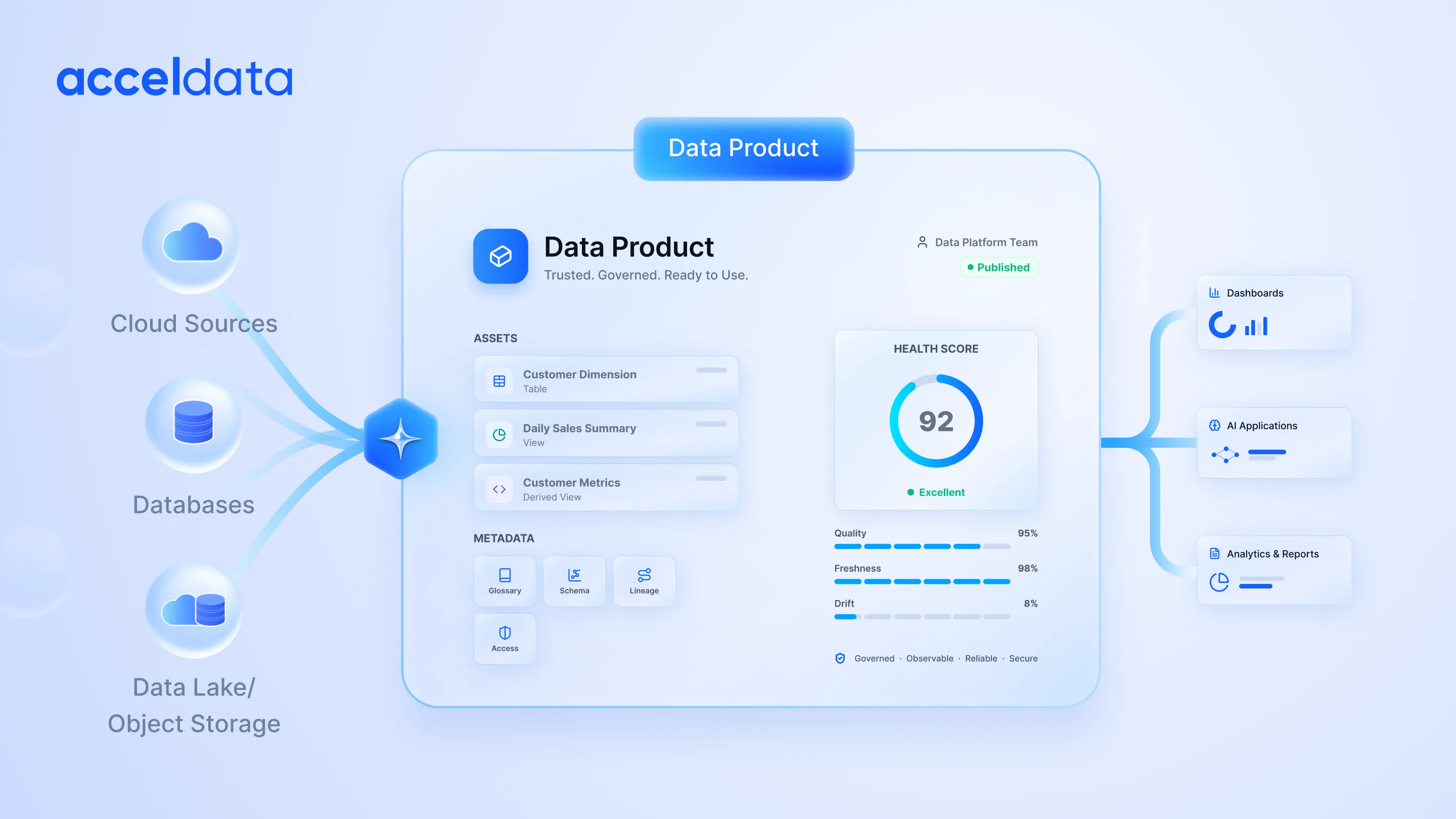
Traditional, centralized governance models break down in multi-agent data systems due to scale, autonomy, and speed. Scalable governance emerges when policies are executed by distributed, policy-aware agents that coordinate through shared signals rather than centralized control.
Enterprise data systems now rely on autonomous agents that ingest, transform, validate, and act on data in real time. But as the agent count grows, centralized oversight quickly becomes the bottleneck.
Governance reviews that once worked for batch pipelines cannot keep pace with machine-speed decisions. This is why scalable data governance has become a strategic priority.
In fact, 84% of organizations with advanced AI maturity say effective AI governance is essential for agentic AI success, compared to 65% of the least mature.
True multi-agent governance demands policy-aware automation, continuous signals, and distributed enforcement designed for governance at scale.
What Are Multi-Agent Data Systems?
Multi-agent data systems replace linear pipelines with coordinated networks of autonomous agents. Each agent owns a specific task across the data lifecycle while aligning to shared objectives and policies.
This shift toward agentic AI transforms data operations from human-led orchestration to distributed intelligence. For enterprises building multi-agent governance, understanding this architecture is critical to enabling scalable data governance.
Definition and core characteristics
A multi-agent data system includes:
- Autonomous agents that execute ingestion, transformation, validation, and monitoring tasks
- Independent decision-making within shared policy boundaries
- Event-driven coordination instead of centralized approvals
- Continuous feedback based on quality, lineage, and drift signals
Agents operate locally but share the governance context. That coordination enables governance at scale, where enforcement grows with agent count rather than human headcount.
Where multi-agent systems appear in enterprises
Multi-agent architectures now power high-impact enterprise workflows:
- Data ingestion and orchestration: Agents adjust throughput dynamically and prevent pipeline congestion.
- Data quality remediation: With agentic AI for data governance, agents detect anomalies and apply fixes automatically, reducing manual intervention.
- AI and ML operations: From preprocessing to monitoring, AI agents are redefining data management by coordinating training, inference, and feedback loops in real time.
These distributed governance systems increase speed and resilience. Without embedded controls, however, autonomy can amplify risk instead of performance.
Why Traditional Governance Does Not Scale in Multi-Agent Environments
Traditional governance assumes human review, sequential approvals, and fixed rulebooks. Those assumptions break in distributed agent architectures. When thousands of autonomous decisions occur per second, centralized control models cannot keep up. This is why scalable data governance requires structural change, not faster committees.
Centralized control becomes a bottleneck
Legacy models depend on a single oversight layer. That design works in centralized data storage environments but fails in distributed execution. A governance board cannot review agent actions at machine speed. Backlogs form instantly, slowing innovation or forcing unchecked approvals. In high-velocity systems, centralized review is not protection. It becomes friction.
Manual oversight cannot match agent velocity
Agents evaluate access, transform data, and trigger workflows in milliseconds. Humans operate in hours. The gap makes manual review unsustainable for multi-agent governance. Enterprises trying to implement data access governance through approval queues often discover that scale collapses under volume. Governance becomes either a bottleneck or symbolic oversight.
Static policies fail in dynamic agent interactions
Static policies assume predictable behavior. Multi-agent systems generate emergent patterns through real-time coordination. Fixed rules cannot anticipate every interaction across distributed governance systems. Effective agentic data governance must adapt continuously. Without adaptive enforcement, governance at scale either restricts system performance or fails to contain risk.
What “Scalable Governance” Actually Means in Multi-Agent Systems
Scalable data governance is not about adding more reviewers. It is about redesigning control so it expands with system growth. In multi-agent environments, governance must operate at decision time, not after the fact.
That shift moves authority from centralized checkpoints to embedded policy logic. Modern AI-driven data governance models reflect this transition from oversight to distributed execution.
Governance that grows with agent count, not headcount
Traditional models tie governance capacity to human review. As agents increase, cost and delay increase. In contrast, well-architected agentic data governance embeds policy rules directly into agents. Each new agent enforces shared standards locally, strengthening governance at scale rather than straining it.
Distributed enforcement instead of central approval
Scalable models execute policies where actions occur. Agents validate access, transformation, and usage decisions in real time. This eliminates queue-based approval systems and supports resilient distributed governance systems. Modern data governance platforms enable this pattern by codifying policy logic once and enforcing it everywhere.
Continuous coordination over periodic review
Periodic audits cannot manage dynamic agent networks. Governance must function as an always-on coordination layer. Agents exchange signals related to quality, lineage, risk, and drift, adjusting behavior continuously. This model ensures compliance and adaptability without slowing performance.
Core Capabilities That Enable Scalable Governance
Effective scalable data governance in multi-agent environments requires architectural capabilities that embed control directly into execution. Governance must move from external review to built-in enforcement across distributed data systems.
Policy-aware agents
At the center of agentic data governance are agents that understand governance intent, not just instructions. Instead of applying rules after execution, policy-aware agents incorporate constraints into decision logic.
| Capability | Traditional agents | Policy-aware agents |
|---|---|---|
| Decision Logic | Task-focused only | Includes governance constraints |
| Policy Understanding | External rules | Internalized intent |
| Compliance | Checked after action | Enforced within action |
| Adaptation | Manual updates | Dynamic policy alignment |
By embedding a shared data protection policy into runtime logic, agents prevent violations before they occur. This design ensures governance at scale without slowing performance.
Decentralized enforcement architecture
In distributed governance systems, enforcement happens where actions occur. No central approval layer reviews every request. Agents validate access, transformation, and sharing decisions locally using synchronized policy definitions.
This model aligns with distributed data principles and supports resilient execution across domains. When governance logic is embedded into a modern data architecture, system growth increases enforcement capacity rather than risk exposure.
Shared governance context across agents
Consistency requires a common semantic model across agents. Without shared definitions, policies drift. Scalable multi-agent governance depends on:
- Standardized policy language
- Version-controlled updates
- Cross-agent synchronization
- Automated validation testing
These capabilities, foundational to agentic AI for data management governance, create a coordinated enforcement fabric across complex ecosystems.
The Role of Observability Signals in Scaling Governance
In multi-agent environments, governance cannot rely on reports generated after execution. Scalable data governance depends on real-time observability signals that inform decisions as they happen. By treating governance as a continuous data flow problem, organizations align oversight with agent velocity.
Agents govern based on signals, not reports
Modern agentic data governance uses live inputs such as freshness, quality, drift, and data lineage to guide enforcement. These signals enable:
- Sub-second policy evaluation
- Context-aware access and transformation controls
- Automated remediation workflows
- Early detection of anomalous behavior
Instead of waiting for dashboards, agents act on state changes immediately. This shift turns governance at scale into an always-on coordination layer.
A national consumer bank facing $10M in potential regulatory exposure lacked visibility into thousands of automated data jobs. By shifting to near-real-time anomaly detection, they reduced SLA breaches by 96%, replacing reactive audits with continuous oversight.
Feedback loops between agents and governance outcomes
Each enforcement action produces learning. If a remediation step succeeds, that outcome strengthens future decision logic. If it fails, controls adjust. Continuous feedback improves policy precision across distributed governance systems, reducing false positives and blind spots.
Detecting systemic risk across agent networks
Governance must identify patterns, not isolated events. Agents monitor cross-system correlations such as coordinated drift, unusual resource spikes, or repeated policy conflicts. Within mature enterprise data governance models, these systemic signals trigger proactive containment before localized issues cascade into enterprise-wide failures.
As PhonePe scaled to 1,500 nodes supporting half a billion daily transactions, passive metadata proved insufficient. Continuous observability improved data quality by 46%, enabling governance to scale alongside infrastructure growth.
How Coordination Replaces Central Control
In high-velocity systems, command-and-control models fail. Scalable data governance emerges when agents coordinate decisions instead of waiting for central approval. This shift enables governance at scale without slowing execution.
Agent-to-agent governance communication
In mature multi-agent governance, agents exchange signals about risk, policy violations, and uncertainty. Oversight becomes a mesh rather than a hierarchy.
Common coordination patterns include:
- Risk propagation signals across dependent agents
- Confidence thresholds for autonomous decisions
- Escalation triggers when uncertainty exceeds limits
- Shared alignment with AI data governance standards
This model strengthens distributed governance systems because every new agent contributes to monitoring capacity.
Conflict resolution without human escalation
Conflicts are resolved through predefined arbitration logic embedded within agentic AI frameworks. When agents disagree, resolution follows:
- Confidence-weighted decision thresholds
- Priority rules based on governance impact
- Automated fallback to stricter policy constraints
Human intervention occurs only when system-wide confidence drops below defined thresholds. This design ensures that agentic data governance remains adaptive while preserving control.
Scaling Governance Across Thousands of Data Assets
Enterprise environments generate thousands of datasets across domains, formats, and platforms. Manual configuration cannot sustain that growth. Scalable data governance depends on abstraction and automation, so controls expand with the asset footprint.
Asset-agnostic policy definitions
Instead of writing rules per dataset, policies apply based on characteristics. A PII control or data retention policy attaches automatically when sensitive fields are detected. This model supports governance at scale by defining intent once and enforcing it everywhere.
Metadata-driven governance expansion
Agents use metadata to classify and govern new assets in real time. When a new source appears, they:
- Extract structural and semantic metadata
- Match attributes to policy templates
- Apply appropriate controls
- Register the asset within distributed governance systems
This automation ensures that multi-agent governance extends instantly to newly discovered assets without human intervention.
A global information provider managing 500 billion records across 30,000 sources faced massive governance gaps under manual review models. After implementing automated rule enforcement, data quality processing dropped from 22 days to 7 hours. Governance scaled with data volume, not review capacity.
Eliminating asset-by-asset configuration
When governance logic is embedded into asset discovery, policy updates propagate automatically. This approach reduces operational risk and avoids the hidden cost of poor data quality and governance. At scale, agentic data governance shifts effort from repetitive configuration to strategic oversight, enabling consistent enforcement across thousands of evolving data assets.
Governance in Multi-Agent AI and ML Pipelines
AI and ML pipelines evolve continuously. Data distributions shift, models degrade, and feedback loops introduce new variables. Without embedded controls, these dynamics undermine scalable data governance. Multi-agent architectures address this by enforcing policy across training, inference, and monitoring stages.
Governing training, inference, and feedback loops
Within automated data pipelines, specialized agents monitor:
- Training data distributions
- Feature drift across data models
- Model performance and bias indicators
- Feedback loop integrity
This structure strengthens multi-agent governance by embedding quality and compliance checks directly into pipeline execution.
Preventing model drift through governance constraints
Monitoring agents apply predefined thresholds to detect model drift early. When variance exceeds policy limits, controls trigger retraining, rollback, or feature recalibration. This adaptive enforcement ensures governance at scale while protecting production systems from silent degradation.
Coordinating data and model agents under shared rules
Data agents and model agents must operate under unified policy logic. Without coordination, data controls and model objectives conflict. Mature agentic data governance frameworks align lifecycle controls with the data governance maturity model, ensuring consistent enforcement across distributed governance systems.
Scalable Governance vs Centralized Governance
The difference between centralized control and scalable data governance becomes clear when systems shift to distributed execution. In agent-driven environments, governance must match decision velocity, automation depth, and AI lifecycle complexity.
| Dimension | Centralized governance | Scalable multi-agent governance |
|---|---|---|
| Control Model | Single authority | Distributed enforcement |
| Scalability | Limited by headcount | Expands with agent capacity |
| Decision Speed | Human-paced | Real-time |
| Adaptability | Static policies | Dynamic, signal-driven |
| AI Readiness | Reactive | Built for agentic data governance |
Centralized models slow multi-agent governance and increase operational risk. Governance at scale depends on embedded controls within distributed governance systems.
Common Failure Modes When Scaling Governance
Even a well-designed, scalable data governance programs fail when legacy thinking persists. In distributed governance systems, control must evolve with system architecture.
Over-constraining agents
Excessive restrictions limit autonomy and reduce system value. When policies prioritize optics over outcomes, governance becomes performance drag. Effective agentic data governance balances safety with operational freedom. Governance at scale should protect critical assets without disabling intelligent automation.
Inconsistent policy interpretation
Without shared context, agents interpret policies differently. This creates uneven enforcement across multi-agent governance environments. Standardized policy language and synchronized updates prevent drift. A clear data governance strategy ensures alignment between control intent and execution logic.
Missing human override paths
Automation handles most decisions, but edge cases require escalation. Systems that lack defined override mechanisms risk paralysis or silent errors. Clear escalation protocols, aligned with data governance vs data management principles, preserve accountability while maintaining speed. Avoiding these failure patterns strengthens governance maturity and improves resilience in AI-driven systems.
Best Practices for Building Scalable Governance in Multi-Agent Systems
Effective scalable data governance requires architecture, not afterthoughts. In distributed governance systems, control must be embedded from design to deployment.
Design governance as a system, not a layer
Governance should be integrated into agent logic from the start. Retrofitting controls onto existing workflows creates gaps and latency. Modern AI data governance frameworks treat policy enforcement as part of system design, not a compliance add-on.
Combine autonomy with bounded authority
Agents need decision freedom within defined constraints. Clear authority limits, expressed in policy code, prevent runaway behavior while preserving speed. This balance strengthens multi-agent governance and enables governance at scale without micromanagement.
Measure governance outcomes, not rule coverage
Mature programs track impact, not rule count. Key indicators include:
- Risk exposure reduced
- Decision velocity maintained
- Violations prevented
- System resilience improved
Aligning metrics with a defined data governance model ensures that agentic data governance delivers measurable value.
The Future of Governance in Multi-Agent Enterprises
In multi-agent environments, governance becomes a coordination fabric, not a control checkpoint. Scalable data governance will define enterprise maturity as agent networks expand. Organizations cannot double governance teams each time automation scales.
Instead, multi-agent governance must embed adaptive controls into distributed governance systems. The shift is clear: from compliance-only oversight to resilience-driven design. In the coming years, governance at scale will separate AI-ready enterprises from those constrained by legacy models.
Operationalize Scalable Governance Across Agents with Acceldata
As multi-agent systems expand, governance must operate at machine speed. Scalable data governance requires real-time enforcement, shared context, and continuous signals across distributed governance systems.
Acceldata’s Agentic Data Management Platform embeds agentic data governance into daily operations through autonomous detection, policy-aware remediation, and cross-domain observability.
Request a demo to operationalize governance at scale across your multi-agent data environment with real-time control and measurable resilience.
FAQs
Why can't centralized governance scale in multi-agent systems?
Centralized governance creates fundamental bottlenecks when agent decisions occur in milliseconds. The velocity mismatch between human review cycles and agent operations, combined with the exponential growth in decision volume, makes centralized approval physically impossible at scale.
How do agents stay consistent without central control?
Agents maintain consistency through shared policy definitions, synchronized state, and peer-to-peer coordination protocols. Like internet routers maintaining network coherence without central control, agents use distributed consensus mechanisms to ensure governance alignment.
Does scalable governance eliminate human oversight?
No—it redirects human oversight to where it provides most value. Instead of reviewing routine decisions, humans focus on policy design, edge case resolution, and system-level optimization. This shift from tactical to strategic oversight improves both efficiency and effectiveness.
How does scalable governance reduce operational risk?
By embedding governance directly into agent decision-making, risks are prevented rather than detected after the fact. Distributed enforcement ensures no single point of failure, while continuous monitoring identifies emerging risks before they cascade through the system.


.png)