




.svg)


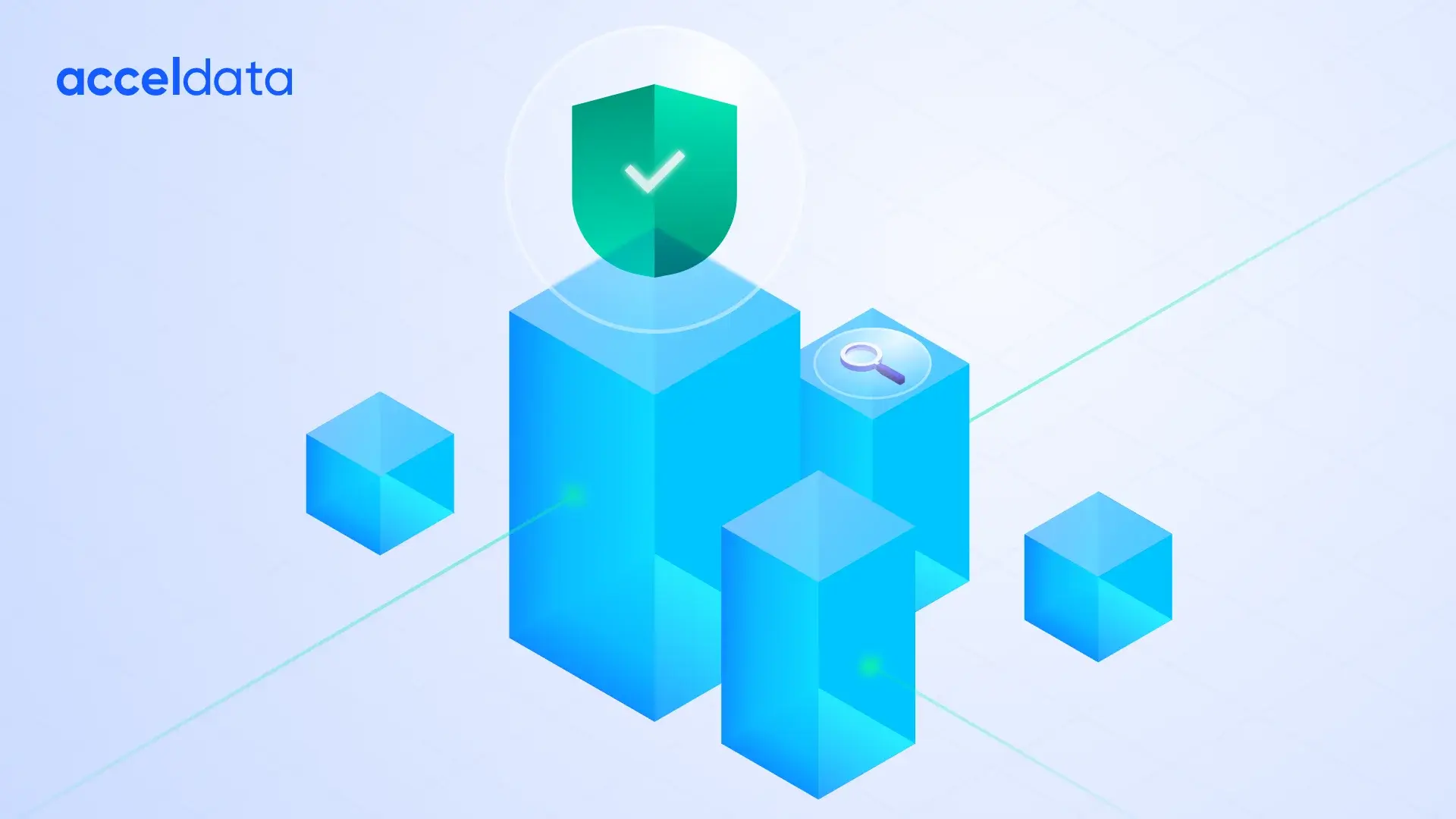

Policies look great on paper, but enforcing them across multiple systems, formats, and teams is a constant uphill climb. A mismatched record or a permissions gap can create tensions across departments.
Agentic AI does not wait for you to identify and fix these issues. These autonomous AI agents monitor, enforce, and even resolve governance issues in real time, delivering stronger security and cleaner data to keep pace with your business.
Let's examine how agentic AI is changing data governance best practices, its significance for security and compliance, and how you can leverage it to safeguard critical assets.
What is Agentic AI in Data Governance?
Agentic AI refers to autonomous AI agents that can make decisions and take action without human intervention. In data governance, these agents streamline and secure the way organizations manage their data, from organizing access control to automating data compliance with AI, by working continuously in the background.
Here are a few key features that help in enhancing data governance with AI:
- Detect and resolve governance issues as they occur with real-time decision-making.
- Handle routine governance tasks at scale without slowing down teams with the help of AI automation.
- Improve detection and response using historical data and patterns while promoting adaptive AI learning
- Seamless integration with existing data tools to embed governance directly into workflows.
The Role of Data Governance in Ensuring Data Security and Control
AI-driven data governance is your organization’s framework of policies, practices, and tools for managing data and ensuring it’s accurate, secure, and accessible to the right people when needed. Done right, it builds trust in your data so decisions, analytics, and AI models are based on reliable information.
Security and control are central to this framework because, without them, manual processes and fragmented tools leave dangerous governance gaps and blind spots. Strong, automated data governance helps you stay compliant with regulations like GDPR, HIPAA, and SOX. It reduces operational and reputational risk, ensuring your data remains protected throughout its lifecycle.
How Agentic AI Enhances Data Governance Best Practices
Traditional governance frameworks often require individuals to identify problems, escalate them, and implement solutions. Agentic AI workflows replace the slow, error-prone process by utilizing autonomous agents that act the moment an issue appears.
Consider these agentic AI data governance best practices:
1. Automated security enforcement
You don't need to hope for your team to remember security protocols with agentic AI. They’re embedded into your data operations. Use them for:
- Encryption and access control: Apply encryption standards and enforce role-based access without waiting for manual provisioning.
- Data masking: Mask or anonymize sensitive fields automatically when accessed by non-privileged users.
- Proactive protection: Detect suspicious activity and block it before data is compromised.
Acceldata’s policy automation enhances security enforcement by enabling context-aware, self-tuning policy orchestration. For example, you can test your policy changes before enforcing them to avoid unintended disruptions. It also automatically compares row-level data between systems to detect mismatches that may indicate integrity or security issues.
2. Real-time compliance monitoring
Compliance demands continuous oversight. With agentic AI, you don’t have to wait for quarterly reviews or audit week to discover a compliance gap. AI agents continuously monitor your data environment to ensure every interaction, transfer, and transformation aligns with your governance policies.
- Always-on oversight: Track every interaction with sensitive datasets, comparing activity to compliance policies like GDPR or HIPAA.
- Instant alerts: Trigger immediate alerts in case of any policy deviation to respond before it becomes a violation.
- Audit readiness: Keep systems up-to-date with tamper-proof records that can be pulled for audits without scrambling.
With Acceldata’s anomaly detection, compliance monitoring turns from reactive to proactive. For example, you can replace manual checks with continuous, end-to-end tracking of data jobs and flows, as well as instantly trace issues like schema drift or null-value spikes back to their origin, making the process more precise.
3. Data integrity checks
Minor data errors can escalate into significant business, operational, or compliance issues. A mislabeled field, a missing value, or a near-duplicate record can derail analytics, skew AI models, and create costly downstream fixes.
Agentic AI can identify and prevent these issues as they arise, ensuring your data remains clean, consistent, and trustworthy.
- Error detection: Flag duplicates, missing fields, inconsistent formats, or conflicting records.
- Self-healing: Correct specific issues, such as standardizing units or merging near-duplicates.
- Source reconciliation: Resolve conflicts between datasets based on predefined rules.
A Reddit user described spending hours on an order fulfillment process manually. They said,
"Someone accidentally copy/pasted a client ID (9 digit number) into the contract duration field. We issued 200 million year license to the client. [sic]"
With the Acceldata data quality agent, these situations are replaced with autonomous, always-on quality assurance. You can scan batch jobs, pipelines, and tables for violations like missing values, stale records, or schema drift 24/7. You can also reason across lineage, metadata, and telemetry to pinpoint where the problem originated, whether it’s a faulty sensor or a customer input error.
Agentic AI’s Impact on Data Access Control and Security
Access control failures often show up during role changes, unusual activity, or audit requests. By then, the damage may already be done. Agentic data access control closes those gaps by dynamically enforcing permissions, detecting risks early, and maintaining a complete record of every interaction.
1. Automated role-based access
Instead of routing requests through slow approval chains, AI agents can adjust permissions as needed. If a contractor’s project ends at midnight, their access is revoked automatically. If a team member assumes a new role, their data permissions are updated in line with policy without requiring any additional tickets. Continuous scans also catch and remove outdated rights, preventing privilege creep.
2. Predictive security threat detection
Predictive AI data governance tools build a baseline of normal activity for each user, team, and application. If someone logs in from an unusual location at 3 a.m. or downloads an unusually large dataset, the system flags it and assigns a risk score. This helps security teams focus on the most urgent threats while avoiding alert fatigue.
3. Audit trails and data provenance
Every access event, who, what, when, and why, is logged automatically. Provenance tracking adds another layer, tracing each data asset from its origin through every transformation and use. This makes it easy to pinpoint the source of changes, prove compliance, and verify that sensitive information hasn’t been altered.
Benefits of Operationalizing Data Governance with Agentic AI
Embedding agentic AI into data governance automation delivers significant benefits like:
- Scalability across data environments: Manage governance across hybrid and multi-cloud setups, scaling effortlessly as data volumes and sources grow.
- Lower operational costs: Automate high-volume governance tasks and reduce manual intervention to cut both labor costs and error-related expenses.
- Consistent policy enforcement: Apply governance rules uniformly across all systems, ensuring compliance and control without additional oversight.
- Faster decision-making: Monitor continuously and provide instant validation so that governance insights are available as soon as they’re needed.
Real-World Applications of Agentic AI in Data Governance
Here’s how agentic workflows are making a measurable difference:
1. Financial services
Banks, insurers, and fintech companies face some of the toughest compliance standards from KYC and AML to SOX regulations. AI agents can monitor transactions in real time, flagging unusual activity and preventing fraud before it spreads.
They also automate compliance reporting, producing audit-ready documentation without the need for weeks of manual preparation.
2. Healthcare
Handling Protected Health Information (PHI) demands zero tolerance for errors. AI agents enforce privacy rules, mask sensitive details, and track data access down to the individual record for complete accountability.
They maintain data quality by detecting mismatched records, missing fields, or incorrect formats before they impact care or compliance. When patient data moves between systems, governance safeguards ensure it remains accurate and protected.
3. Retail and e-commerce
In retail, data governance has a direct impact on customer trust and confidence. AI agents automatically apply anonymization rules to prevent personal details from being exposed during analytics.
They detect suspicious account activity or purchase patterns in real time, helping to stop fraud before it damages your brand. Clean, consistent data also enables accurate personalization without crossing privacy boundaries.
Best Practices for Operationalizing Data Governance with Agentic AI
To successfully harness the benefits of data governance AI and enjoy successful agentic data management, consider these best practices:
- Align governance rules with both business objectives and regulatory requirements, and make sure they’re easy for teams to follow in daily operations.
- Ensure all stakeholders understand the purpose, scope, and impact of governance policies so adoption is smooth and consistent.
- Keep governance rules adaptable as regulations, business priorities, and data environments evolve quickly.
- Use AI agents for 24/7 oversight, automated audit trail creation, and anomaly detection so compliance is maintained without last-minute scrambles.
Future Trends in Agentic AI Data Governance
The pace of innovation in AI-powered governance is only accelerating. Here’s what’s next:
1. Advanced AI capabilities
Future governance agents will move beyond today’s rule enforcement to predictive and context-aware decision-making. They’ll use deeper pattern recognition to anticipate risks before they emerge and trigger corrective actions that align with evolving business and regulatory demands.
2. Increased autonomy
AI will shift from supporting governance teams to independently managing policy creation, updates, and enforcement. These agents will adapt rules on the fly in response to new data types, security threats, or operational changes.
3. Convergence of AI and blockchain
Pairing AI with blockchain could deliver unprecedented transparency and security. Blockchain creates tamper-proof, immutable records of every data event, while AI continuously validates and enforces governance policies. Together, they form a verifiable, real-time system of trust ideal for heavily regulated industries.
Shift to Autonomous Data Management with Acceldata
Agentic AI embeds intelligence directly into your data infrastructure, upholds policies, and adapts them in real time, ensuring your data remains accurate, secure, and compliant.
As a result, you get a governance framework that’s faster, smarter, and resilient enough to handle the demands of modern data ecosystems, allowing your teams to focus on innovation.
Acceldata's agentic data management platform combines autonomous AI agents, anomaly detection, data lineage, policy automation, and scalable reasoning into a single unified system. It enforces rules, understands them, adapts them, and acts instantly to keep your data accurate, reliable, and audit-ready.
For enterprises managing vast, complex, and fast-changing data environments, this means fewer blind spots, faster resolutions, and governance that keeps pace with business demands.
Discover how Acceldata’s Agentic AI solutions can help you automate and enhance your data governance practices for better security and control. Contact us for more info!
Frequently Asked Questions About Agentic AI in Data Governance
1. What is the role of agentic AI in data security?
Agentic AI enhances data security by automating policy enforcement, monitoring data access and usage, and detecting suspicious activity in real time. This ensures that threats are identified and addressed before they can cause damage.
2. How does agentic AI automate data governance?
Agentic AI enforces governance policies in real time by continuously scanning data, monitoring access, and verifying quality metrics. When it detects a policy violation or data issue, it can take immediate corrective action without requiring manual intervention.
3. What are the key benefits of using agentic AI for compliance management?
With agentic AI, organizations gain always-on compliance monitoring, significantly reduce manual reporting work, and lower the risk of violations by catching issues early. This results in smoother audits and stronger regulatory alignment.
4. Can agentic AI handle large-scale data governance tasks?
Yes. Agentic AI is built to manage vast datasets across multiple platforms, adapting governance rules as data grows and changes. It ensures performance and compliance remain consistent even in highly complex environments.