




.svg)



For decades, the "Governance Committee" was the gold standard for enterprise data integrity. You likely remember the drill: a cross-functional group of stakeholders meeting once a month to review access requests, debate data definitions, and approve policy exceptions. In a world of static data warehouses and quarterly reporting cycles, this centralized model worked by providing a necessary human brake.
However, the ground has shifted. Today, your data is a high-velocity stream powering real-time analytics and autonomous AI agents. Recent research from Gartner indicates that by 2027, 80% of organizations seeking data and analytics governance will fail. The manual, committee-led approach simply cannot scale to the speed of modern business.
By shifting from periodic human reviews to execution-driven, agentic systems, you can move away from being the "department of no" to becoming the "foundation of scale." This evolution ensures your data remains compliant without sacrificing the speed of innovation.
How Governance Committees Were Originally Meant to Work
The traditional governance operating model was built on the assumption that data was a controlled, finite resource.
Centralized Decision-Making Models
In this classic setup, you relied on a small group of experts to act as gatekeepers. These committees were responsible for:
- Approving access: Manually vetting who gets to see which dataset.
- Policy definition: Drafting long documents that describe how data should be handled.
- Exception management: Reviewing one-off requests where the standard rules didn't apply.
Assumptions Behind Committee-Based Governance
This model flourished because several conditions were true at the time:
- Slow-changing systems: Databases were updated in batches, usually overnight or weekly.
- Limited producers: Data was created by a handful of core enterprise applications.
- Clear boundaries: There was a clear line between the "creators" of data (IT) and the "consumers" (Business).
While these assumptions held for years, the explosion of cloud-native architectures has rendered them obsolete. Embracing a more dynamic approach is the only way to maintain relevance in a distributed data landscape.
Why Governance Committees No Longer Scale
If you feel like your governance process is a bottleneck, you aren't alone. The committee-based model is currently facing a "breaking point."
Decision Latency in Always-On Data Systems
Data pipelines today move at sub-second speeds. If your pipeline detects a schema change or a quality issue at 2:00 AM on a Tuesday, waiting for the governance committee meeting on the following Friday is a recipe for disaster. By the time a human makes a decision, the "bad" data has already polluted your downstream dashboards and AI models.
Human Bottlenecks and Organizational Drag
Your data stewards and reviewers are likely overloaded. As the volume of data assets grows, the backlog of approvals grows with it, creating a culture of "governance bypass" where teams find workarounds just to keep projects moving. This drag ultimately increases your risk profile while slowing down critical business insights.
Inconsistent Enforcement Across Platforms
Humans are subjective. Two different stewards might interpret the same "privacy policy" differently when applied to different cloud platforms, leading to governance fragmentation. This inconsistency makes it nearly impossible to maintain a unified security posture across a multi-cloud environment.
Transitioning to an automated approach is the only way to ensure your governance framework can keep pace with the relentless speed of modern data.
The Structural Mismatch Between Committees and Modern Data
The gap between how we govern and how we execute has become a chasm that manual processes can no longer bridge.
- Real-time pipelines vs. periodic reviews: You cannot manage a continuous flow of information with a scheduled meeting; modern data requires continuous governance that acts at the same tempo as the data itself.
- AI surface area: AI doesn't just use data; it creates it. As you deploy more LLMs and agentic systems, the number of "decisions" that need governing—from bias checks to prompt injection monitoring—multiplies beyond human capacity.
- The scale of assets: When you have thousands of datasets, features, and models, manual oversight becomes a mathematical impossibility.
Relying on human-only committees in this environment is like trying to manage high-frequency trading with a hand-written ledger. Transitioning to automated logic is the only way to bridge this structural divide.
What Autonomous Governance Systems Do Differently
Autonomous systems flip the script by acting on the human’s behalf.
Governance Decisions Executed by Systems
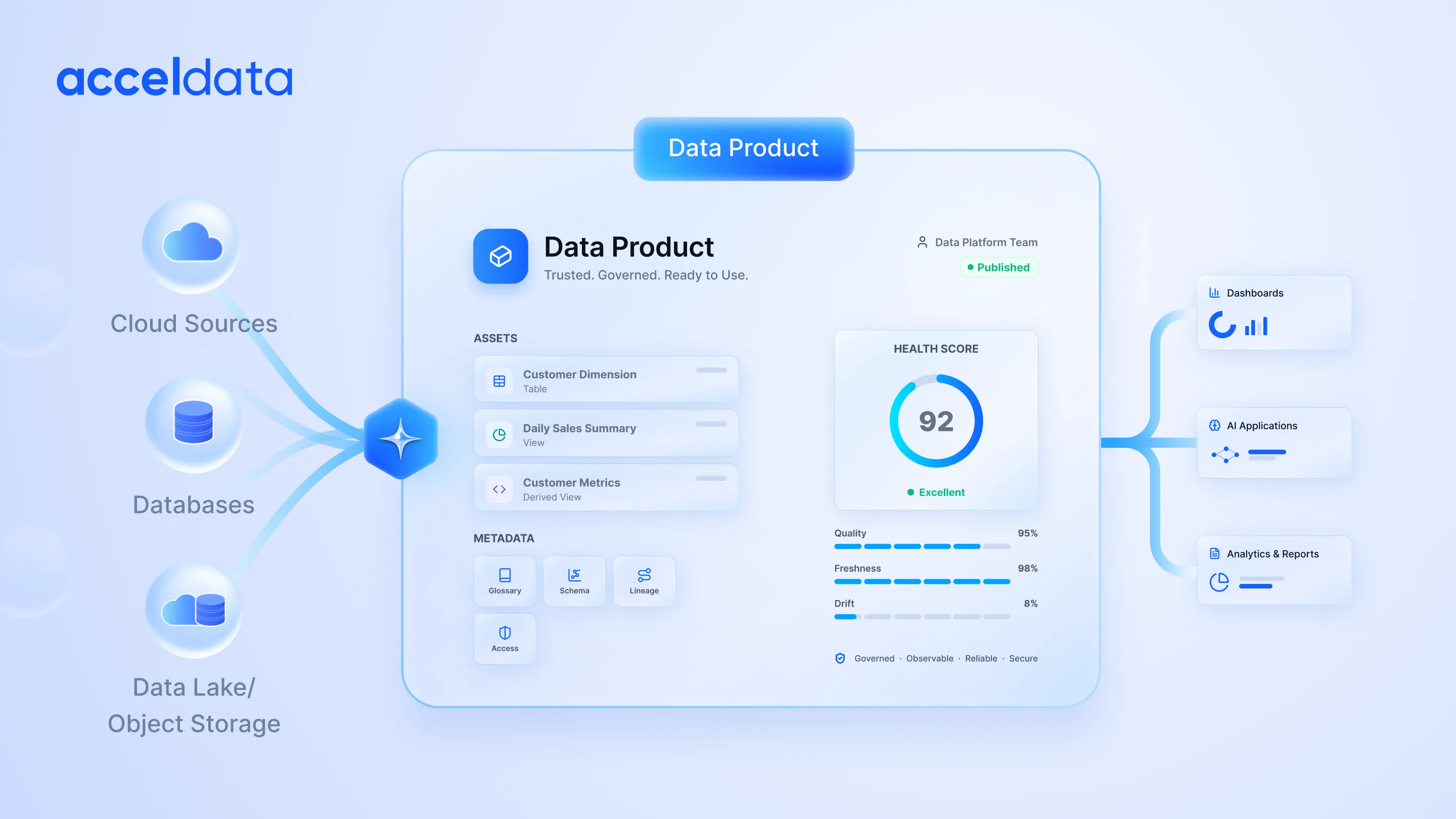
In an autonomous model, policies are not just text in a PDF; they are executable logic. When you define a rule—such as "mask all PII for analysts"—the system doesn't just flag it; it enforces it at runtime across all environments. This ensures that your security standards are always active, regardless of the time of day.
Continuous Enforcement Instead of Approval Cycles
Autonomous systems provide always-on validation. If a data quality agent detects a breach in a "freshness" SLA, it can automatically trigger a remediation workflow or quarantine the data. This removes the dependency on meeting cadences and ensures your data quality is never compromised.
Context-Aware Decision Making
These systems leverage metadata, lineage, and observability signals to make informed decisions. For example, the system can determine that a certain data drift is acceptable for a dev environment but critical for a production financial report.
This intelligence allows the system to handle complexity that would normally require a human's nuance. In an autonomous model, the focus shifts from manual oversight to proactive, system-wide execution that adapts to your data's unique context.
By integrating these intelligent behaviors directly into your workflows, you ensure that governance is never an afterthought but a continuous, built-in feature of your data environment.
From Committees to Control Planes
To scale, you must treat governance as an operating layer, not an administrative task.
Governance as an Operating Layer
By embedding governance directly into your data platforms, you move enforcement closer to the workloads. This "governance as code" approach ensures that every Spark job or Snowflake query is automatically compliant with your enterprise standards. It transforms governance from a peripheral activity into a core component of your data architecture.
Policy Interpretation Without Human Mediation
Autonomous systems evaluate intent and constraints. When you set a high-level goal, the system uses agentic governance systems to determine the best way to enforce it across diverse technical stacks. This results in deterministic and repeatable enforcement that no committee could achieve manually.
By turning governance into a foundational operating layer, you ensure that every data asset remains compliant from the moment it is created until it is consumed.
How Autonomous Governance Redefines Roles (Not Removes Them)
A common fear is that "autonomous" means "no humans," but in reality, it means humans move to higher-value work.
- Policy designers: Instead of clicking "approve" on 100 access requests, you focus on defining the intent, thresholds, and constraints that guide the AI.
- Escalation authorities: Your governance committee evolves into a "Supreme Court." They no longer review every minor traffic ticket; they handle complex edge cases and oversee the behavior of the autonomous system itself.
Automating the mundane tasks allows your best talent to focus on strategic data leadership. This shift increases job satisfaction while simultaneously improving organizational security.
Risk Reduction Through Autonomous Governance
Shifting to an autonomous model significantly lowers your enterprise risk by removing human error and delay.
Faster Detection and Enforcement
By handling issues before they have a downstream impact, you prevent small errors from becoming headline-grabbing outages.
Reduced Compliance Exposure
Regulatory requirements like GDPR and the EU AI Act demand "continuous" evidence of compliance. Autonomous systems generate automated evidence packs and audit trails in real-time. This proactive documentation ensures that your organization is always audit-ready, without the need for manual data gathering.
More Consistent Governance Outcomes
Humans are prone to fatigue and bias, but machines are not. An autonomous system applies the same policy with the same rigor every time, ensuring your governance outcomes are predictable across the entire enterprise. This consistency is the foundation of trust in any modern data-driven organization.
Automating the detection and remediation of risks, you replace the "best-effort" approach of human committees with a rigorous, machine-speed defense system. Ultimately, this proactive stance transforms governance from a defensive cost center into a reliable driver of enterprise-wide trust and stability.
Committee-Based vs. Autonomous Governance
To truly understand the necessity of this shift, you must evaluate the stark contrast between the traditional, human-led approach and the modern, system-driven model.
| Dimension | Committee-based governance | Autonomous governance |
|---|---|---|
| Decision speed | Decisions are delayed by meeting schedules and human review cycles, often taking days or weeks. | Policies are evaluated and applied in milliseconds at the point of data ingestion or processing. |
| Scalability | Throughput is bottlenecked by the finite capacity and availability of human data stewards. | Governance capacity scales horizontally with your infrastructure to handle trillions of records. |
| Enforcement | Relies on manual checks or periodic audits, often catching violations long after they occur. | Provides proactive, real-time enforcement that blocks or remediates non-compliant data instantly. |
| Consistency | Policy application varies based on the subjective interpretation of different committee members. | Rules are applied via deterministic code, ensuring identical outcomes across all platforms and pipelines. |
| AI readiness | The manual pace is insufficient to govern the high-speed outputs and risks of agentic AI models. | Designed for the AI era, providing the machine-speed guardrails necessary for safe, autonomous operations. |
This comparison highlights why the traditional model is no longer sustainable for high-growth enterprises. Switching to autonomous systems is the only way to keep pace with the modern data economy.
Common Concerns About Replacing Committees
It’s natural to feel hesitant about letting a system take the wheel, but the benefits of automation far outweigh the perceived risks.
- Fear of losing control: You aren't losing control; you are gaining visibility. Autonomous systems provide explainability logs that show exactly why every decision was made.
- Trust in automated decisions: You can start with "Human-in-the-Loop" (HILT) configurations, where the AI suggests an action and you simply click "confirm."
- Accountability: Accountability stays with the policy designers who define the rules that the system executes.
By implementing these systems with clear oversight, you can build trust while reaping the rewards of automation. Understanding these concerns is the first step toward a successful transition to an agentic model.
Why Autonomous Governance Is Inevitable
The market is moving faster than any committee can possibly respond.
- Data velocity: As data volumes continue to grow exponentially, manual oversight will eventually reach a 0% coverage rate.
- AI requirements: You cannot govern an AI agent that makes thousands of decisions per minute with a monthly meeting.
- Efficiency: Organizations lose significant revenue annually due to poor data quality and manual friction.
Refusing governance automation will eventually leave your organization unable to compete in an AI-first world. Adopting these systems now ensures you stay ahead of the curve.
What the Transition Looks Like in Practice
You don't have to switch overnight; most successful enterprises adopt a hybrid approach.
- Phase 1: Use agents for data profiling and anomaly detection to provide "recommendations."
- Phase 2: Gradually authorize the system to perform automated remediation for low-risk datasets.
- Phase 3: Full autonomous enforcement for standard policies, with humans managing only the most complex exceptions.
This phased approach allows your team to build confidence in the system while realizing immediate efficiency gains. Starting small is the most effective way to ensure long-term success.
The End State: Governance as an Autonomous System
In the near future, governance will no longer be an activity you "do"—it will be a state your data "is in." Committees will define the "North Star" of intent, while autonomous control planes ensure that every byte of data follows that star in real-time.
This shift allows you to stop worrying about the "how" of governance and focus on the strategic "why" of your business.
As you navigate this shift from manual committees to autonomous systems, the Acceldata Agentic Data Management Platform provides the intelligence and guardrails you need.
With specialized agents for anomaly detection, pipeline health, and policy enforcement, we help you build a governance model that actually scales.
Ready to move beyond the committee bottleneck? Book a demo of the Acceldata platform today and see how autonomous governance can transform your data operations. This is your opportunity to turn governance into a competitive advantage.
Frequently Asked Questions
Does autonomous governance eliminate governance committees?
No, it evolves their role. Committees shift from approving individual requests to designing high-level policies and overseeing system performance.
How do enterprises maintain accountability with autonomous systems?
Accountability is maintained through comprehensive audit logs and "explainability" features that document the rationale behind every automated decision.
Can autonomous governance handle exceptions and nuance?
Yes, by using context-aware engines like xLake, these systems can interpret complex metadata to handle most nuances, while escalating truly unique cases to human experts.
Is autonomous governance suitable for regulated industries?
Absolutely. In fact, it is often preferred in regulated sectors like finance and healthcare because it provides more consistent enforcement and a continuous audit trail.


.png)