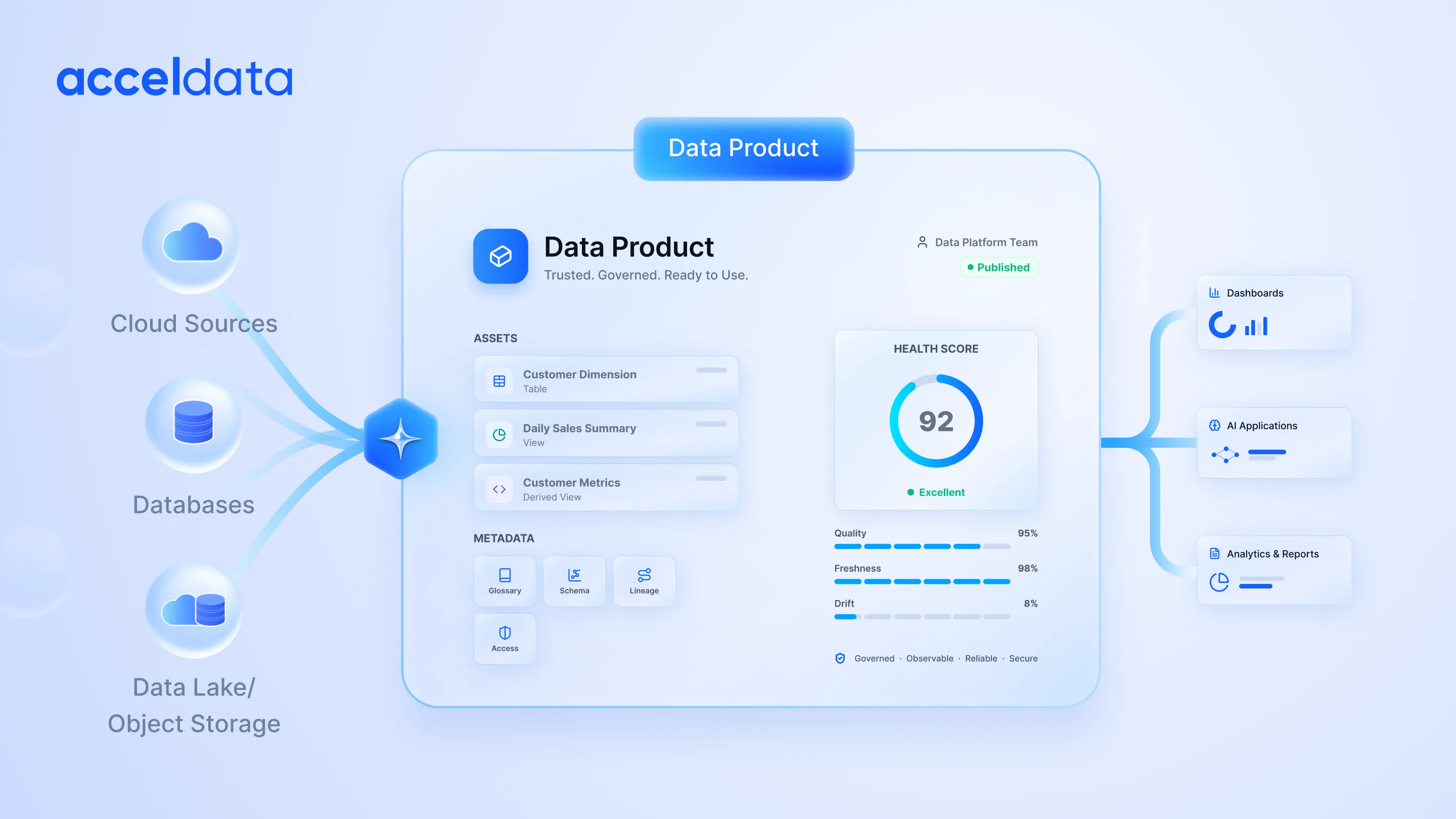
.svg)


.webp)

Your data products are scaling fast, but is your trust in them scaling just as quickly? While decentralized data ownership empowers teams to move at the speed of business, it often triggers a "wild west" of fragmented quality and ownership drift. This tension is a primary reason why legacy governance is struggling to survive in the age of AI.
In fact, a 2025 Gartner report warns that by the end of 2026, 60% of AI projects will be abandoned primarily due to a lack of "AI-ready" data and insufficient governance.
The real challenge isn't deciding whether to govern, but figuring out how to do it without slowing down. Scaling requires a shift from static paperwork to execution-led, agentic systems that bake control directly into your data pipelines. This article dives into the data product governance challenges and shows you how an AI-first approach helps you maintain high standards without losing your competitive edge.
By choosing an automated path, you ensure that autonomy doesn't turn into anarchy. This guide will help you balance team independence with the reliability your enterprise demands.
Why Data Product Scale Breaks Traditional Governance
Traditional governance was designed for a centralized world. A single committee would approve schemas, verify metadata, and grant access. When you scale to dozens or hundreds of data products, this model shatters.
- Centralized approval slows delivery: If every new version of a data product requires a committee review, the "agility" of the product model disappears.
- One-size-fits-all policies don’t work: A marketing data product has different privacy and uptime requirements than a financial reporting product.
- Manual reviews do not scale: Humans cannot physically inspect the data lineage and quality of thousands of moving data assets in real-time.
- Governance teams become bottlenecks: Small central teams are overwhelmed by requests, leading to months of delay.
- Teams bypass controls to ship faster: When governance is seen as a "blocker," engineering teams find workarounds, creating shadow data pipelines.
Data product scale requires governance to enable productivity through guardrails, not constrain it through gates. Efficient scaling data governance means automating the "boring" parts of compliance so teams can focus on innovation.
What Makes Data Product Governance Unique
Governing a "product" is fundamentally different from governing a "table." Data products are live entities with lifecycles, and their governance must reflect that reality.
- Domain-owned data assets: The people closest to the data are responsible for its health.
- Explicit consumers and SLAs: Data products come with a promise of uptime and quality, much like a SaaS API.
- Product-style iteration cycles: Versioning and deprecation are constant, not one-time events.
- Decentralized development teams: Multiple teams build on shared infrastructure and platforms simultaneously.
Control must move closer to execution. To maintain order, you need governance for data products that live within the data pipeline, monitoring to ensure that every domain adheres to global standards without manual intervention.
Core Governance Challenges at Scale
As data products proliferate across the enterprise, the "cracks" in a decentralized strategy begin to show. Without a unified framework for cross-team data governance, organizations face five primary hurdles:
- Ownership ambiguity: When a data product uses upstream data from three different teams, who is responsible for a failure in the final output?
- Quality inconsistency: Team A defines "valid" as non-null, while Team B requires complex regex validation.
- Access sprawl: As products scale, managing who has access to what across various cloud environments becomes a security nightmare.
- Duplication and divergence: Two teams might create nearly identical "Customer" products with slightly different logic, leading to "multiple versions of the truth."
- Trust erosion across domains: If a consumer can't rely on the data product’s SLA, they will stop using it, defeating the purpose of the data product model.
Establishing governance at scale requires addressing these issues not just through policy, but through automated enforcement. Acceldata’s discovery agent helps teams overcome these hurdles by providing instant visibility into all data assets across the enterprise.
Challenge 1 — Ownership and Accountability Drift
The most common friction point in data mesh governance is the gap between domain ownership and enterprise accountability.
Domain Ownership vs. Enterprise Accountability
While a domain team "owns" the product, the enterprise is "accountable" for regulatory compliance (like GDPR or CCPA). Conflict arises when a domain team prioritizes feature speed over the rigorous tagging required for global privacy audits.
Lifecycle Ownership Gaps
Who owns a data product six months after the initial developers have moved to a new project? Without clear data product ownership roles, abandoned products become "zombie data" that continues to consume costs and pose security risks.
Escalation Breakdown
In a scaled environment, issues often fall between the cracks. If a central data platform has an outage that affects a domain’s data product, the end consumer is left in the dark because the escalation path is undefined.
Solving ownership drift requires clear metadata that links every asset to a responsible party. Effective data product management ensures that ownership is a living attribute, not a static document.
Challenge 2 — Inconsistent Quality and SLAs
Quality is the currency of data products. If the quality is inconsistent, the currency is devalued.
When different teams use different tools and metrics for quality, the consumer has no way to compare products. A "99% quality score" from the Sales team might mean something entirely different than a "99%" from the Finance team. This lack of standardization leads to trust erosion, where consumers build their own "shadow" validation layers.
| Feature | Centralized quality | Federated quality | Execution-led quality |
|---|---|---|---|
| Control | Single central team | Individual domain teams | Automated global guardrails |
| Speed | Slow (Bottleneck) | Fast (Inconsistent) | Fast (Standardized) |
| Scalability | Low | High | Very High |
| Reliability | High | Low/Variable | High (Continuous) |
To maintain high standards, enterprises are turning to data quality agents that automatically apply global rules to local data products. This ensures that every product meets a minimum "fitness for use" before it ever reaches a consumer.
Challenge 3 — Access and Privacy at Scale
As you scale, the number of "data handshakes" between teams grows exponentially. This leads to several critical risks:
- Over-permissioning: To avoid delays, admins often grant "admin" or "select *" rights to entire teams, violating the principle of least privilege.
- Manual approvals: If every access request requires a Jira ticket and a human signature, the "on-demand" nature of data products dies.
- Sensitive data leaks: Without automated policy enforcement, PII (Personally Identifiable Information) can easily flow from a secure domain into a less-secure downstream product.
Scaling requires automated access control that can parse metadata and apply privacy masks in real-time. This ensures that data is accessible to those who need it without exposing the company to unnecessary risk.
Challenge 4 — Lineage and Dependency Blind Spots
In a scaled data product environment, no product is an island. Every product is likely a consumer of another.
When teams optimize locally, they often ignore the downstream impact of their changes. For example, changing a column name might "fix" a local dashboard but break ten downstream data products across three different departments. Without data lineage agents, the incident "blast radius" grows uncontrollably, and root cause analysis becomes a multi-day investigation.
Challenge 5 — Trust Erosion Between Teams
Trust is hard to build but very easy to break. In a decentralized ecosystem, trust breaks when:
- Quality issues recur: Consumers will forgive a one-time glitch, but repeated failures drive them back to manual Excel extracts.
- Documentation diverges from reality: If the "Product Catalog" says a field is an integer but the pipeline emits a string, trust is lost.
- Shadow pipelines emerge: Once consumers lose faith in the "official" data product, they start scraping source systems directly, leading to massive technical debt.
To maintain trust, you must provide transparency that allows both producers and consumers to interact with data in natural language, ensuring everyone stays on the same page.
Why Documentation-First Governance Fails Data Products
For years, governance meant writing a 50-page PDF on "Data Standards." In the world of high-velocity data products, this approach fails for three reasons:
- Docs lag behind reality: The moment a developer updates a schema, the documentation is obsolete.
- Enforcement depends on goodwill: You are essentially "hoping" that busy developers read the manual and follow every rule.
- No runtime protection: Documentation cannot stop a broken pipeline or alert you to a PII leak; it only tells you what should have happened.
Data products require execution-led governance—where the "rules" are written in code and enforced by the platform during data processing. This shifts governance from a post-hoc audit to a real-time safety net.
Execution-Led Governance for Data Products
Execution-led governance is the evolution of data management. It moves the "brain" of governance into the runtime environment. Instead of checking if a product is compliant, the system makes it compliant as it runs.
This model enables:
- Policy enforcement at runtime: Automatically blocking or masking data that violates privacy rules.
- Quality and SLA automation: If a data product fails a quality check, the anomaly detection engine can halt the pipeline before bad data reaches consumers.
- Lineage-driven impact controls: Automatically notifying downstream users when an upstream change is detected.
- Autonomous issue handling: Using resolve capabilities to suggest or apply fixes for common data drift issues.
By embedding these controls, you allow teams to move fast without the fear of "breaking the world." You provide the guardrails that make decentralization safe.
Role of Agentic Systems in Data Product Governance
The next frontier in managing data product governance challenges is Agentic AI. Unlike traditional automation, which follows "if-then" logic, AI agents can reason about the state of your data.
- Agents prioritize cross-team issues: They can identify that a quality drop in Domain A is actually caused by a subtle logic shift in Domain B.
- Adapt enforcement by domain criticality: An agent can automatically apply stricter validation to a "Financial Reporting" product than a "Test Lab" product.
- Enable self-healing: When an agent detects a schema change, it can update the contextual memory of the system and suggest the necessary code patches to the data engineer.
Agentic systems act as the "connective tissue" that holds a decentralized data mesh together, ensuring that global standards are met without human intervention.
Governance Models That Scale With Data Products
To successfully scale, you need a hybrid approach that balances autonomy with control.
| Model | Autonomy level | Scalability | Best for |
|---|---|---|---|
| Federated governance | High | High | Diverse organizations with many independent domains. |
| Platform-enforced | Medium | Very High | Organizations are looking for maximum automation and consistency. |
| Manual centralized | Low | Low | Small startups or highly regulated, static environments. |
Most modern enterprises are moving toward Federated Governance with Guardrails. In this model, the central team provides the "Platform", and the domain teams define their own specific logic within that platform’s automated framework. This creates planning efficiency that keeps the entire organization aligned.
How Leading Enterprises Govern Data Products at Scale
Successful organizations don't just "do" governance; they build a culture of data excellence. Here is the blueprint they follow:
- Define non-negotiable policies: Clearly state which rules (like PII masking) are mandatory for every data product.
- Automate enforcement: Use tools like data pipeline agents to ensure every pipeline is monitored from day one.
- Share metrics transparently: Create a public leaderboard of data product health to encourage friendly competition and accountability.
- Measure trust and adoption: The ultimate metric for a data product isn't "is it governed?"—it's "is it being used to drive business value?"
By focusing on these four pillars, you can scale your data operations without sacrificing the integrity of your data.
Scaling Your Data Future
Scaling data products without execution-led governance inevitably leads to fragmentation, rising costs, and a breakdown of trust. As you move toward a decentralized data mesh, the "old ways" of manual oversight simply cannot keep up with the velocity of modern AI and analytics.
By embedding governance into your runtime systems and leveraging the Agentic Data Management Platform, you transform governance from a "department of no" into a competitive advantage. You empower your teams to innovate with the confidence that their data products are secure, reliable, and compliant.
Acceldata’s AI-first platform acts as the "connective tissue" for your data mesh, using the xLake Reasoning Engine to provide deep insights and automated fixes across complex environments. This agentic approach eliminates the need for manual checkpoints by allowing autonomous agents to manage data quality, lineage, and cost optimization in real-time. Whether you are managing massive financial datasets or sensitive healthcare records, Acceldata ensures your data products remain high-quality and audit-ready as they grow.
Ready to see how Agentic Data Management can solve your governance challenges?
Book a demo of the Acceldata platform today and discover how to automate trust across your entire data ecosystem.
FAQs
Why is data product governance hard to scale?
It's hard because traditional governance relies on manual reviews and centralized committees, which become bottlenecks as the number of decentralized data products grows. Scaling requires moving to automated, execution-led enforcement.
Can governance be decentralized safely?
Yes, provided you have global guardrails in place. A federated model allows teams to own their data while a central platform (like Acceldata) automates the enforcement of non-negotiable enterprise standards.
How does lineage help govern data products?
Lineage provides the "map" of how data flows between products. It allows you to perform impact analysis before making changes and quickly identify the root cause of issues across different team domains.
Do data mesh architectures require new governance models?
Absolutely. Data mesh moves away from centralized control toward domain-led ownership. This requires a shift to "Governance as Code" or execution-led governance that can scale horizontally across many teams.
Can agentic systems enforce data product SLAs?
Yes. AI agents can monitor data quality and performance in real-time, automatically triggering alerts or remediations when a data product risks violating its promised Service Level Agreement.


.png)