





.svg)




Struggles related to data governance often stem from treating it as a static documentation exercise rather than an operational discipline. In the Data and AI Leadership Executive Survey by NewVantage Partners, only 26.5% of organizations reported having successfully established a data-driven organization, despite decades of investment in governance tools.
The core issue is rarely intent; it is operational capability. This article explains the major struggles related to data governance, why generic tools like SharePoint and ServiceNow fall short, and how agentic data management can automate enforcement instead of relying on manual effort.
Why Do Organizations Struggle With Data Governance in the First Place?
Understanding the major struggles related to data governance requires looking beyond the technology stack. Most failures are rooted in organizational misalignment and a fundamental misunderstanding of what governance should achieve.
Governance Seen as “Compliance,” Not “Enablement”
Many organizations view governance strictly as a defensive measure. When governance is framed solely as a risk mitigation or compliance activity (GDPR, HIPAA), it becomes a tax on the data team. Engineers see it as a hurdle to clear rather than a value-add, leading to minimal compliance where teams do just enough to pass an audit but fail to build reliable systems.
No Clear Ownership or Accountability
Without defined roles, data quality becomes everyone's problem and no one's responsibility. Data often exists in a tragedy of the commons. Producers create data but do not know who uses it; consumers find errors but do not know who to call. Assigning stewards without giving them the authority or tools to enforce standards leads to frustration.
Siloed Teams and Fragmented Data Processes
Data stacks typically mirror organizational silos. Marketing has its own definitions, Finance has another, and Engineering has a third. Without a unified Discovery capability to map assets across these boundaries, governance remains fragmented and ineffective.
Lack of Leadership Support or Budget
Governance requires cultural buy-in from the top. If leadership expects immediate ROI or cuts the budget the moment a fire drill is over, the program will collapse. Successful governance requires sustained backing to survive the initial friction of implementation.
Technology Alone Doesn’t Fix Governance Problems
A common pitfall is assuming that buying a tool solves the problem. This is particularly evident when companies attempt to use general-purpose platforms for specialized data governance needs.
Why SharePoint Fails as a Governance Engine
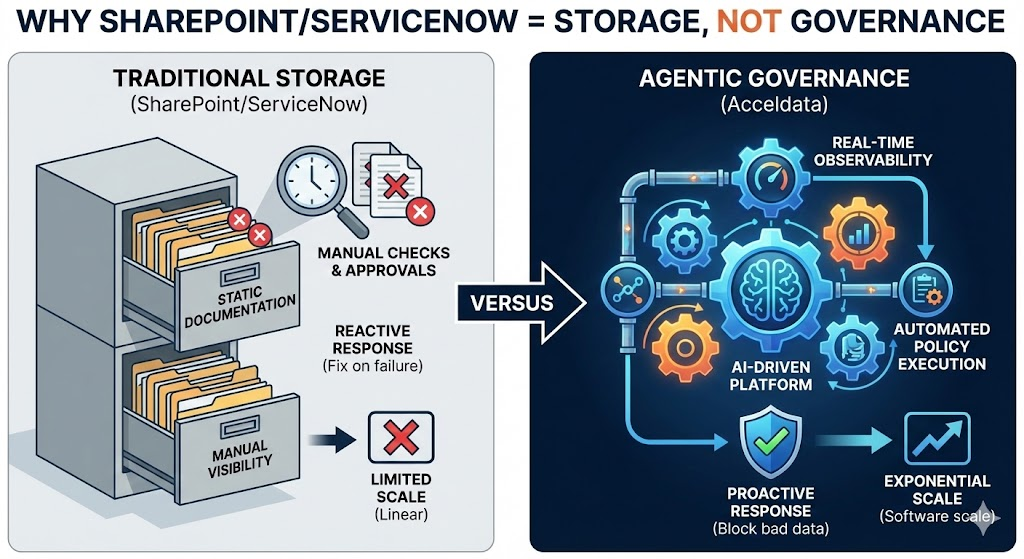
SharePoint is often the default choice for storing policy documents due to its ubiquity in the enterprise. However, it fails because it is a document repository, not a governance engine. A policy document in SharePoint is static; it cannot see the data pipeline, manage metadata, or enforce rules automatically.
Why ServiceNow Doesn’t Solve Governance by Default
ServiceNow is excellent for IT service management and workflows, but it lacks deep data awareness. It cannot automatically detect a schema change in Snowflake or a quality drop in a Kafka stream. Without this real-time visibility, ServiceNow tickets become reactive records of failure rather than proactive governance controls.
Tools Without Processes Only Add More Complexity
Buying a catalog without fixing the underlying process creates shelfware. If the tool does not integrate into the daily workflow of the engineer via policies that run in the CI/CD pipeline, it will be ignored.
Comparison: Traditional Governance vs. Agentic Governance
The gap between legacy methods and modern demands is significant. The following table highlights the operational differences between manual governance and automated, agentic systems.
| Feature | Traditional Governance (SharePoint/Manual) | Agentic Governance (Acceldata) |
|---|---|---|
| Enforcement | Manual checks & approvals | Automated policy execution |
| Visibility | Static documentation | Real-time observability |
| Response | Reactive (Fix on failure) | Proactive (Block bad data) |
| Scale | Linear (Requires more people) | Exponential (Software scale) |
The Human and Organizational Struggles Behind Governance Failures
The most persistent major struggles related to data governance are human, not technical. Culture often eats governance strategy for breakfast.
Data Stewards Are Assigned But Not Empowered
Stewards are often appointed without the necessary leverage to effect change. These individuals are responsible for quality but lack the authority to block bad data or resources to fix pipelines. They become data janitors rather than governors, leading to high turnover.
Engineers Don’t See Governance as Their Job
If governance is not automated, engineers will view it as a friction to shipping code. To solve this, governance must be baked into the tools they already use, automating tasks like schema validation so that "good governance" is the path of least resistance.
Business Teams Don’t Understand Governance Language
There is a translation gap between technical metadata and business value. Governance teams often speak in technicalities (lineage, schema drift), while business teams speak in outcomes (revenue, churn). Bridging this gap is critical for program survival.
Governance Policies That Are Too Rigid or Unusable
Policies must adapt to the speed of business. A rigid policy that demands "100% completeness on all fields" will halt development. Effective governance applies strict rules to critical assets and lighter guardrails to experimental ones, using contextual memory to understand the asset's history.
Operational Struggles That Break Governance in the Real World
Even with good intentions, operational realities can crush a governance program if the tooling cannot handle the scale.
Manual Processes That Don’t Scale
You cannot manually review every pull request for data compliance. As data volumes grow, manual checks become impossible. Operational struggles related to data governance often stem from a refusal to automate routine checks. IDC research shows that 45.7% of organizations believe they derive less than half of the potential value from their data because of data management deficiencies, underscoring how poor governance drains effort and outcomes.
Lack of Real-Time Visibility or Lineage
When a report breaks, the lack of visibility makes root cause analysis a manual archaeological dig. Without automated data lineage agents, teams cannot trace data flow, killing trust in the governance program's ability to protect the business.
Inconsistent Metadata or Duplicate Definitions
Without a centralized, automated metadata layer, definitions drift across systems. "Gross Revenue" might mean one thing in the CRM and another in the ERP. This inconsistency leads to conflicting reports and is a classic symptom of governance failure.
Quality Issues That Go Unnoticed Until Too Late
Reactive governance waits for a user to complain before investigating. Proactive governance uses data quality agents to detect anomalies (volume spikes, null values, schema changes) before the data lands in the executive dashboard.
Diagnosing the Struggle: Symptom vs. Root Cause
Identifying the real problem is half the battle. The table below maps common governance symptoms to their underlying causes.
| Operational Symptom | Governance Root Cause | Agentic Solution |
|---|---|---|
| Broken Dashboards | Upstream Schema Drift | Automated Schema Contracts |
| Slow Incident Response | Missing Lineage | Real-Time Lineage Agents |
| Conflicting Metrics | Duplicate Metadata Definitions | Unified Data Catalog |
| Compliance Fines | Manual PII Tagging | AI-Driven PII Classification |
Indicators That Your Governance Program Is Struggling
How do you know if you are facing major struggles related to data governance? Look for these diagnostic signs.
Nobody Uses the Governance Portal
If you bought a fancy data catalog but your analysts still Slack each other to ask "where is the customer table?", your governance program has failed to integrate into the user workflow.
Definitions Change From Team to Team
If the CEO gets three different numbers for the same metric from three different departments, governance is not standardized.
Frequent Data Discrepancies and Breakages
If your team spends more time fixing broken pipelines than building new ones, it indicates a lack of upstream governance and quality contracts.
Slow Root-Cause Analysis During Incidents
If it takes days to trace a bad record back to its source, your lineage and metadata governance capabilities are insufficient for your scale.
How Companies Can Overcome Real Governance Struggles
Overcoming struggles related to data governance requires a shift to agentic automation and strategic focus.
Start With a Few Critical Data Domains
Do not try to govern everything at once. Focus on the 10-20 critical datasets that drive financial reporting or customer experience. Solve the major struggles related to data governance for these assets first to prove value.
Build Governance Into Engineering Workflows
Shift left by integrating governance checks into the CI/CD pipeline. Use data observability to monitor data in motion. Make governance part of the build process, not an afterthought.
Automate Quality, Lineage, and Policy Controls
Replace manual stewards with autonomous agents. A global information provider faced massive struggles with manual quality checks on thousands of files daily. By automating validation with Acceldata, they reduced issue resolution time by 99% (from 14 days to 4 hours). Automation is the only way to scale governance without scaling headcount.
Make Governance a Business-Enablement Program
Reframe governance as a way to move faster, safely. PhonePe, India’s leading fintech, used automated governance to manage 40+ open-source technologies during hypergrowth. Instead of slowing down, governance allowed them to scale reliability to 99.97% availability across 70+ clusters.
Turning Governance From a Struggle Into a Strategic Advantage
The major struggles related to data governance (manual work, lack of adoption, and tool fatigue) are solvable. By moving away from passive documentation repositories like SharePoint and embracing Acceldata's Agentic Data Management platform, organizations can embed governance into the fabric of their data estate.
Governance is not about restricting access; it is about ensuring that the data fueling your AI and analytics is reliable, secure, and understood. Book a demo today to see how Acceldata can automate your data governance and eliminate these struggles.
Frequently Asked Questions About Struggles Related to Data Governance
Why do so many companies struggle with data governance despite using tools like SharePoint or ServiceNow?
Companies struggle because SharePoint and ServiceNow are workflow and document management tools, not data governance engines. They lack the ability to connect directly to data pipelines, read metadata, or enforce policies automatically, leading to reliance on manual updates that quickly become obsolete.
What are the major struggles related to data governance?
The major struggles include a lack of adoption by engineering teams, manual and unscalable processes, unclear ownership of data assets, and the inability to prove the business value of governance initiatives to leadership.
Why is data ownership such a big challenge?
Data ownership is challenging because data flows across many teams (producers, movers, consumers). It is often unclear who is responsible for the data's quality at each stage, leading to finger-pointing when things break.
What processes fail most often in governance programs?
Manual data entry for catalogs, manual approval workflows for schema changes, and periodic manual audits are the processes that fail most often because they cannot keep up with the velocity of modern data systems.
How can companies improve governance without buying expensive tools?
Companies can improve governance by defining clear ownership, standardizing critical business definitions, and implementing "governance as code" using existing engineering tools to enforce basic schema contracts and quality checks.
What are the first steps to fixing broken governance?
The first steps are to identify the most painful struggles related to data governance in your organization (e.g., frequent downtime), pick one high-value domain to fix, and implement automated controls to solve that specific problem before expanding.