.svg)



The market for agentic AI data management tools exploded from 5 vendors to over 50 in just two years. Each claims to revolutionize your data operations, but most deliver glorified automation dressed up as AI.
As data complexities grow, automation and intelligent tools simplify management, reduce errors, and improve efficiency. They help industries turn sophisticated data sets into actionable insights with speed and precision.
Before you invest millions in the wrong platform, you need a clear evaluation framework. This guide provides the specific criteria and practical steps to identify which agentic AI tools actually solve data management challenges versus those that just sound impressive in demos.
What is Agentic AI and How Does It Impact Data Management?
Agentic AI in data management represents autonomous systems that understand context, make decisions, and take action without constant human oversight. This means systems that go beyond alerting you to duplicate records. They understand why duplicates matter to your revenue reporting, remember how your team resolved similar issues last quarter, and automatically implement the fix while documenting actions for compliance.
The impact of agentic AI on data management is straightforward and transformative. Unlike traditional AI that simply processes data and reports on it, agentic AI takes autonomous action based on contextual understanding and past experiences.
AI-driven data management transforms reactive firefighting into proactive optimization, with organizations cutting up to 90% manual interventions. While understanding these capabilities is crucial, it's equally important to recognize the challenges of agentic AI in data management.
Understanding the Challenges in Data Management
Every data leader faces an escalating crisis of complexity that traditional tools weren't designed to handle. The convergence of exploding data volumes, quality issues, and regulatory demands creates a perfect storm that demands a new approach.
1. Data volume
The average enterprise manages over 400 data sources, with volumes doubling every two years. This creates processing delays, storage costs growing faster than budgets, and teams overwhelmed by scale.
2. Data quality issues
Poor data quality directly impacts your bottom line through wrong decisions, customer dissatisfaction, and compliance violations. This is where data quality automation becomes critical.
3. Compliance and governance
Regulations such as GDPR, CCPA, and HIPAA require tracking data lineage across hundreds of systems, managing consent in real time, and providing audit trails for every transformation. One missed requirement can result in millions in fines.
These challenges might seem overwhelming, but they're exactly what agentic AI was designed to solve. The benefits of implementing these intelligent systems extend far beyond simple problem-solving to transforming your entire data operation.
Key Benefits of Using Agentic Data Management Platform
The transition from traditional data management to agentic data management delivers measurable improvements across every aspect of your data operations. Organizations implementing these systems report transformations that seemed impossible with conventional tools.
1. Automation of repetitive tasks
Agentic AI in data management eliminates mundane work. These automated data management tools handle data profiling, anomaly detection, quality rule generation, and schema mapping. Unlike basic automation, agentic AI adapts without reprogramming.
2. Improved data accuracy
By learning from every correction, agentic systems achieve accuracy levels humans can't match at scale. They predict and prevent issues before they impact your business.
3. Scalability
Traditional tools break down as data volumes grow. Agentic AI scales seamlessly, processing terabytes or petabytes with the same efficiency, suitable for both startups and Fortune 500 companies.
4. Enhanced data governance
AI-driven data governance ensures the right data reaches the right people securely and compliantly. The system automatically classifies sensitive data, tracks lineage, and enforces policies. Data lineage tracking becomes automated and accurate.
These benefits sound impressive, but realizing them requires choosing the right tool for your specific needs. Let's explore how to evaluate and select an agentic AI platform that delivers on these promises.
How to Choose the Right Agentic Data Management Platform?
Selecting an agentic data management platform requires careful evaluation of your current challenges and future goals. Let's look at how a financial services company would carry out its selection process.
Consider a mid-sized credit union with 50 branches managing customer data across multiple systems. It faces daily challenges due to data inconsistencies between its core banking system, loan origination platform, and CRM tools.
Step 1: Assessing needs
The credit union documents that 30% of loan applications face delays due to data mismatches. The compliance team spends 20 hours weekly on manual CFPB reports. They create a requirements matrix that lists must-have features, such as real-time validation and automated compliance reporting.
Step 2: Evaluating AI capabilities
They look for platforms offering real-time anomaly detection that understands banking patterns. The AI needs to differentiate between legitimate large transfers and potential fraud based on customer history.
Step 3: Testing integration capabilities
The credit union needs seamless connections to its Fiserv core, Encompass loans, and Salesforce CRM. Proper data pipeline monitoring is essential to track data flow and identify bottlenecks.
Step 4: Assessing customization options
They need custom quality rules, such as recognizing that “Bob” and “Robert” with the same SSN aren’t errors but require consolidation for reporting.
Step 5: Calculating ROI and making the decision
Based on the assessment, implementing agentic AI reduces loan delays by 60%, saves 15 hours weekly on compliance, and improves service efficiency by 40%. They select the platform that best addresses their specific needs.
With these criteria in mind, you're ready to evaluate specific platforms. Let's examine the leading agentic AI tools available today and how they compare.
Top Agentic Data Management Tools
The market offers several AI-powered data management platforms, but few deliver true agentic capabilities. Understanding the differences between marketing claims and actual autonomous functionality is crucial for making the right choice.
1. Acceldata's Agentic Data Management platform
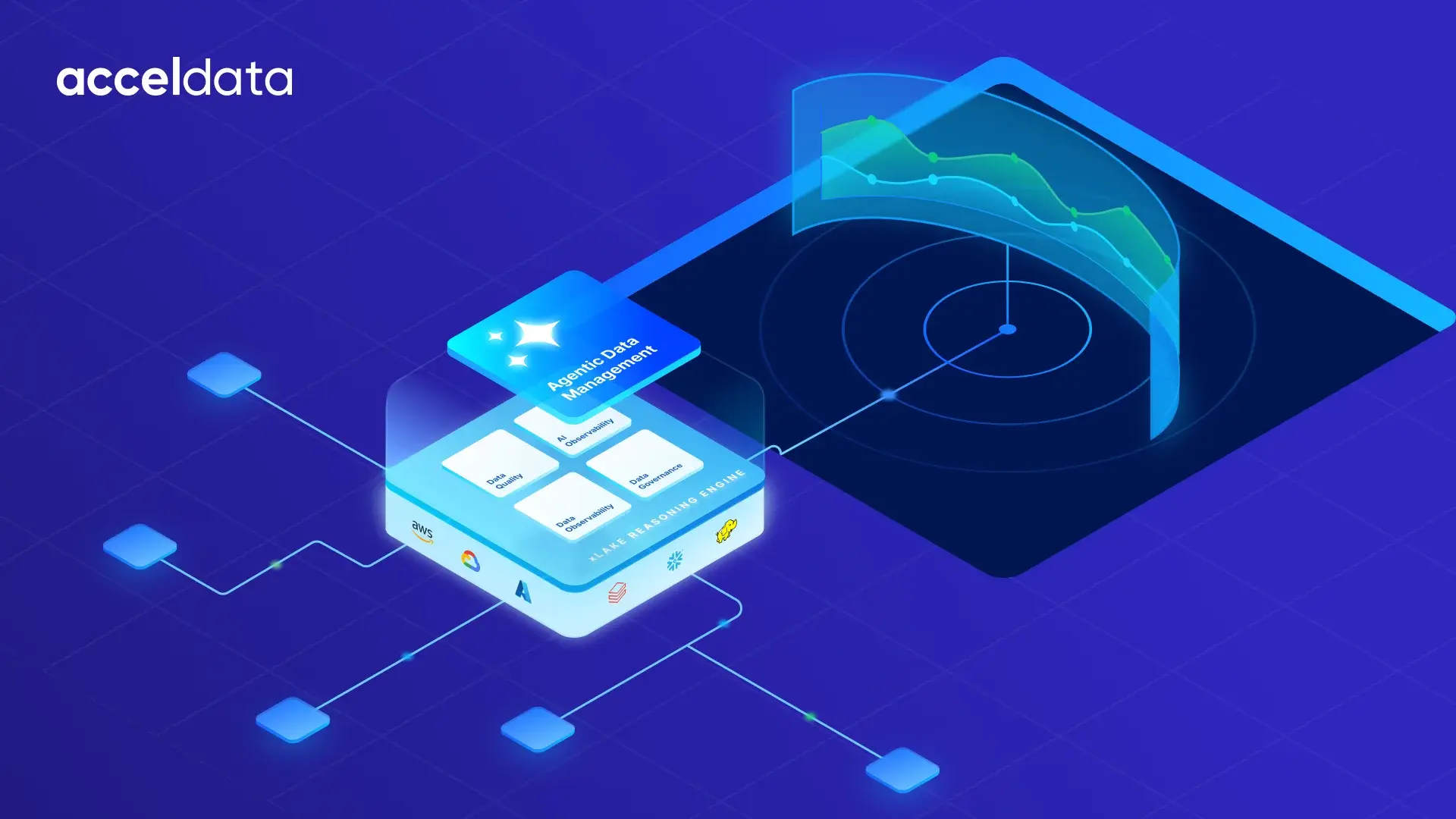
Acceldata provides comprehensive agentic data management capabilities, including autonomous quality monitoring, predictive pipeline optimization, and natural language data exploration. The platform's contextual memory learns from every interaction. The data profiling agent automatically discovers new data sources.
2. Other leading platforms
While several vendors offer AI-powered tools, few provide true agentic capabilities: Informatica CLAIRE focuses on metadata, Talend emphasizes quality scoring, and Collibra excels at governance workflows.
| Feature | Acceldata | Informatica | Talend | Collibra |
|---|---|---|---|---|
| Autonomous actions | Yes | Limited | No | No |
| Contextual learning | Yes | Yes | Limited | No |
| Predictive analytics | Yes | Yes | Yes | Limited |
| Natural language | Yes | No | No | Yes |
Now that you understand the available options, let's explore how these tools solve real-world data management problems. The following examples show agentic AI in data management works across common scenarios.
How Agentic AI Solves Common Data Management Problems
Agentic AI systems don't just identify problems; they understand context, apply past learnings, and implement solutions autonomously.
1. Data cleansing
A healthcare network with patient records across 20 hospitals benefits from agentic AI detecting that "St. Mary’s Hospital" and "Saint Mary’s Medical Center" refer to the same facility. The system understands that insurance claims require the registered name, while patient communications prefer the shortened version. It maintains both variants but links them intelligently, reducing the need for manual cleansing.
2. Real-time data validation
A global e-commerce company uses agentic AI to validate international addresses in real time. The system instantly verifies German addresses against postal standards, autocorrects errors, and recognizes that rural Bavaria addresses often lack street numbers. This significantly reduces failed deliveries.
3. Automated data governance
A financial institution implements automated policy enforcement for GDPR compliance. When customers exercise the "right to be forgotten," the AI traces data across 50+ systems, archives audit trails, and deletes personal information while maintaining anonymized records for regulatory reporting.
Solving these problems is just the beginning. To maximize your investment in agentic AI, you need a strategic approach to implementation that ensures adoption and delivers measurable results.
Best Practices for Implementing Agentic AI Tools in Your Data Management Strategy
Successful agentic AI implementation for data management requires more than purchasing software and turning it on. Organizations that achieve the best results follow proven practices that ensure smooth adoption and maximum value.
1. Start with a clear strategy
Define specific, measurable goals, such as reducing data errors by 50% or achieving GDPR compliance. Clear objectives guide deployment and measure success.
2. Leverage AI for continuous monitoring
Use agentic AI's discovery capabilities to maintain constant visibility. Proactive monitoring catches issues before they impact operations.
3. Train your teams
Even autonomous systems need human oversight. Ensure your team understands how to configure, monitor, and optimize AI performance.
4. Measure results
Track improvements in quality scores, resolution times, and compliance metrics. Use these measurements to continuously refine your approach.
These practices position you for success today, but the rapid evolution of agentic AI promises even more powerful capabilities ahead. Understanding these future developments helps you make platform choices that won't become obsolete.
The Future of Agentic AI in Data Management
The agentic AI revolution in data management has just begun. Current capabilities already transform how organizations handle data, but emerging developments promise even more dramatic improvements.
1. Evolving capabilities
Future systems will feature self-healing pipelines that reconfigure when sources change. They'll predict data needs before requests arrive and pre-optimize queries for performance.
2. Integration with emerging technologies
Agentic AI will work with blockchain for immutable audit trails and quantum computing for complex optimization, creating unprecedented capabilities.
3. AI for predictive data management
Next generation systems will predict issues days in advance, allowing preventive action before problems materialize. This shift from reactive to predictive will revolutionize data management.
As these capabilities evolve, the gap between organizations that utilize agentic AI and those relying on traditional tools will widen dramatically. The time to act is now, before your competition gains an insurmountable advantage.
Unlock Smarter Data Management with Acceldata’s Agentic AI
Data complexity will continue to increase, and manual approaches cannot keep pace. Agentic AI provides the autonomous and intelligent solution organizations need to transform data chaos into a competitive advantage.
Acceldata’s platform brings together all these capabilities and has already delivered proven results across Fortune 500 companies.
Book a demo with Acceldata today and discover how agentic AI transforms data management from a constant struggle into a strategic asset.
FAQs About Agentic AI and Data Management
1. How does agentic AI help automate data management tasks?
Agentic AI autonomously handles repetitive tasks such as data validation, cleansing, and classification while learning from each action to improve future performance.
2. What are the best Agentic AI tools for data quality management?
Acceldata, Informatica CLAIRE, and Talend offer strong data quality capabilities, with Acceldata providing the most comprehensive autonomous features.
3. Can agentic AI be integrated with existing data management platforms?
Yes, modern agentic AI tools offer APIs and connectors for popular platforms, including Databricks, Snowflake, AWS, and Azure.
4. How can businesses assess the ROI of implementing agentic AI tools?
Businesses can assess the ROI of implementing agentic AI tools by measuring the reduction in data errors, the decrease in manual intervention time, the speed of issue resolution, and the prevention of compliance violations.