




.svg)




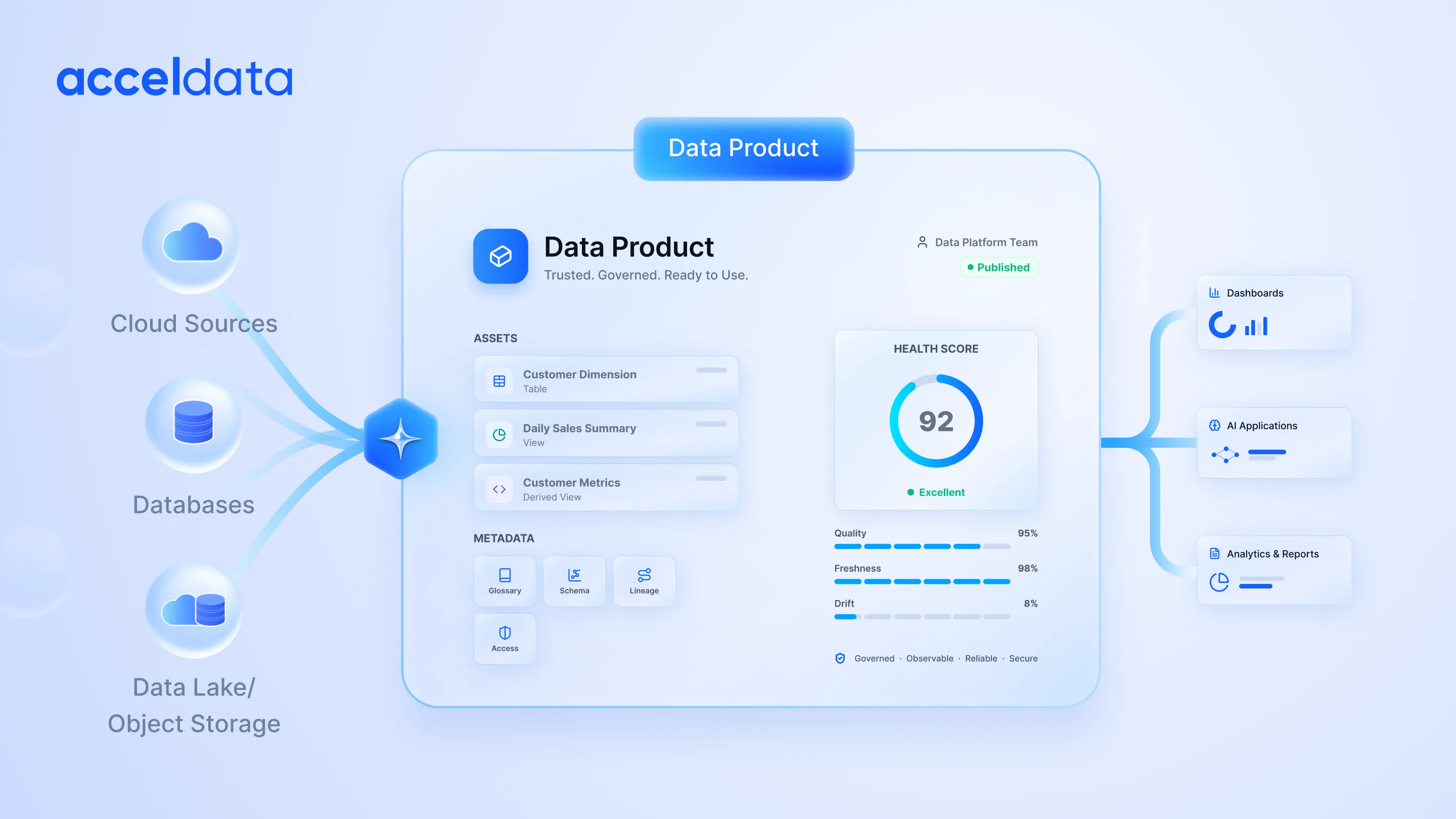
AI is accelerating everything, and it is also exposing gaps in weak governance. According to Gartner estimates publicly referenced by industry analysts, 60 percent of organizations will fail to realize the expected value of their AI use cases by 2027 because their governance frameworks are not cohesive or mature enough. These forecasts show a clear pattern: AI initiatives stall when the underlying data is not reliable or AI-ready.
A solid data governance plan for business ensures the data feeding every model is accurate, consistent, and well-managed. This article explains why a solid data governance plan for businesses is important, and how you can build a framework that supports reliability, automation, and enterprise-wide trust.
What Is a Solid Data Governance Plan for a Business?
A solid data governance plan for business leaders is a strategic framework that outlines how data assets are managed, protected, and utilized. It moves beyond simple IT rules to define the people, processes, and technologies responsible for data integrity across the enterprise.
Governance as a business strategy, not just an IT function
Historically, governance was an IT ticket, but modern strategies must align data controls with revenue goals. A robust plan ensures that marketing has accurate customer profiles for campaigns and that finance has reconciled numbers for reporting, bridging the gap between technical execution and business value.
The role of policies, standards, and ownership
The plan codifies the rules of engagement for your data estate. It answers critical questions: Who owns this data? How long must we keep it? Who can access it? Without these definitions, teams operate in silos, creating fragmented and unreliable data swamps.
How governance enables reliable, predictable data
Ultimately, the goal of any governance plan is reliability. By implementing Agentic Data Management, organizations can automate the enforcement of these plans, ensuring that policies are executed in real time rather than sitting in a static document.
Why Is a Solid Data Governance Plan Important for Businesses?
Leaders often ask why a solid data governance plan for businesses is important when speed is the priority. The answer lies in the cost of chaos: without governance, speed leads to errors, security breaches, and unreliable analytics.
Supports accurate, consistent decision-making
Trust is the primary output of good governance. It ensures that the "Revenue" metric in the dashboard means the same thing to the CEO, the CFO, and the Sales VP, eliminating time wasted on reconciling conflicting spreadsheets.
Reduces operational risk and compliance failures
Regulatory bodies do not accept ignorance as a defense. A solid data governance plan for business compliance automates the detection of PII and ensures adherence to GDPR, CCPA, and HIPAA. Policies allow you to set these guardrails once and enforce them everywhere.
Improves collaboration across departments
Data friction slows down innovation. By creating a unified language and catalog for data, governance breaks down silos. Marketing can trust Engineering's data feed because they know it has passed certified quality checks validated by data lineage agents.
Enables AI and advanced analytics at scale
AI models are voracious consumers of data. Training a model on biased or corrupt data creates algorithmic risk. Governance provides the clean fuel needed to run the AI factory safely, ensuring that automated decisions are both accurate and explainable.
Key Components of a Solid Data Governance Plan
To build a solid data governance plan for business success, you must include specific pillars that translate strategy into action.
Governance Component Matrix
The following matrix maps the essential building blocks of a modern governance strategy to the specific business value they deliver.
Ownership structure (stewards, owners, councils)
You must define who is accountable for every data asset. Data Owners (business side) set the requirements, while Data Stewards (technical side) execute the controls. A Governance Council resolves conflicts and sets high-level strategy.
Data quality policies & controls
Quality cannot be an afterthought in your plan. Your plan must define thresholds for accuracy, completeness, and freshness. Data quality agents automate these checks, preventing bad data from polluting downstream systems.
Metadata & lineage management
You cannot govern what you cannot see. Automated lineage tracking is essential for understanding impact analysis, allowing you to know exactly which dashboards will break if a column is renamed.
Access control, security & privacy rules
Security policies must be granular to protect sensitive information. Implementing Role-Based Access Control (RBAC) ensures that users access only the data they need, reducing the attack surface for potential breaches.
Compliance & risk management alignment
Your governance plan must map directly to external regulations. It should define retention schedules and deletion policies to minimize legal exposure, often managed through automated planning capabilities to forecast storage needs.
Operational workflows for governance tasks
Governance is a verb, requiring active management. Your plan must define workflows for requesting access, approving schema changes, and remediating data incidents. Resolve capabilities help automate these remediation steps.
Metrics & KPIs for governance success
Define success to ensure long-term adoption. Metricize your governance with KPIs like "percentage of critical data elements with owners" or "time to resolve data quality incidents."
Steps to Build a Solid Data Governance Plan for Your Business
Creating a solid data governance plan for business agility involves a structured, phased approach. To illustrate this, consider a hypothetical online retailer struggling with inventory discrepancies.
Step 1 — Assess current data maturity
Start by auditing your current state to find gaps. The hypothetical retailer would use discovery tools to scan their environment, likely finding that inventory data lives in three disconnected silos with conflicting values.
Step 2 — Identify governance goals & business outcomes
Don't govern for the sake of governing. The retailer could define a clear goal, such as "Achieve 99% inventory accuracy to reduce order cancellations by 50%," aligning the governance plan directly with revenue retention.
Step 3 — Define roles & responsibilities
Formalize the RACI (Responsible, Accountable, Consulted, Informed) matrix. In this scenario, the VP of Supply Chain would be assigned as the Data Owner for inventory assets, while the Lead Data Engineer would become the Data Steward responsible for technical execution.
Step 4 — Create policies, standards, and definitions
Draft the initial rulebook to standardize data usage. The retailer could define "Available Inventory" as "Stock on Hand minus Pending Orders," creating a standard policy that mandates all warehouse updates must push to the central data lake within 60 seconds.
Step 5 — Implement tools & governance technology
Manual governance fails at scale, so automation is required. The retailer would deploy platforms that support data observability to monitor the freshness and completeness of the warehouse feeds continuously, replacing their manual spreadsheet checks.
Step 6 — Roll out workflows & automation
Integrate governance into the developer workflow to ensure compliance. The engineering team could set up automated CI/CD blocks that prevent any code changes to the inventory API unless the new schema passes a backward-compatibility check using anomaly detection.
Step 7 — Monitor, improve, and scale
Treat governance as a product that evolves. Finally, the retailer would review their "Order Cancellation Rate" KPI monthly; if the rate hasn't dropped, they would refine the freshness thresholds using contextual memory to understand historical trends.
Examples of Solid Governance Plans in Real Companies
Real-world success stories highlight why is solid data governance plan for businesses important across different sectors.
Retail (improving inventory & customer data accuracy)
Retailers face massive challenges with manual quality checks on thousands of files daily. A global information provider implemented a solid data governance plan for business efficiency involving automated validation. They reduced issue resolution time from 14 days to just 4 hours, a level of speed critical for retailers managing dynamic inventory.
Finance (ensuring regulatory compliance)
Financial institutions must manage reliability at scale. PhonePe, a leading fintech, used a governance-focused observability strategy to manage 70+ clusters. Their plan focused on reliability and reconciliation, ensuring 99.97% availability while scaling transaction volumes massively.
Healthcare (protecting sensitive patient data)
Healthcare organizations must prioritize data reliability to support patient outcomes. For HCSC, governance was about ensuring data product reliability. Their roadmap prioritized the ability to detect anomalies early, ensuring that sensitive member data remained accurate and secure across a hybrid cloud environment.
From Policy to Autonomous Action
A solid data governance plan provides the strategic blueprint for trusting your data, but a plan alone cannot fix broken pipelines. To truly succeed, organizations must move from static documentation to active enforcement, ensuring that quality, security, and compliance are baked into the data lifecycle.
This requires a platform capable of autonomous action. Acceldata's Agentic Data Management platform empowers you to execute your governance plan with autonomous agents that monitor, validate, and heal your data estate. By embedding contextual intelligence into every phase, Acceldata turns governance from a bottleneck into a competitive advantage.
Book a demo with Acceldata to see how our agentic platform can help you build and automate your governance plan today.
Frequently Asked Questions
Why does every business need a solid data governance plan?
Every business needs a solid data governance plan for business stability to ensure data accuracy, comply with regulations, and make trusted decisions. Without it, data becomes chaotic and unreliable.
What should be included in a strong governance plan?
A strong plan includes ownership structures, data quality policies, lineage tracking, security controls, and clear operational workflows for managing data through its lifecycle.
What are the risks of not having a governance plan?
The risks include regulatory fines, security breaches, poor decision-making based on bad data, and the inability to scale AI or analytics initiatives effectively.
How does governance improve AI and data analytics?
Governance ensures that the data feeding AI models is unbiased, complete, and accurate. It helps avoid "garbage in, garbage out" scenarios in machine learning.
Who should own data governance in a business?
Governance should be owned jointly by business leadership (defining the "what") and IT/Data teams (executing the "how"), often coordinated by a Chief Data Officer (CDO).
How long does it take to implement a governance plan?
Initial implementation can take 3-6 months to show value, but data governance is an ongoing program that evolves with the business, not a one-time project.


.png)