.svg)


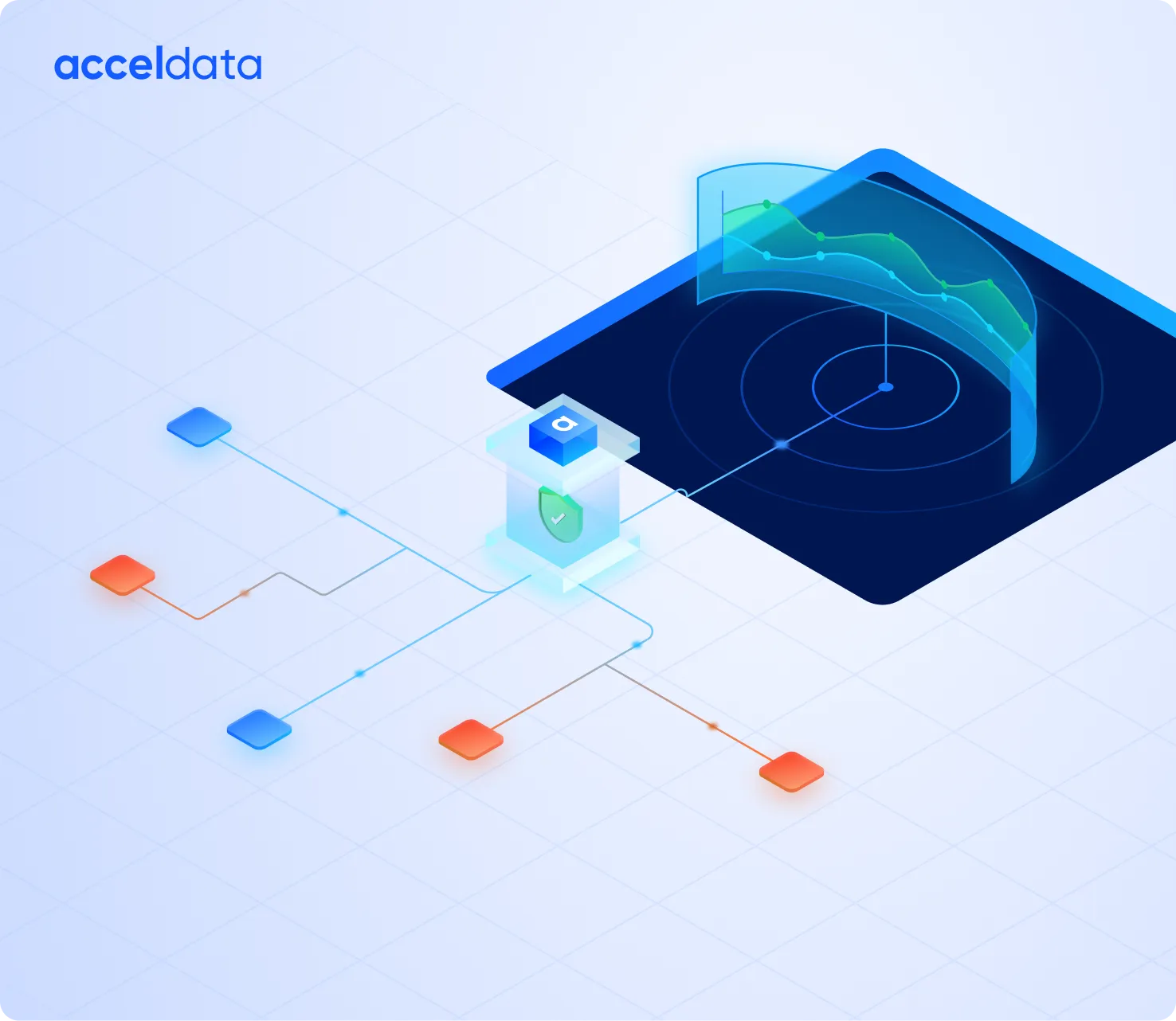

Automated lineage reveals how data moves, transforms, and breaks across complex architectures. Impact analysis turns that lineage into a proactive decision-making engine for governance, reliability, and AI.
Introduction
Most data failures are not dramatic. There is no system crash, no error message, no alert. A column gets renamed. A transformation logic changes quietly. A new table replaces an old one. And somewhere downstream, a revenue report starts lying to your CFO, an AI model trains on features that no longer mean what they did last quarter, and a compliance audit uncovers a data trail your team cannot reconstruct.
The data was moving the whole time. You just could not see it.
This is the fundamental problem that automated data lineage solves. Not the spectacular failures that trigger incident bridges, but the slow, invisible drift that erodes trust in data long before anyone raises a hand. In a distributed enterprise stack, where a single customer record might pass through Kafka, a dbt model, Snowflake, and a Looker dashboard before anyone consumes it, the dependency graph is too complex and too dynamic to track any other way.
Automated data lineage tools map that graph continuously. Impact analysis turns it into a decision-making engine, telling you what will break before you make a change, not after.
This article covers what both capabilities actually mean at enterprise depth, what to demand from any platform you evaluate, and the gaps that most tools will not tell you about upfront.
Why Manual Lineage Fails at Enterprise Scale
Attempting to document data dependencies manually is a task that collapses under its own weight. For an enterprise processing terabytes daily, traditional mapping approaches are not just inefficient; they are actively dangerous.
The core problem is constant schema evolution. Upstream application developers add, drop, or rename columns to support new product features. In a decentralized environment, they often do this without notifying the downstream data engineering team. Manual documentation cannot track these unannounced structural shifts, leaving analytics teams blind to incoming pipeline failures.
Multi-cloud and hybrid stacks compound this. When data moves from an on-premises Oracle database into an AWS S3 data lake and then into BigQuery, tracing the dependency graph manually across those network boundaries is impractical. This fragmentation creates hidden dependencies across teams. A marketing dashboard might silently depend on a staging table owned by the finance team. If finance drops that table, marketing loses their reporting, and no manual catalog will offer any warning.
AI pipelines introduce a further layer of complexity. Machine learning models consume continuously updating feature sets, and tracking which datasets trained a specific model version requires automated, code-level precision. Meanwhile, GDPR, HIPAA, SOC 2, and BCBS 239 all demand immediate, irrefutable proof of data provenance. An auditor reviewing a GDPR data transfer will not accept an outdated Visio diagram. They require dynamic, system-generated evidence. In 2023, Meta was fined €1.2 billion for GDPR non-compliance related to data transfer practices, demonstrating the financial stakes of inadequate data traceability (Source: Irish Data Protection Commission).
Enterprise data lineage platforms exist because human engineering cannot keep pace with the velocity of modern data operations.
What Is Automated Data Lineage?
Automated data lineage is the machine-driven process of tracing data from its origin to its final consumption point. It eliminates human mapping by parsing system logs, query histories, and orchestration metadata. True automated lineage operates across three distinct dimensions.
Technical lineage
Technical lineage maps the physical execution path of data. It tracks ingestion, transformation, and consumption paths at the asset level, showing that a specific Airflow DAG extracted data from Source A, ran a SQL transformation, and loaded the result into Table B. This gives data engineers the macro-level view needed to understand overall architecture and orchestration flow.
Column-level lineage
While technical lineage shows table-to-table movement, column-level lineage tools provide fine-grained transformation visibility. If a privacy officer needs to know where a Social_Security_Number field ends up, table-level lineage is too broad. Column-level lineage parses the actual SQL and Python transformation code to trace how a specific field is renamed, aggregated, or joined as it moves through the pipeline. This granularity is what separates genuinely useful governance tools from decorative dashboards.
Cross-system lineage
Data does not live in one system. Cross-system lineage bridges gaps between different vendor ecosystems, tracing data from operational source databases through ETL/ELT tools like Fivetran or dbt, into cloud warehouses like Snowflake or Databricks, and out to BI dashboards in Tableau or PowerBI, ML feature stores, and real-time streaming applications.
What Is Impact Analysis and Why It Matters
If automated lineage is the map, data lineage and impact analysis is the system that prevents you from making changes without knowing what breaks. Impact analysis uses the dependency graph to simulate and understand the downstream consequences of any data event.
The most critical function is blast radius detection. When a pipeline fails or a table is corrupted, engineers need to instantly know who is affected. Impact analysis surfaces every downstream dashboard, ML model, and business report that relies on the compromised data. This enables risk-aware schema changes. Before a developer drops a column in a production database, they can consult the impact analysis engine to see exactly which downstream queries will break, allowing them to notify stakeholders and rewrite logic proactively.
Consider what this means for incident response. With impact analysis, engineers can trace the root cause of a failure quickly by following the dependency graph upstream rather than interrogating individual tables manually. This same capability drives automated governance enforcement: if sensitive data is accidentally surfaced in an unauthorized environment, impact analysis identifies all exposed downstream assets so access can be revoked immediately.
For AI reliability specifically, data scientists need to know when the upstream data feeding their models has been structurally altered. Without lineage, a model can continue running on silently broken feature data for days before anyone detects the drift.
Key insight: Lineage explains "what happened." Impact analysis explains "what will break."
Core Capabilities Enterprises Should Expect
When evaluating tools for automated lineage and impact analysis, procurement teams must look past polished user interfaces. Enterprise-grade platforms require deep architectural capabilities to function reliably in production.
1. Continuous metadata ingestion
The platform must operate in real time, not on weekly batch schedules. Event-driven APIs or continuous log parsing should ingest metadata the moment a pipeline executes or a schema changes. Stale lineage graphs lead to false assumptions, and false assumptions lead to incidents. A system that updates nightly will not help you respond to a production failure that happened at 2 AM.
2. Transformation-aware lineage
Moving data is straightforward. Transforming it is where complexity lives. The lineage tool must parse complex SQL scripts, dbt models, Apache Spark jobs, and streaming logic. If the tool cannot interpret JOIN, CAST, and GROUP BY statements within your transformation code, it cannot generate accurate column-level lineage. This is a non-negotiable requirement. You can verify this capability through data lineage tracking with Acceldata's lineage agent, which traces transformations at the code level.
3. Downstream impact mapping
The platform must connect infrastructure decisions to business outcomes. It is not sufficient to show that Table A feeds Table B. The tool must trace lineage all the way to the final consumer endpoints: executive BI dashboards, ML feature stores, and automated financial reports. This requires native integrations with the BI and ML tools your organization already uses. Acceldata's data observability capability extends this mapping to include real-time pipeline health alongside dependency visualization.
4. Governance and policy context
A technical dependency diagram becomes far more useful when governance context is layered onto it. The lineage tool should integrate with your data catalog to overlay policies directly onto the dependency graph, including PII tags, access control rules, and data quality SLAs. If a table fails a quality threshold, the lineage graph should reflect that status immediately, so engineers can see both the structural dependency and the quality signal in one view. Acceldata's policy enforcement engine automates this propagation across downstream assets.
Core capabilities at a glance:
How Automated Lineage Enables Governance at Runtime
Lineage for governance and compliance is not a passive auditing exercise. When lineage is automated and deeply integrated into the data stack, it becomes an active operational control.
Consider policy enforcement via lineage. When a data steward tags an upstream column as "Highly Confidential," an automated platform tracks that column as it moves through ETL transformations. Using contextual memory and policy propagation, the governance layer automatically carries that classification tag to all downstream materialized views and dashboards, without requiring manual reclassification at each step.
This enables dynamic, conditional access controls. If an unauthorized user attempts to open a downstream report containing data derived from a confidential source, the system can mask the data or block access entirely, based purely on the lineage graph, not a static permissions list.
Automated lineage also powers automated issue routing. When a pipeline breaks, the platform uses the lineage map to identify the domain owner of the affected downstream assets and routes a high-priority alert directly to them. This bypasses the centralized IT helpdesk and reduces resolution time significantly. Acceldata's resolve capability operationalizes this routing as part of the agentic data management layer.
Finally, automated lineage enables compliance audits without manual effort. Organizations can export visual, system-generated proof of data provenance for HIPAA or GDPR regulators on demand, rather than reconstructing data flows retrospectively from spreadsheets.
Common Gaps in Lineage Tools
The market for lineage tools is fragmented, and many organizations discover operational gaps only during their first major data incident.
The most common failure is shallow, table-only lineage. A tool that cannot parse SQL to provide column-level tracking is functionally useless for root-cause analysis or privacy compliance. You cannot prove you protected a customer's email address if you can only show the table moved.
A second widespread problem is stale metadata. Tools that rely on manual batch syncs to update the lineage graph leave engineering teams operating on information that does not reflect the current production state.
Many lineage tools also suffer from no integration with observability. A dependency map is useful; a dependency map that also shows which pipelines are currently failing and which tables have anomalous row counts is essential. These two signals belong together, and a tool that separates them forces engineers to context-switch constantly.
Finally, most legacy tools have poor ML and streaming coverage. They map batch warehouses adequately but go blind the moment data enters an Apache Kafka stream or a Databricks ML workspace. For organizations building AI pipelines, this is not a minor limitation; it is a complete failure to serve a core modern use case.
Acceldata's data pipeline agent addresses this gap by extending lineage visibility into streaming and ML environments.
How Enterprises Should Evaluate Lineage Tools
Procuring an enterprise-grade platform requires a rigorous evaluation process. Do not accept static vendor demonstrations. Test the tool against your most complex, messy production pipelines.
Evaluation checklist:
- Column-level accuracy: Feed the tool a complex, 400-line SQL transformation script with multiple joins, casts, and conditional logic. Does the platform accurately map individual column dependencies, or does it fail on nested transformations?
- Metadata freshness: During a proof of concept, alter a schema in your database. Measure precisely how many seconds or minutes it takes for that change to reflect in the lineage graph.
- Cross-platform coverage: Verify that the tool can trace a dependency from an operational PostgreSQL database through a cloud ingestion tool, into Snowflake, and out to a Tableau dashboard, without any gaps or manual bridging.
- Integration with governance and observability: The tool must not operate as an isolated island. It should overlay data quality scores and security classification tags directly onto the dependency graph. Explore how Acceldata unifies these signals through its anomaly detection capability.
- Scalability and performance: Ask vendors for documented technical limits. Determine whether the platform can render a lineage graph for an environment with 100,000 tables without the interface degrading.
The broader picture of how agentic data management brings all of these capabilities together is outlined in Acceldata's convergence of data personas article, which explores how data engineering, governance, and AI operations are converging under a unified management layer.
The Foundation of Proactive Data Operations
According to a 2025 IBM Institute for Business Value report, 43% of chief operations officers now rank data quality issues as their most significant data priority, and over a quarter of organizations estimate they lose more than $5 million annually as a direct result (IBM IBV, 2025). Automated lineage, paired with real-time impact analysis, is how leading enterprises are breaking that cycle.
Organizations that pair deep, column-level lineage with real-time impact analysis move their data operations from reactive firefighting to proactive governance. They execute schema changes safely, resolve pipeline incidents faster, and scale AI initiatives with documented data provenance rather than hope.
Acceldata operationalizes this through its Agentic Data Management platform. By combining automated cross-platform lineage, real-time data observability, and autonomous policy execution, Acceldata gives enterprise data teams the visibility and control to keep data ecosystems transparent, compliant, and reliable at scale.
Book a demo today to see how Acceldata automates data lineage and impact analysis across your entire data stack.
Summary: Manual lineage cannot survive the velocity of modern data platforms. Automated data lineage and impact analysis tools parse complex transformations to deliver real-time, column-level visibility, enabling faster incident response, safer schema changes, and robust governance across the enterprise.
FAQs
What is automated data lineage?
Automated data lineage is the machine-driven process of tracking the flow of data from its origin to its final consumption point. It parses query logs, orchestration metadata, and transformation code to map exactly how data is extracted, altered, and loaded across different systems, without requiring manual documentation.
How does impact analysis work?
Impact analysis uses the automated lineage graph to simulate the consequences of a data event. If an engineer plans to drop a database column, or if a pipeline fails unexpectedly, impact analysis identifies every downstream dashboard, ML model, and business report that will be affected by that specific change.
Why is column-level lineage important?
Column-level lineage tracks the movement of individual data fields rather than entire tables. This granularity is critical for regulatory compliance, because it lets you prove where specific PII fields are stored and how they were processed. It also enables precise root-cause analysis during data outages and gives engineers visibility into complex SQL transformations.
Can lineage support AI governance?
Yes. AI models are highly dependent on the quality and provenance of their training data. Automated lineage provides the audit trail that AI governance requires. It documents exactly where training data originated, what transformations were applied, and whether sensitive data was properly handled before entering the model. The EU AI Act, effective August 2027, will make this kind of traceability a compliance requirement for high-risk AI systems.
How is lineage different from documentation?
Traditional documentation describes what data should look like. It is static, manually maintained, and becomes outdated the moment a schema changes. Automated lineage describes what data actually looks like in production right now. It is dynamic, machine-generated, and continuously updated, making it an operational control rather than a historical record.


.png)