




.svg)


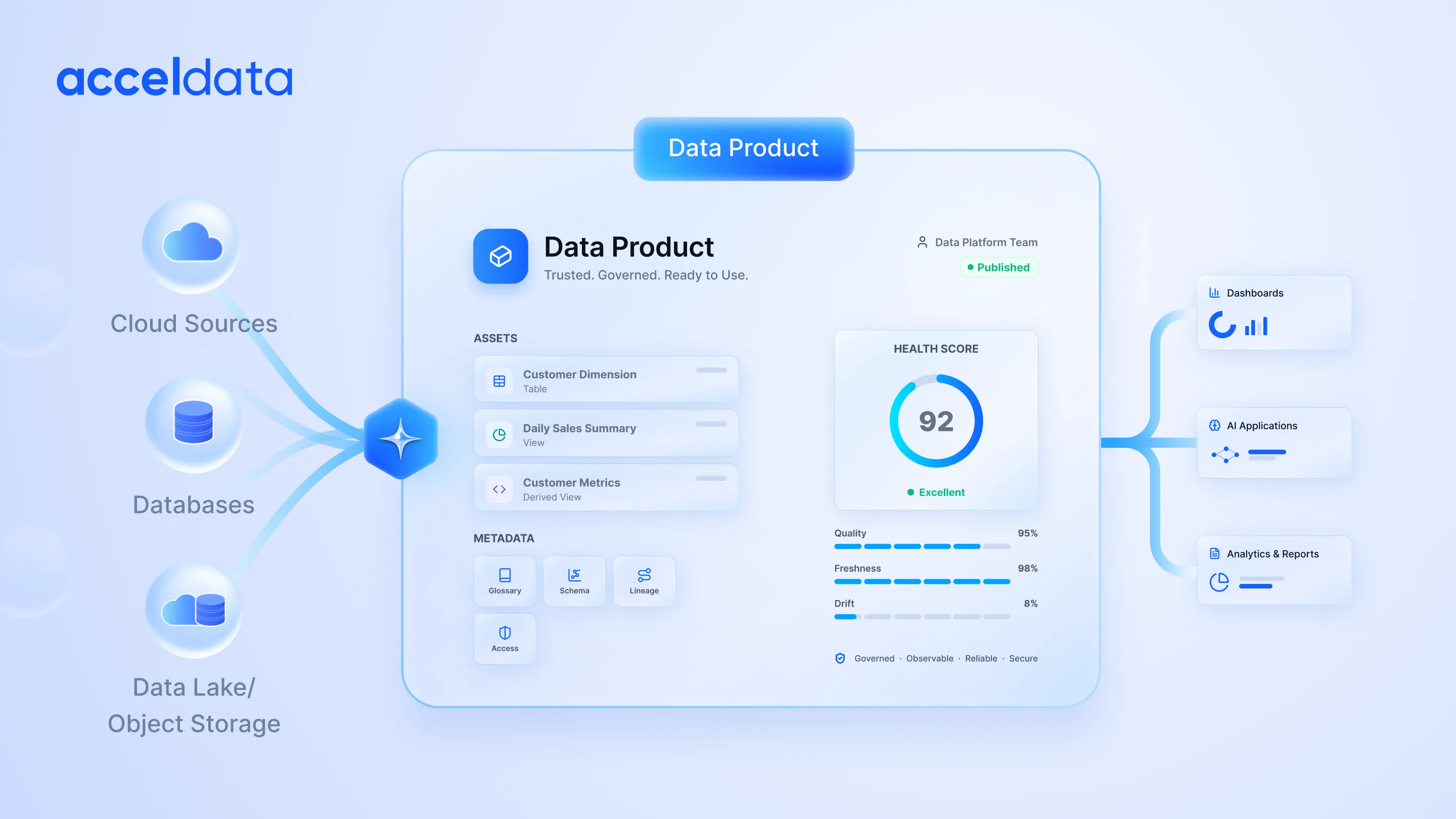
Data control feels real when observability and governance work together. Integrated data governance allows teams to tap into real-time signals about data health, lineage, and usage. Combined with control layers that keep the data stack trustworthy, compliant, and usable, this approach enables accurate, comprehensive, and policy-driven decisions.
Visual: Observability Signals → Governance Engine → Automated Actions → Unified Control
Data systems across warehouses, lakehouses, pipelines, APIs, streaming engines, and cloud-native services generate massive operational signals—yet governance teams typically rely on static policies and documentation. This creates a split between how data behaves and how it is governed.
Integration solves this gap. Observability provides real-time signals (freshness, lineage, quality, drift, violations, performance), while governance provides structure (policies, access rules, ownership, compliance). When combined, they enable unified control: proactive governance, automated enforcement, and predictive oversight.
This article explores integration models, signal-to-policy flows, architecture layers, implementation strategies, and real-world scenarios.
Why Observability + Governance Must Converge
When working with modern data ecosystems, teams often gain fragments of insight but lose control where it matters most. Here’s why blending observability and governance creates a living system that’s crucial to decide and act on insights in real time:
- Static governance breaks in dynamic data environments: Traditional governance frameworks are written as fixed policies that assume stable pipelines and predictable usage. By converging with observability, governance becomes responsive, adapting controls and actions based on live signals.
- Observability without governance lacks business meaning: Observability tools surface metrics, anomalies, and lineage, but they do not explain which issues matter most to the business or why. Governance adds context by linking technical signals to ownership, risk, and compliance priorities, turning noise into insight.
- Real-time policy enforcement needs tight integration: Policies defined in documents or dashboards cannot intervene when data issues emerge at runtime. When observability feeds directly into governance, policies can be enforced automatically, blocking, masking, or alerting the moment thresholds are crossed.
- Multi-cloud complexity demands unified control: Data now flows across clouds, regions, and platforms, each with its own tooling and control plane. Converged observability and governance provide a single view and control layer, ensuring consistent enforcement across the entire data stack.
- AI/ML pipelines require continuous, governed monitoring: Models evolve, data drifts, and features change long after deployment. Linking observability with governance ensures AI and ML pipelines are continuously monitored against defined policies for quality, bias, and compliance, not just performance.
- Active governance is emerging as a shared priority: Industry conversations increasingly point to the limits of passive oversight and post-hoc audits. By merging observability with governance, organizations help detect, evaluate, and act upon issues as they happen.
Challenges When Observability & Governance Operate Separately
Businesses stay in react mode if observability and governance live in different corners of the data stack. Here are a few hurdles that land data teams in a constant firefighting loop:
- Policies are blind to real-time data health: Governance rules are often defined without awareness of current pipeline failures, schema drift, or freshness issues. Without observability signals feeding into governance, policies cannot respond when data quality degrades in the moment.
- Alerts lack governance-driven severity: Observability systems generate alerts based on technical thresholds, but they rarely reflect business criticality or compliance risk. In the absence of a governance context, teams struggle to prioritize what must be fixed immediately versus what can wait.
- Access permissions remain static despite risk: Data access controls are typically granted based on role or entitlement, not current data conditions. When governance is disconnected from observability, permissions cannot adapt dynamically to quality failures, privacy violations, or regulatory exposure.
- No unified view of lineage, ownership, and reliability: Lineage tools show how data moves, while governance systems track ownership and policies in isolation. Without convergence, teams lack a single source of truth that connects where data comes from, who owns it, and whether it can be trusted.
- Distributed teams struggle to align quality and compliance: Data engineering, analytics, and governance teams often operate with different tools and definitions of success. This separation creates friction, making it difficult to resolve issues that cut across quality, compliance, and accountability.
- Manual workflows slow decision-making: When insights and policies are disconnected, enforcement relies on tickets, reviews, and human intervention. These manual processes delay remediation and increase the likelihood that issues escalate before action is taken.
Key Components of an Integrated Governance-Observability Framework
An integrated framework aligns policy, visibility, and action in real time.
1. Unified Signal Collection Layer
Visual: Signal Types → Source Systems → Aggregation Layer
Think of the data stack as a living system that constantly emits signals about its health, movement, and reliability. Pulling these signals together from monitoring, quality checks, and metadata creates a shared, real-time understanding of what is happening and why.
With everything anchored to one source of truth, observability and governance stop talking past each other and start acting in sync.
a. Operational Metrics
Latency, volume, throughput, and error counts reveal how data pipelines perform under real-world load. When captured centrally, these metrics help teams detect failures early and understand whether performance issues are isolated glitches or systemic problems.
b. Quality & Freshness Signals
Signals such as data drift, rule failures, and SLA KPIs breaches indicate whether data can be trusted for downstream use. Surfacing these in real time allows governance controls to react immediately when quality or timeliness drops below acceptable thresholds.
c. Lineage & Metadata Signals
Lineage and metadata expose how data flows across systems and how schemas evolve. These signals make it possible to assess upstream and downstream impact quickly, tying technical changes to ownership, reliability, and risk.
2. Policy Intelligence Layer
Governance only becomes effective when policies can think and respond in the moment. By converting static rules into executable logic, incoming signals can be evaluated dynamically rather than against fixed thresholds.
When Agentic AI and ML-driven intelligence are woven in, policies evolve with patterns, context, and risk, making governance adaptive, consistent, and operational at scale.
a. Machine-Readable Policy Encoding
SLA definitions, access controls, and quality constraints are expressed in a format that systems can execute, not just humans can read. This enables policies to be applied uniformly and updated quickly as requirements change.
b. Context-Aware Rule Evaluation
Rules are evaluated using patterns across multiple signals instead of single-point alerts. Severity can increase or decrease based on factors such as data criticality, downstream usage, or repeated violations, leading to smarter prioritization.
c. Policy-Signal Mapping
Each incoming signal is mapped to specific governance actions, such as alerts, access restrictions, or remediation workflows. This ensures that detected issues trigger meaningful responses rather than isolated notifications.
3. Control Plane for Unified Governance Actions
Seeing issues is only half the story; acting on them is where real control begins. A centralized execution plane turns evaluated policies and live signals into concrete actions across systems, pipelines, and users.
This closes the loop between detection and enforcement, ensuring governance steps in early instead of arriving after damage is done.
a. Data Quality Enforcement
Actions such as quarantining datasets, rejecting flawed records, or triggering reprocessing are executed automatically when data quality thresholds are breached. This prevents unreliable data from propagating downstream and impacting analytics or models.
b. Access Controls
Permissions can be adjusted dynamically based on data sensitivity, quality status, or policy violations. Instead of static role-based access, teams gain conditional controls that reflect the current risk profile of the data.
c. Compliance Controls
Regulatory requirements like GDPR, HIPAA, or PCI are enforced through automated actions tied to observed signals. When violations or risk conditions are detected, controls are triggered immediately to reduce exposure and ensure continuous compliance.
4. Lineage-Driven Governance Automation
As data flows across pipelines and platforms, hidden dependencies amplify risk when issues go unchecked. Lineage-driven automation brings clarity by showing how problems spread, who is impacted, and where action matters most.
Instead of broad, reactive controls, governance becomes precise, faster, and aligned to real business impact.
a. Blast Radius Calculations
Lineage makes it possible to calculate the downstream impact of a policy or quality violation before any action is taken. This helps teams understand which reports, models, or business processes are affected and respond with the right level of urgency.
b. Auto-Issue Routing
By linking lineage with ownership metadata, issues are automatically routed to the domain or data owner responsible for the source. This removes ambiguity, reduces handoffs, and enables faster, more accountable resolution.
c. Root-Cause Propagation Mapping
Governance violations are traced upstream through lineage to uncover the original source of failure. Addressing these root causes prevents recurring issues and improves trust across the data ecosystem.
5. Multi-Cloud & Platform-Neutral Governance
Modern data stacks rarely live in a single environment, spreading instead across data clouds, services, and execution engines. Governance must follow the data wherever it runs, without being rewritten for each platform. A platform-neutral approach ensures that visibility, control, and enforcement remain consistent even as infrastructure choices evolve.
a. Uniform Controls Across Clouds
Policies are defined once and applied consistently across AWS, Azure, and GCP through a unified governance framework. This eliminates fragmented controls and reduces the risk introduced by cloud-specific exceptions.
b. Service-Level Observability
Signals are collected directly from services such as Kubernetes, serverless functions, and streaming engines. This provides governance with fine-grained visibility into how data behaves at the execution layer, not just at the dataset level.
c. Cross-Platform Consistency
Standardized rules and enforcement logic are applied across all environments, regardless of underlying technology. This ensures data quality, security, and compliance remain predictable as workloads move or scale.
6. AI-Augmented Governance Insights
As data ecosystems grow in scale and complexity, human-defined rules alone struggle to keep pace. AI augments governance by learning patterns, detecting subtle risk signals, and surfacing insights before issues escalate.
This shifts governance from reactive enforcement to anticipatory decision-making, where action is guided by intelligence rather than static thresholds.
a. Anomaly-Based Governance Actions
Machine learning models detect unusual patterns across data quality, usage, or access behavior. When anomalies emerge, governance actions can be triggered automatically, allowing teams to intervene before issues become widespread.
b. Predictive Compliance Alerts
AI models analyze historical trends and signal patterns to forecast potential policy or compliance breaches. These predictive alerts give teams time to correct course proactively instead of responding after violations occur.
c. Automated Documentation Generation
Large language models generate clear summaries of lineage paths, detected violations, and remediation steps. This reduces manual documentation effort while keeping audits, reviews, and stakeholders aligned.
Implementation Strategies for Integrated Governance
Here are clear, execution-focused strategies that turn governance from a framework into a working system:
Start with unified lineage as a foundation
Unified lineage creates a shared map of how data flows across sources, transformations, and consumers. It grounds governance decisions in real dependency and impact, not assumptions. Build lineage first across pipelines, platforms, and consumption layers so every policy and action reflects how data actually moves.
Connect observability tools to governance engines via APIs
Observability systems already detect performance, quality, and reliability signals. Connecting them to governance engines via APIs turns these signals into live policy inputs instead of isolated alerts. Stream operational and quality signals directly into governance workflows for continuous evaluation.
Integrate DQ scoring and SLA metrics into governance dashboards
Data quality and SLA performance define whether data can be trusted, not just whether it exists. Surfacing these metrics alongside ownership, risk, and data compliance gives stakeholders a clear, shared view of data health. Embed DQ scores and SLA status into governance dashboards for fast, informed decisions.
Encode governance policies into machine logic
Policies lose power when they remain descriptive instead of executable. Encoding SLAs, access rules, and quality thresholds into machine-readable logic enables consistent and automated enforcement. Define policies once in code so they can be evaluated and updated at runtime.
Use event-driven triggers for enforcement actions
Manual reviews slow governance down and increase risk exposure. Event-driven triggers allow enforcement actions to happen the moment violations occur. Configure workflows that automatically quarantine data, adjust access, or escalate issues based on real-time events.
Deploy integration in phases
Integrated governance works best when introduced progressively. Starting with visibility builds trust, alerts introduce accountability, and automation delivers control. Roll out in phases to minimize disruption while steadily increasing governance maturity.
Real-World Scenarios Where Integration Delivers Value
Visual: Before vs After Integration → Control ↑, Risk ↓, Reliability ↑
When observability and governance operate as a unified system, everyday data issues turn into decisive moments of control. Each scenario below shows what is happening, how integration changes the outcome, and the tangible shifts an integrated setup delivers.
Scenario 1: Freshness SLA breach triggers governance
A critical dataset fails to meet its freshness SLA just before business users begin reporting. With observability and governance integrated, the breach immediately activates policy-driven controls, preventing stale data from spreading while pinpointing downstream impact through lineage.
- Stale data consumption is paused automatically before the business impact
- Affected consumers are notified with clear context and ownership
- Lineage-driven impact data analysis prioritizes remediation efforts
Scenario 2: PII detected by observability
Unexpected PII appears in a dataset during routine monitoring. Integration allows governance policies to respond instantly, enforcing protections without waiting for manual review or escalation.
- Sensitive fields are masked or restricted in real time
- Compliance actions are logged automatically for audit readiness
- Risk exposure is reduced without interrupting safe data use
Scenario 3: Upstream schema drift detected
A producer pushes an unapproved schema change that could break downstream pipelines. Integrated governance intercepts the change early, stopping disruption at the source.
- Schema changes are blocked before reaching consumers
- Downstream failures and rework are avoided
- Producers receive immediate, actionable feedback
Scenario 4: Model degradation linked to data drift
Model monitoring reveals declining performance caused by drifting input data. Integration connects observability signals to governance workflows, triggering corrective action instead of delayed investigation.
- Data drift is tied directly to the model performance impact
- Retraining workflows are initiated automatically
- Model reliability is restored with minimal downtime
Best Practices for Unified Data Control
To bridge the gap between "knowing" your data and "controlling" it, organizations must move away from static documentation and toward a dynamic, feedback-driven architecture.
- Treat observability as a governance dependency: Governance cannot exist in a vacuum; without real-time observability, policies are merely suggestions rather than enforced standards.
- Maintain machine-readable policies tied to metrics: Transition from PDF-based guidelines to "Policy as Code" where automated thresholds trigger immediate alerts or access restrictions.
- Ensure lineage completeness for correct enforcement: Understanding the full journey of data, from source to consumption, is the only way to ensure governance rules aren't bypassed during complex transformations.
- Use AI-driven prioritization for governance alerts: Avoid "alert fatigue" by using machine learning to distinguish between minor schema drifts and critical compliance breaches.
- Establish governance + observability review rituals: Foster collaboration between Data Engineers and Compliance Officers to ensure technical metrics align with business risk appetites.
- Continuously refine severity mappings and response rules: As your data ecosystem evolves, regularly update what constitutes a "Critical" incident to keep response efforts focused where they matter most.
The Path Forward: Scaling Trust with Unified Control
Integrated observability and governance transform data management from a reactive, fragmented process into a unified, automated control system. By turning real-time signals into enforceable governance actions, enterprises achieve higher reliability, predictable quality, and consistent compliance.
As organizations scale cloud-native, multi-domain, and AI-driven workloads, unified control becomes essential for long-term trust and operational excellence. This is where Acceldata’s Agentic Data Management excels by providing an all-in-one Data Observability Cloud. It allows teams to visualize complex data pipelines, automate quality checks, and monitor spend.
Want to effectively turn the "black box" of big data into a transparent, governed asset? Book a demo call with Acceldata today!
FAQs
What is integrated data governance?
It is the practice of combining traditional data oversight (privacy, compliance, and standards) with technical monitoring. Instead of checking for compliance once a quarter, integrated governance happens continuously within the data pipeline itself.
How does observability enhance governance?
Observability provides the "eyes" for governance. While governance defines the rules, observability monitors the data in real-time to ensure those rules are being followed, providing the metadata necessary to prove compliance.
Can real-time signals drive automated governance actions?
Absolutely. Modern systems use triggers, such as a sudden drop in data quality or a schema change, to automatically pause downstream pipelines or flag sensitive data for review before it reaches a reporting dashboard.


.png)