




.svg)




Modern data platforms continue to grow in complexity. Teams are managing more services, more users, more pipelines, and higher expectations for performance and reliability, often without added headcount. The challenge today is no longer just collecting signals. It is making observability easier to use, easier to scale, and more actionable in day-to-day operations.
That is what drives innovation in Pulse 4.1.0.
Acceldata Pulse is a data observability platform for Hadoop and modern big data environments, designed to help teams monitor platform health, improve operational efficiency, and troubleshoot issues faster across the systems they already run.
This release builds on the momentum of recent Pulse innovations with new capabilities that help teams standardise monitoring, expand visibility across more services, reduce manual troubleshooting effort, and improve enterprise readiness.
If you missed the broader recap from earlier this year, you can catch up in our Pulse Year in Review 2025 blog, which looked back at the key updates introduced across Pulse 4.0 and the product direction heading into 2026.
At a glance
With Pulse 4.1.0, teams can:
- Create visualisations once and reuse them across multiple dashboards
- Monitor JupyterHub activity, usage, and performance in real time
- Gain improved observability for Airflow running on Kubernetes
- Analyse Gluten- and Velox-enabled Spark workloads with deeper operator-level visibility
- Monitor Pulse services running on Kubernetes directly from the Admin UI
- Troubleshoot faster with Pulse Sense (Beta)
- Get near real-time HDFS metadata visibility in File Explorer
- Strengthen resilience with disaster recovery actions for Hadoop, Hive, and HBase
- Improve usability and compliance with WCAG 2.1 AA accessibility enhancements
- Strengthen operations with new alerts, integrations, and platform enhancements
Pulse 4.1.0 is also certified for supported ODP environments. To check supported versions and deployment alignment, review the compatibility details here. For teams planning broader platform modernisation, you can also explore Open Data Platform (ODP).
Reusable visualizations with a centralized library

As observability expands across more teams and environments, dashboard sprawl becomes a real operational challenge. Important charts get rebuilt multiple times, standards drift, and even simple updates take longer than they should.
Pulse 4.1.0 introduces a centralised Visualisation Library that allows teams to create visualisations once and reuse them across multiple dashboards.
Why this matters
- Teams can build dashboards faster
- Shared views stay more consistent across users and environments
- Updating commonly used visualisations becomes easier
- Dashboarding becomes more scalable as observability adoption grows
Key capabilities include:
- Reusable visualisations so teams can create a visualisation once and use it across multiple dashboards without duplication
- Centralised updates, so editing a shared visualisation automatically updates it everywhere it is used
- Automatic filter promotion so that commonly used filters can be elevated to the dashboard level for better usability
For teams upgrading from Pulse 4.0.x, existing dashboards are automatically migrated to the new Visualisation Library, with no user action required. Export/import functionality continues to work seamlessly, and scheduled reports remain fully supported.
For platform and operations teams, this turns visualisations into reusable building blocks rather than one-off dashboard work.
Broader observability for modern platform services
Big data environments today extend well beyond core Hadoop services. Teams are increasingly supporting notebooks, Kubernetes-based orchestration, and accelerated Spark execution frameworks alongside traditional platform components.
Pulse 4.1.0 expands observability coverage to better reflect that reality.
JupyterHub observability
Pulse now provides real-time visibility into JupyterHub metrics, helping teams monitor user activity, resource usage, and performance through interactive dashboards and charts.
Why this matters
- Better visibility into shared notebook environments
- Easier tracking of usage patterns and resource pressure
- Faster identification of issues affecting data science and analytics users
Airflow observability on Kubernetes
Pulse 4.1.0 adds observability for Airflow deployed on Kubernetes, along with a major refresh of Airflow metrics in the Pulse UI.
Why this matters
- Better insight into orchestration health in Kubernetes-based environments
- Easier monitoring of workflow behaviour and service stability
- Faster diagnosis when pipelines slow down or fail
Gluten and Velox metrics for Spark
Pulse 4.1.0 now surfaces Gluten and Velox metrics when Spark jobs run with Gluten enabled and Velox in use. It also adds DAG-level visibility into both Velox and Spark operators.
Why this matters
- Deeper insight into accelerated Spark workloads
- Better understanding of execution flow at the operator level
- Faster root-cause analysis for performance bottlenecks in complex jobs
For readers who want more background on why Gluten and Velox matter, you can explore our related blog on ODP Spark with Gluten & Velox.
Pulse Server Monitoring on Kubernetes
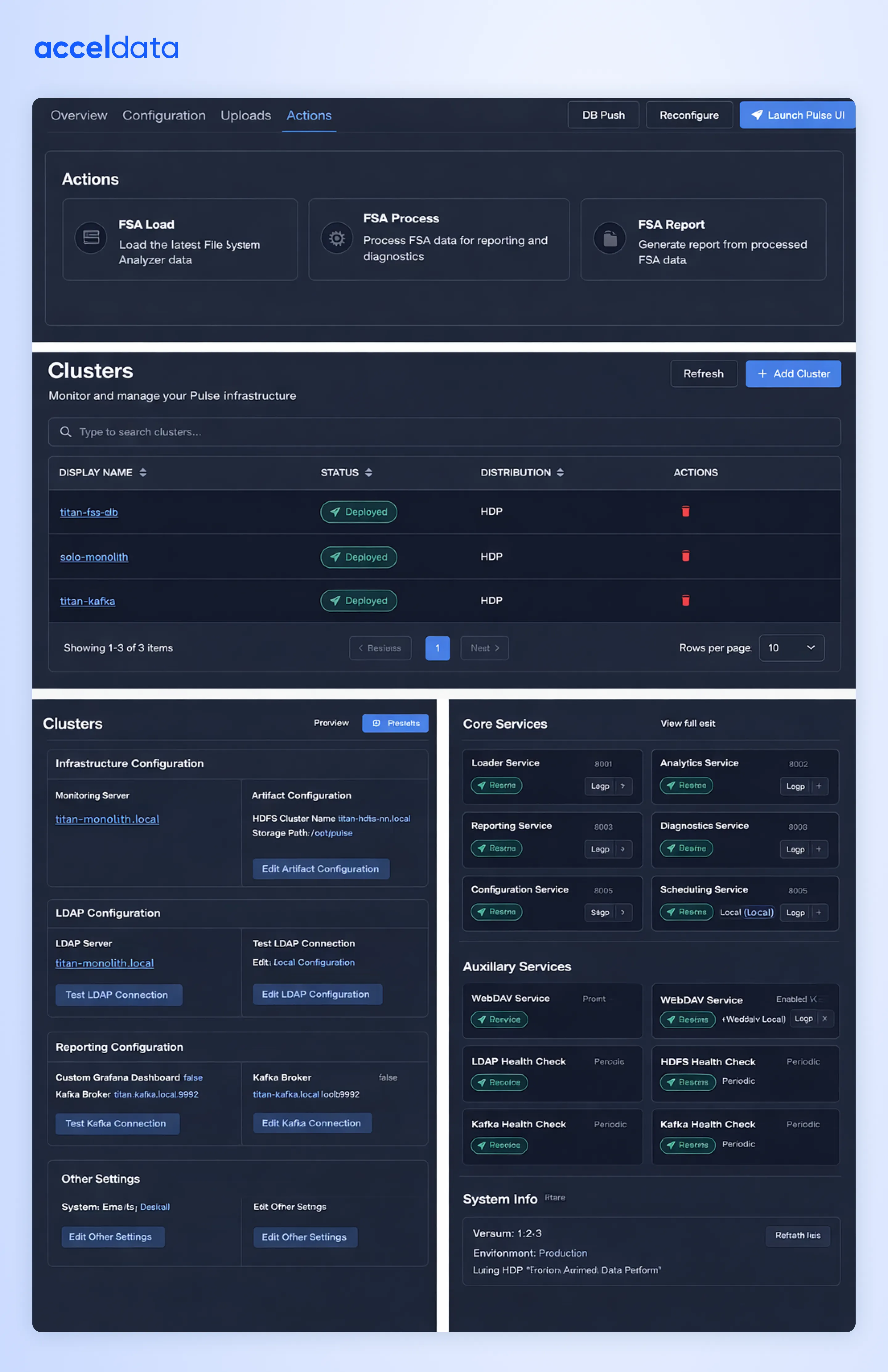
Pulse 4.1.0 now brings real-time monitoring of Pulse services running on Kubernetes directly into the Admin UI, giving administrators deeper visibility into application health, logs, and runtime behaviour without leaving the interface.
Why this matters
- Monitor overall Pulse server health in real time
- Troubleshoot runtime and deployment issues faster
- Analyse authentication, API, and service-level errors more easily
- Improve operational visibility with access to pod health, container resource usage, and live service logs
This enhancement helps administrators operate Pulse more efficiently in Kubernetes environments while speeding up debugging and incident resolution.
Faster troubleshooting with Pulse Sense (Beta)
Troubleshooting in distributed environments often means jumping across dashboards, checking multiple signals, and manually piecing together context before teams can even start acting.
Pulse 4.1.0 introduces Pulse Sense (Beta), an agentic capability designed to simplify troubleshooting and operational analysis. Pulse Sense helps users diagnose issues such as slow-running applications or unhealthy components without manually navigating across multiple dashboards.
Why this matters
- Faster time to diagnosis
- Less manual effort during investigations
- A simpler path from symptom to action
- Better support for lean teams managing complex environments
More current HDFS visibility
Pulse 4.1.0 enhances the HDFS File Explorer with near real-time synchronisation of HDFS metadata.
Previously, HDFS insights were generated once every 24 hours. With this enhancement, administrators can inspect HDFS file activity more frequently, improving visibility into active workloads and the current state of the environment.
Why this matters
- More current insight into HDFS activity
- Better visibility into active workloads and file system changes
- Faster operational decision-making when storage conditions shift
Disaster recovery for Hadoop, Hive, and HBase
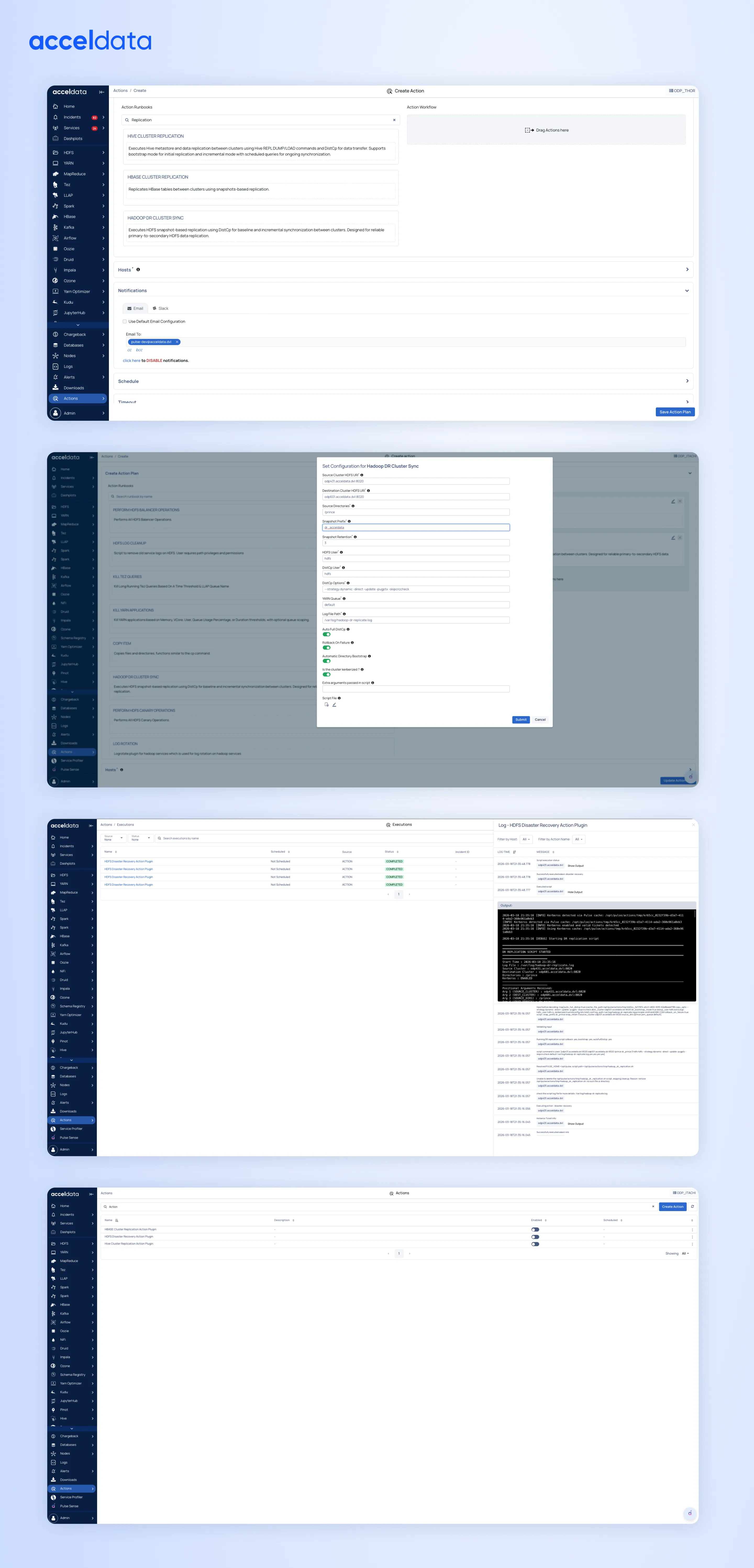
Pulse 4.1.0 introduces disaster recovery actions for Hadoop, Hive, and HBase, helping teams strengthen resilience and simplify cross-cluster recovery planning for critical data environments.
These capabilities support cross-cluster replication using snapshots, DistCp, and REPL workflows, along with incremental sync, automated scheduling, and configurable execution parameters.
Why this matters
- Improve resilience across Hadoop, Hive, and HBase environments
- Replicate only new or changed data more efficiently
- Reduce manual effort with automated scheduling
- Gain more control over disaster recovery execution and recovery workflows
Accessibility improvements for enterprise readiness
Pulse 4.1.0 includes WCAG 2.1 AA accessibility enhancements across the UI, including improved colour contrast, visible focus indicators, keyboard navigation, ARIA support, accessible forms, and screen-reader compatibility.
Why this matters
- Better usability for all users
- Stronger support for enterprise accessibility requirements
- Improved readiness for VPAT and accessibility reviews
- A more inclusive experience across core workflows
More actionable operations with alerts and integrations
Observability delivers the most value when teams can act on issues quickly and consistently.
Pulse 4.1.0 expands that operational layer with updates such as:
- Netcool alert notifications for centralised event management
- New alerts for namespace and disk space quota usage
- Alerts for HDFS small files
- Coordinator-specific Impala alert metrics
- Additional support for Kafka custom alerts
Why this matters
- Faster response through better alert routing
- Improved visibility into common operational risks
- More flexibility in how teams connect Pulse into existing incident workflows
For enterprises operating within established monitoring and response ecosystems, these additions make Pulse easier to operationalise.
Additional enhancements across the platform
Pulse 4.1.0 also includes several enhancements aimed at efficiency, resilience, and day-to-day manageability:
- Kubernetes Cluster Optimisation (Beta) to help reclaim unused CPU and memory requests and improve workload packing
- Database Insights enhancements, including improved Hive storage visibility through new charts and deeper table insights
- NATS Object Store health checks to simplify operational management and monitoring
- Enhanced Impala query observability for more reliable tracking under high-load conditions
- Pulse Home customisation for more flexible agent deployment outside the default installation path
- PulseNode Agent on Kubernetes for streamlined deployment, cluster registration, and clean removal in containerised environments
Together, these updates help teams improve utilisation, strengthen resilience, and reduce operational friction across large environments.
Built for real production operations
Beyond new features, Pulse 4.1.0 also includes a broad set of fixes and refinements that improve stability, usability, and operational consistency.
That matters because observability platforms need to do more than surface insights. They need to be dependable in real production environments, easy to operate under pressure, and flexible enough to fit into the way enterprise teams already work.
Explore Pulse
Pulse 4.1.0 continues our focus on helping organisations simplify operations, improve performance, and expand observability across the big data ecosystems they already run.
Whether your team is standardising dashboards, supporting Kubernetes-based services, improving visibility into shared notebook environments, or looking to reduce time to resolution during incidents, Pulse 4.1.0 is designed to help you operate with more clarity and confidence.
You can also review the Pulse 4.1.0 release notes for detailed release information.
Book an expert consultation to see how Pulse fits into your environment and helps your team improve observability, simplify operations, and troubleshoot issues faster.


.png)