.svg)




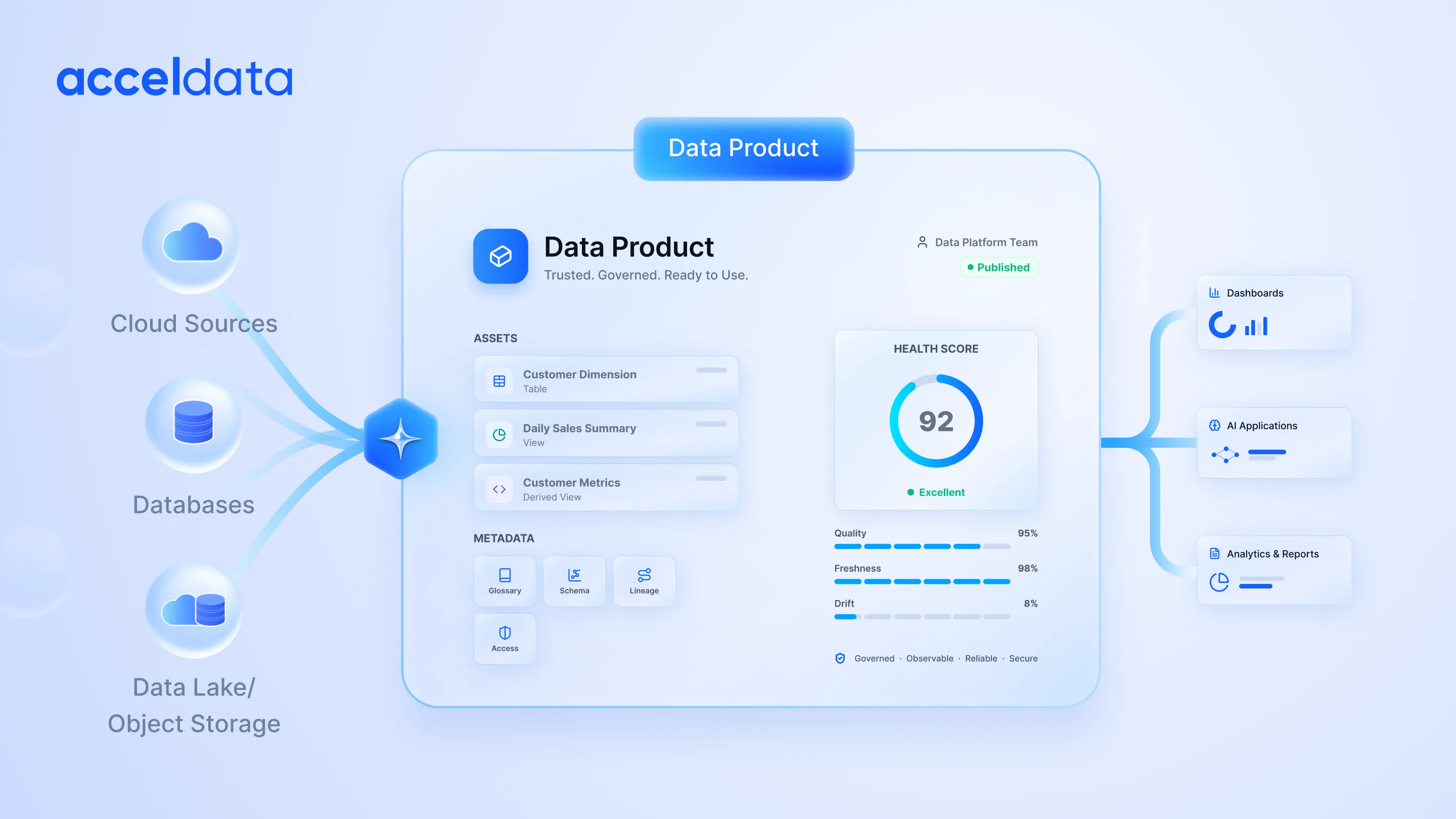
In the high-stakes world of modern data engineering, your speed of insight is only as good as the metadata supporting it.
Imagine your data stack scaling at 10x speed while your governance remains stuck in the slow lane, causing pipelines to crash into walls of "missing context."
You need a lightweight metadata solution that acts as a high-speed navigation system—providing instant visibility and lineage without the agonizing six-month implementation cycle of traditional platforms.
This article explores how agile approaches help you reclaim control over data sprawl and what are the tools redefine the space by replacing manual curation with intelligent, autonomous automation.
Why Modern Data Stacks Need Lightweight Metadata Solutions
Traditional metadata platforms were built for static, on-premises environments where changes happened quarterly. In your modern data stack, however, schema changes occur daily, and new pipelines are spun up in minutes. Heavyweight solutions often require manual entry and extensive configuration, which simply cannot keep pace with a cloud-native ecosystem.
A lightweight metadata solution focuses on speed and flexibility. Instead of trying to be the "encyclopedia" for every byte of data, these tools act as a "GPS," providing the most relevant directions to find, understand, and trust your assets. By prioritizing low overhead, you allow your data engineers to focus on building rather than documenting.
- Scalability: They grow with your Snowflake or Databricks environment without requiring a dedicated "metadata team."
- Adoption: Because they are easier to use, your analysts actually use them, breaking down the silos that plague traditional governance.
The shift toward these solutions is driven by a need for "Active Metadata"—where metadata doesn't just sit in a catalog but actively informs your data quality and pipeline health.
What “Lightweight Metadata” Means in Practice
Defining a lightweight metadata solution isn't about having fewer features; it's about having a smaller operational footprint. It’s the difference between a massive, multi-volume textbook and a dynamic, searchable wiki that updates itself.
Focused Metadata Collection vs Exhaustive Coverage
You don't need to catalog every temporary table or sandbox experiment. Lightweight solutions focus on the "Gold" or "Certified" datasets that actually drive business decisions. This targeted approach ensures that your data discovery remains relevant and noise-free.
Minimal Setup and Low Operational Overhead
Most lightweight tools are SaaS-based and offer "plug-and-play" connectors. You can connect your warehouse and see results in hours, not months. This speed is essential for teams operating in agile environments where the cost of delay is high.
Designed for Fast Discovery and Context
The primary goal is answering the question: "Can I trust this data?" By providing quick data profiling and table-level lineage, these tools give you the context needed to make decisions without wading through unnecessary technical jargon.
Lightweight Metadata Solution for Modern Data Stack
The "Modern Data Stack" (MDS) has evolved into a lean, integrated environment where metadata is the connective tissue. Choosing the right metadata management solutions depends on where your team experiences the most friction.
Schema and Table-Level Metadata Tools
Tools: dbt (Data Build Tool) and OpenMetadata
These tools automatically crawl your warehouse schemas to maintain an accurate "Source of Truth" for column definitions and table structures. While dbt focuses on documentation through code, OpenMetadata provides a unified UI for data observability to catch schema drift before it breaks downstream reports.
Usage and Query-Based Metadata Capture
Tools: DataHub and Amundsen
By analyzing query logs and usage patterns, these platforms identify your most popular assets and flag "orphaned" tables that are no longer in use. This operational metadata is crucial for planning and cost optimization, helping you delete unused data and save on cloud credits.
Annotation and Documentation-First Tools
Tools: Atlan and CastorDoc
These solutions prioritize a "social" experience, allowing users to tag, review, and describe datasets in a collaborative environment. They turn tribal knowledge into a shared asset, much like how Acceldata’s "Business Notebook" allows users to interact with metadata using natural language.
Acceldata provides a converged platform that encompasses all these features into a single, Agentic Data Management framework. Instead of stitching together multiple tools for schema crawling, usage tracking, and documentation, Acceldata’s xLake Reasoning Engine unifies these signals to drive autonomous action.
Whether it is automatically detecting schema drift (like OpenMetadata), optimizing cloud costs based on query logs (like DataHub), or enabling natural language discovery via the Business Notebook (like Atlan), Acceldata acts as an intelligent layer that doesn't just catalog your data—it actively manages it.
Lightweight Metadata Solutions vs. Traditional Metadata Platforms
The choice between "lightweight" and "traditional" is often a trade-off between agility and deep compliance.
| Feature | Lightweight metadata solution | Traditional metadata platform |
|---|---|---|
| Setup time | Days to weeks | Months to years |
| Primary user | Data engineers & analysts | Data stewards & compliance officers |
| Cost | Low to moderate (SaaS) | High (Licensing + Services) |
| Automation | High (API-driven) | Low (Manual curation) |
| Governance | "Just-in-Time" | "Just-in-Case" |
While traditional platforms offer robust auditing, they often struggle with the velocity of modern data. Organizations are increasingly moving toward agentic analytics and active metadata to automate these governance tasks, bridging the gap between being "lite" and being "compliant."
Best Tool for Quick Metadata Collection/Data Entry?
When you need a "quick win," manual spreadsheets are often your worst enemy. They lack validation, create silos, and inevitably become outdated the moment they are saved. The most effective ways to capture metadata quickly involve a mix of low-code flexibility and AI-driven automation.
- Relational Low-Code Interfaces: Instead of flat files, teams are turning to platforms that offer a spreadsheet-like feel but function as relational databases. These allow for multi-select tags, linked records, and structured APIs that make manual data entry much more reliable and easier to integrate into your primary data stack.
- Structured Form-Based Gathering: For projects requiring input from non-technical stakeholders, using structured forms is a "scrappy" but highly effective method. This ensures that human-generated context—like business definitions or data ownership—is collected in a consistent format that can be automatically synced to your metadata repository.
- Collaborative Computational Notebooks: Modern analysis environments now allow you to document logic and annotate data projects in real-time. This bridges the gap between the "doing" and the "documenting," ensuring that metadata is captured at the moment of discovery rather than as an afterthought.
Modern metadata management solutions are now supercharging these methods with AI Agents that act as virtual stewards. These agents can auto-generate descriptions based on data samples and proactively alert you when data quality drops, ensuring your metadata stays fresh without the manual burden.
By moving away from rigid, legacy documentation, you empower your team to maintain a high-context environment that scales as fast as your data.
When Lightweight Metadata Solutions Are Not Enough
As helpful as they are, lightweight solutions have limits. You might need to graduate to an Agentic Data Management strategy when:
- Regulatory demands overwhelm: If you are navigating complex GDPR audits that require contextual memory and multi-year auditing.
- Scale reaches the exabyte level: When thousands of pipelines cross hybrid clouds, basic schema crawlers can't provide the deep lineage needed for root cause analysis.
- Autonomous action is required: If you want your system to not just show a problem but resolve it automatically, you need an engine that reasons, not just a catalog that lists.
While lightweight tools are excellent for initial visibility, they often lack the "connective tissue" required to handle the operational friction of a truly massive data landscape.
Ultimately, when your goal shifts from merely documenting data to building a self-healing, autonomous environment, you need a platform that can think and act on your behalf.
How to Choose the Right Metadata Management Approach
Selecting the ideal strategy requires a careful balance between your current technical debt and your future scalability goals.
- Identify the pain point: Is your team struggling to find data, or is the data they find broken?
- Assess your stack: Are you purely cloud-native, or do you have legacy systems requiring anomaly detection across environments?
- Prioritize automation: Choose a platform that moves beyond "passive" lists to "active" capabilities where metadata triggers policy enforcement.
- Test for time-to-value: If a tool takes months to show your first lineage map, it's not the right fit for a modern stack.
By aligning your choice with these specific operational criteria, you ensure that your metadata investment remains a catalyst for growth rather than a maintenance burden.
Ultimately, the right approach should feel like a tailwind for your engineering team, automating the mundane so they can focus on high-value innovation.
Why Acceldata is the Future of Metadata Management
If you are looking to balance the speed of a lightweight metadata solution with the power of an enterprise platform, Acceldata’s Agentic Data Management Platform is the answer.
We don't just provide a catalog; we provide an AI-first "Reasoning Engine" (xLake) that turns passive metadata into autonomous action. Built for petabyte-scale environments, xLake establishes a new industry benchmark by validating and profiling billions of rows in minutes, ensuring your data is always AI-ready.
Our Data Pipeline Agent and automated lineage tools ensure that your metadata is always live, dynamic, and actionable. Beyond simple tracking, Acceldata deploys over 10 specialized AI agents that proactively monitor quality, track lineage, and optimize costs across hybrid and multi-cloud landscapes.
These agents utilize contextual memory to learn from past incidents, allowing the system to self-evolve and prevent repeat issues without human intervention. To bridge the gap between technical and business teams, our Business Notebook provides a natural language interface, enabling anyone to query metadata and understand complex data journeys without writing a single line of SQL.
Whether you're optimizing cloud spend or ensuring rigorous compliance with GDPR or HIPAA, Acceldata provides the "Active" layer that traditional and even most lightweight tools lack.
Ready to move beyond static catalogs? Book a demo and see how Agentic Data Management can transform your data operations into a self-healing ecosystem.
Frequently Asked Questions
What is a lightweight metadata solution?
It is a tool or framework designed for rapid deployment and low operational overhead, specifically tailored for the modern cloud data stack. Unlike traditional platforms, it prioritizes automated discovery and "active" use cases over manual documentation and rigid compliance.
How do lightweight metadata solutions differ from data catalogs?
Traditional data catalogs act as passive "phone books" that require significant manual curation to remain useful. In contrast, lightweight metadata solutions are operational; they integrate directly into your workflows to provide real-time data observability and automated alerts.
Can lightweight metadata solutions scale with growing data stacks?
They can scale in terms of volume, but they often struggle with complexity. While they handle more tables easily, they may lack the contextual memory needed to manage thousands of cross-platform dependencies without upgrading to an agentic approach.
What types of teams benefit most from lightweight metadata tools?
Small to mid-sized engineering teams and decentralized organizations (like those practicing Data Mesh) benefit most. These teams need to move fast and cannot afford the administrative burden of a dedicated metadata management department.
Do lightweight metadata solutions support lineage?
Most modern lightweight tools support basic table-level lineage. However, for deep, column-level data lineage that tracks transformations across complex pipelines, you typically need a platform with advanced reasoning capabilities.
How do teams keep metadata consistent without heavy governance?
The secret is "Governance as Code" and automation. By using automated policies, teams ensure that metadata is captured at the moment of creation, reducing the need for manual cleanup later.
Can lightweight tools integrate with BI and ETL systems?
Yes, most are built with an "API-first" philosophy. They offer native connectors for common MDS tools like Snowflake, dbt, Fivetran, and Tableau, ensuring your metadata flows seamlessly across the entire lifecycle.
When should teams move from lightweight metadata to enterprise platforms?
You should consider moving when your needs shift from "discovery" to "autonomous action." If you need a system that doesn't just flag an anomaly but actually initiates a resolution, it is time to look at an Agentic Data Management platform.


.png)